
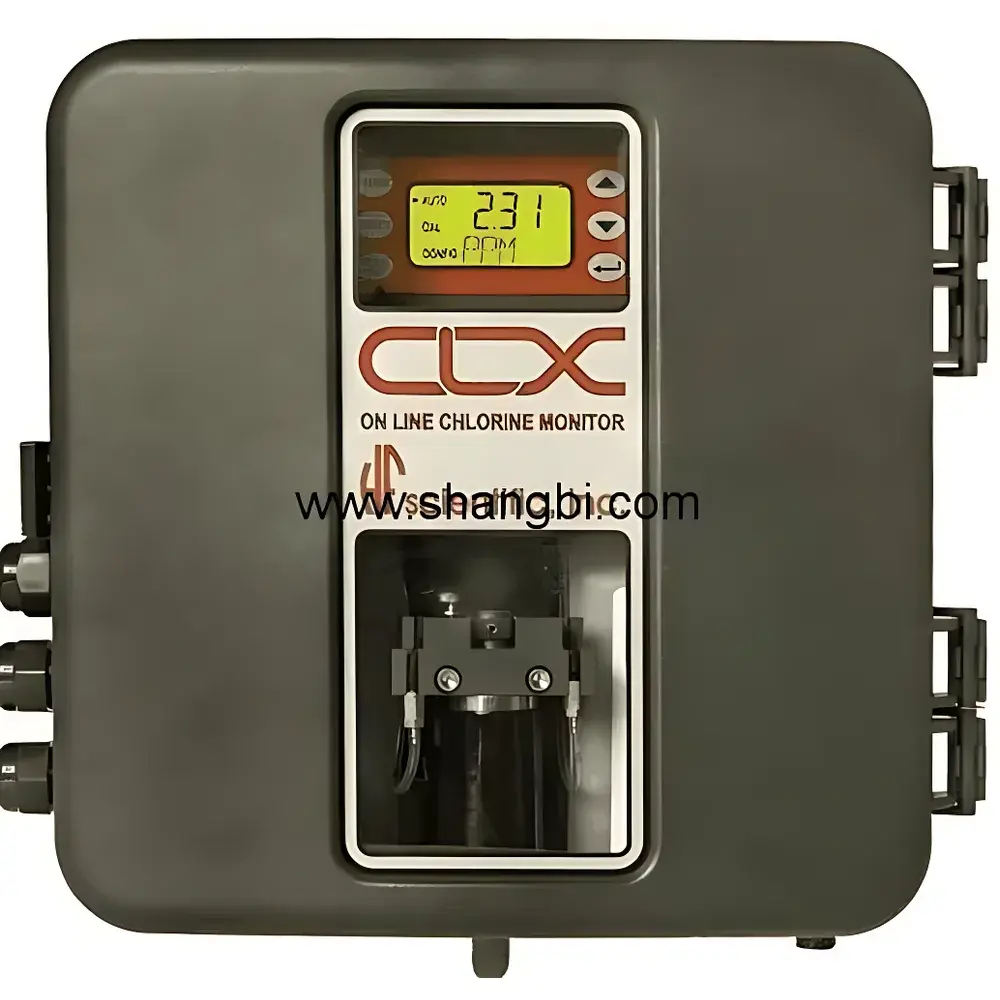
HF Scientific CLX Residual and Total Chlorine Analyzer
| Origin | USA |
|---|---|
| Manufacturer Type | Authorized Distributor |
| Product Origin | Imported |
| Model | CLX |
| Instrument Type | Laboratory Benchtop Analyzer |
| Measurement Principle | DPD Colorimetric Spectrophotometry |
| Measured Parameter | Residual Chlorine (Free & Total) |
| Range | 0–10 mg/L Cl₂ |
| Accuracy | ±5% or ±0.03 mg/L Cl₂ (0–6 mg/L) |
| Repeatability | ±0.01 mg/L |
| Resolution | 0.01 mg/L |
| LOD | 0.01 mg/L |
| Output Options | 4–20 mA analog output |
| Enclosure Rating | IP66 |
Overview
The HF Scientific CLX Residual and Total Chlorine Analyzer is a laboratory-grade benchtop instrument engineered for precise, reliable quantification of free chlorine (residual chlorine) and total chlorine in drinking water, wastewater effluent, swimming pool systems, and industrial process streams. It employs the standardized N,N-diethyl-p-phenylenediamine (DPD) colorimetric method—fully compliant with APHA Standard Methods 4500-Cl G, ASTM D1253, and ISO 7393-2. The analyzer utilizes a stable LED-based optical system with fixed-wavelength photometry (typically 515 nm) to measure the intensity of the magenta-colored DPD-chlorine complex. This principle ensures high specificity for chlorine species while minimizing interferences from oxidants such as bromine, iodine, or monochloramine—provided appropriate reagent protocols and sample pretreatment (e.g., glycine quenching for monochloramine differentiation) are applied.
Key Features
- Benchtop laboratory design optimized for routine QC/QA testing in municipal water labs, environmental contract laboratories, and industrial hygiene departments
- DPD-based colorimetry eliminates need for costly electrochemical sensors—reducing long-term maintenance and calibration drift concerns
- High-resolution digital display with intuitive menu navigation and on-screen calibration prompts
- Dual-mode operation: supports both residual (free) chlorine and total chlorine measurement via sequential DPD reagent addition (DPD-1 for free Cl₂; DPD-1 + potassium iodide for total Cl₂)
- Integrated 4–20 mA analog output and RS-485 interface with Modbus RTU protocol for seamless integration into SCADA, LIMS, or PLC-based monitoring networks
- IP66-rated enclosure ensures protection against dust ingress and powerful water jets—suitable for humid lab environments or near-point-of-use deployment
- Auto-zero function and built-in temperature compensation (±0.1 °C resolution) enhance measurement stability across ambient lab conditions (10–35 °C operating range)
Sample Compatibility & Compliance
The CLX analyzer accepts standard 10 mL or 25 mL sample volumes in clean, borosilicate glass or high-density polyethylene (HDPE) cuvettes. It is validated for use with potable water, filtered surface water, secondary-treated wastewater, and chlorinated cooling water. Sample turbidity up to 5 NTU does not significantly affect accuracy when using the recommended DPD reagent protocol. The instrument meets functional requirements for EPA Method 334.0 and is routinely employed in laboratories operating under ISO/IEC 17025 accreditation. Its measurement traceability aligns with NIST-traceable chlorine standards (e.g., potassium permanganate–standardized DPD titrant), supporting GLP documentation workflows. While not FDA 21 CFR Part 11–compliant out-of-the-box, audit-ready data logs (when paired with compatible third-party software) support GMP-aligned validation protocols for pharmaceutical water systems.
Software & Data Management
The CLX operates independently without proprietary PC software; however, its Modbus RTU interface enables bidirectional communication with industry-standard SCADA platforms (e.g., Ignition, Siemens Desigo, Schneider EcoStruxure). All measurements—including date/time stamp, operator ID field (manually entered), calibration history, and raw absorbance values—are stored internally for up to 1,000 records. Data export is supported via USB-to-serial adapter or direct RS-485 connection to a host PC running terminal emulation or custom Python/Node-RED scripts. Calibration coefficients, zero offset, and span values are password-protected and logged with timestamps to satisfy internal QA audit trails. Firmware updates are delivered via secure download from HF Scientific’s technical support portal—requiring no hardware modification.
Applications
- Verification of disinfectant residual compliance per WHO Guidelines for Drinking-water Quality and US EPA Stage 2 Disinfectants and Disinfection Byproducts Rule (DBPR)
- Validation of chlorine contact time (CT) calculations in water treatment plants
- Monitoring chlorine decay kinetics during distribution system sampling campaigns
- Calibration verification of online amperometric or membrane-based chlorine sensors
- Research applications involving chlorine demand studies, breakpoint chlorination experiments, and disinfection byproduct (DBP) precursor characterization
- Regulatory reporting for state-certified laboratories participating in the EPA’s Clean Water Act (CWA) National Pollutant Discharge Elimination System (NPDES) program
FAQ
Does the CLX require daily recalibration?
No—calibration is required only after reagent lot changes, instrument servicing, or at user-defined intervals (e.g., per shift or per batch). A two-point calibration (zero and mid-range standard) is sufficient for routine operation.
Can the CLX distinguish between free chlorine and monochloramine?
Yes—by performing sequential DPD additions (DPD-1 alone for free chlorine; DPD-1 + glycine or sodium thiosulfate pretreatment followed by DPD-1 + potassium iodide for monochloramine-selective measurement), users can derive monochloramine concentration by difference.
Are reagents included with the instrument?
No—the CLX is supplied without reagents. Compatible J.A.W. DPD powder reagents (Cat. No. 09952–09956) are sold separately in 60-day and 1-year pack sizes, certified for shelf life stability under refrigerated storage (2–8 °C).
What maintenance is required beyond reagent replacement?
Annual optical path cleaning (using lint-free swabs and isopropyl alcohol) and verification of LED output intensity using the factory-provided reference filter are recommended. No consumable optics or lamps require scheduled replacement within the first five years of normal use.
Is the CLX suitable for field use?
It is designed for laboratory environments; while portable power adapters exist, its IP66 rating does not confer drop resistance or battery autonomy—thus it is not classified as a field-portable instrument per ASTM D5117.







