
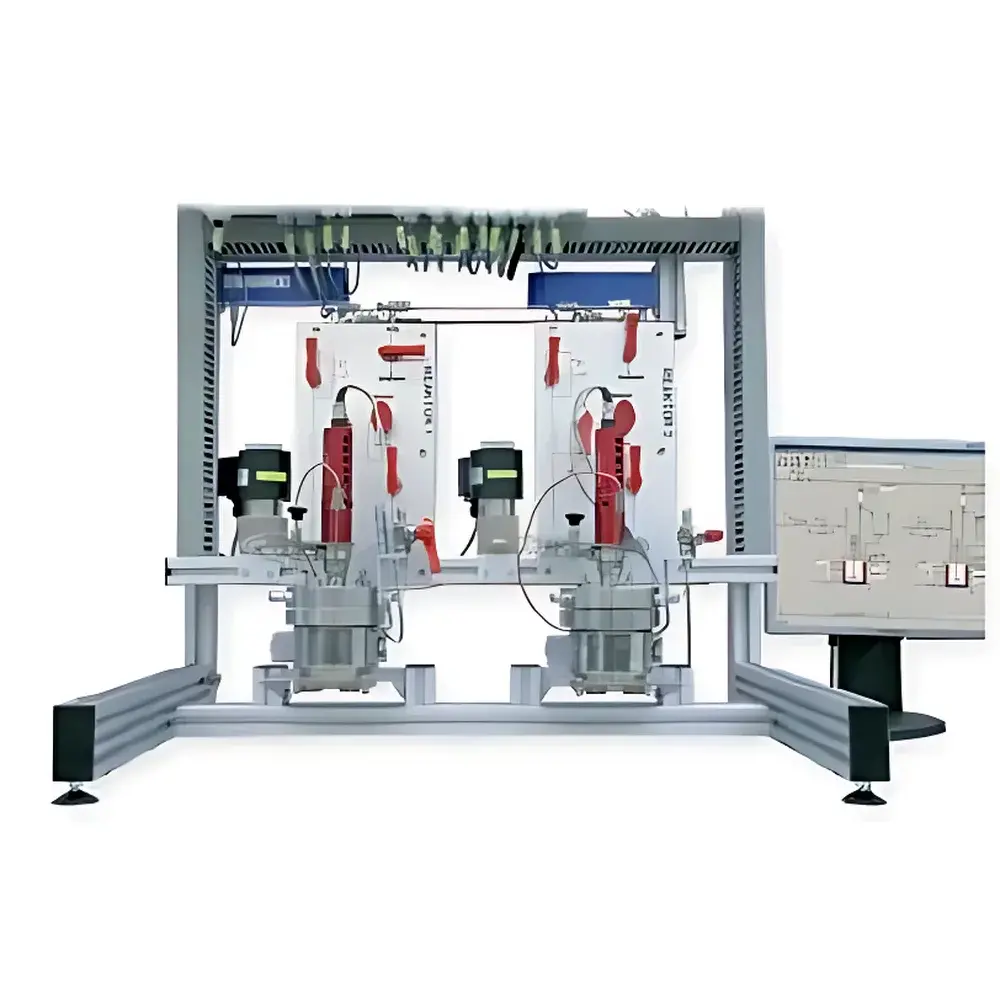
Hitec Zang HiClave High-Pressure Reaction System
| Brand | Hitec Zang |
|---|---|
| Origin | Germany |
| Model | HiClave |
| Pressure Rating | Up to 300 bar |
| Temperature Range | Up to 300 °C |
| Reactor Volume Options | 10–250 mL |
| Construction Materials | SS 1.4571 (316 Ti) or Hastelloy C-4 |
| Sealing | All-metal face seal with threaded closure |
| Stirring Options | Magnetic stirring (10–20 mL), top-driven magnetic-coupled mechanical stirring (50–250 mL, torque up to 50 N·cm) |
| Gas/Liquid Inlets/Outlets | Up to 7 ports |
| Integrated Hydration Module | Automated inert gas purging, leak testing, and pressure hold verification |
| Real-time Gas Consumption Monitoring | Mass-flow-based kinetic measurement with timestamped data logging |
Overview
The Hitec Zang HiClave High-Pressure Reaction System is an engineered platform for controlled, reproducible experimentation and process development under elevated pressure and temperature conditions. Based on the Couette flow principle in sealed, all-metal reactor vessels, the HiClave leverages precision-machined face seals and robust flanged closures to maintain integrity at operating pressures up to 300 bar and temperatures up to 300 °C. Its modular architecture supports both single-vessel operation and parallel reaction configurations—enabling comparative kinetic studies, catalyst screening, and parameter optimization across multiple conditions simultaneously. Designed for rigorous laboratory and pilot-scale applications, the system complies with fundamental mechanical design principles outlined in PED 2014/68/EU and incorporates safety-critical features including pressure relief integration points, redundant pressure monitoring interfaces, and fail-safe interlocks compatible with external control systems.
Key Features
- Scalable reactor volumes: 10 mL, 20 mL, 50 mL, 100 mL, and 250 mL configurations—each optimized for thermal uniformity and mass transfer efficiency.
- Material options: Reactor bodies and closures constructed from corrosion-resistant SS 1.4571 (equivalent to ASTM A240 UNS S31603Ti) or Hastelloy C-4 for aggressive chemistries involving halides, strong acids, or hydrogen sulfide.
- Sealing integrity: All-metal static sealing via precision-ground conical or flat-face metal-to-metal contacts—eliminating elastomer degradation and enabling long-term stability under cyclic thermal and pressure loads.
- Stirring flexibility: Magnetic stirring for small-volume reactors; top-mounted magnetically coupled mechanical stirrers with torque ratings of 20 N·cm (standard) or 50 N·cm (high-torque option) for viscous or heterogeneous media.
- Thermal management: Compatible with external heating mantles, electric heating jackets, and active cooling via Peltier plates or internal coolant loops—supporting ramp rates and isothermal hold precision per ISO 17025 traceable calibration protocols.
- Hydration Module (HiTec Zang Vl-HiClave-Hydr): Fully automated sequence for inert gas purging (e.g., N₂ or Ar), configurable multi-cycle evacuation/refill, and pressure-hold leak verification—programmable test duration, target pressure, and pass/fail thresholds.
Sample Compatibility & Compliance
The HiClave accommodates heterogeneous multiphase reactions—including gas–liquid, gas–solid, and gas–liquid–solid systems—common in catalytic hydrogenation, oxidation, carbonylation, and polymerization workflows. Its port configuration (up to seven independent feed/inlet/outlet connections) permits simultaneous introduction of gaseous reagents, liquid substrates, solid catalysts, and inert carrier streams. All wetted components meet FDA-compliant surface finish standards (Ra ≤ 0.8 µm) where applicable. The system supports GLP-compliant operation when integrated with validated data acquisition platforms—audit trails, electronic signatures, and 21 CFR Part 11–compliant software modules are available upon request. Pressure vessel certification documentation aligns with EN 13445-3 and ASME Section VIII Div. 1 requirements for non-fired pressure equipment.
Software & Data Management
While the base HiClave operates via analog instrumentation and manual valve control, optional digital integration includes Hitec Zang’s HiControl™ interface—a Windows-based application supporting real-time monitoring of pressure, temperature, stirring speed, and gas mass flow. Raw sensor outputs are timestamped and stored in CSV or SQL-compatible formats for post-processing in MATLAB, Python (Pandas), or industry-standard LIMS environments. Gas consumption kinetics are calculated using ideal gas law corrections and calibrated thermal mass flow sensors (±1% FS accuracy), with derivative curves automatically generated to identify induction periods, rate maxima, and endpoint convergence. Data export meets ASTM E1447 and ISO/IEC 17025 reporting conventions.
Applications
- Catalytic hydrogenation of unsaturated organic compounds under controlled H₂ partial pressure.
- Oxidation reactions employing O₂ or air at elevated pressures to improve selectivity and reduce residence time.
- Carbonylation and hydroformylation processes requiring precise CO/H₂ ratio control and high-pressure stability.
- Step-growth and chain-growth polymerizations (e.g., polyesters, polyethers) where monomer volatility necessitates pressurized containment.
- Supercritical fluid-assisted synthesis and extraction using CO₂, ethane, or propane as tunable solvents.
- Electrocatalytic and photochemical reaction studies in sealed electrochemical cells or quartz-jacketed variants.
FAQ
What pressure and temperature ranges are certified for continuous operation?
The HiClave is rated for continuous operation at ≤300 bar and ≤300 °C. Short-term excursions beyond these limits are not recommended and void warranty coverage.
Can the system be integrated into a centralized process control network?
Yes—via optional 4–20 mA, Modbus RTU, or Ethernet/IP I/O modules compatible with Siemens S7, Rockwell ControlLogix, or DeltaV DCS architectures.
Is third-party validation support available for GMP environments?
Hitec Zang provides IQ/OQ documentation templates and on-site qualification assistance through authorized service partners—aligned with EU Annex 15 and ASTM E2500 guidelines.
How is gas consumption quantified and what uncertainty applies?
Gas uptake is measured using calibrated thermal mass flow meters referenced to local atmospheric pressure and temperature; combined standard uncertainty is ±1.5% for typical H₂/N₂/CO measurements under laminar flow conditions.
Are spare parts and maintenance kits supplied with the system?
Standard maintenance kits—including O-rings (where applicable), pressure transducer calibration adapters, and stirrer coupling components—are included. Extended service contracts cover biannual inspection, recalibration, and wear-part replacement.



