
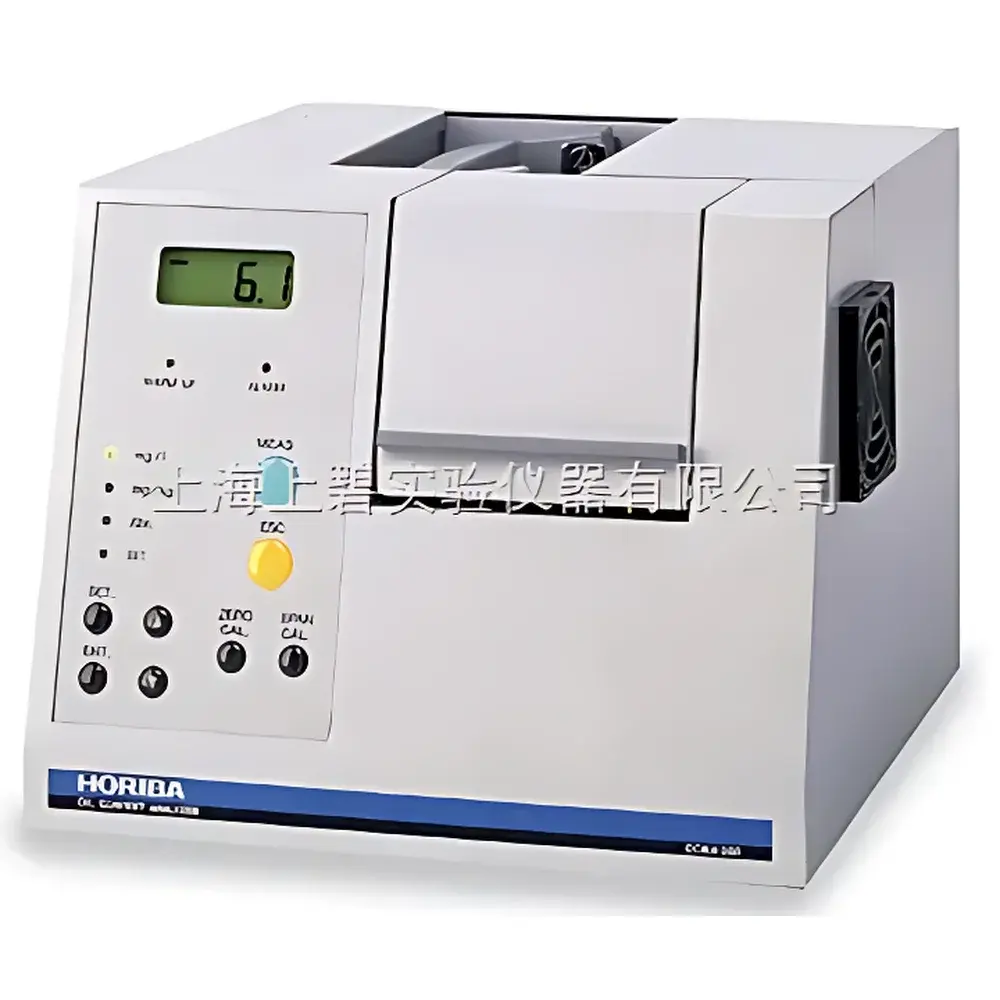
Horiba OCMA-350 Oil-in-Water and Oil-in-Soil Concentration Analyzer
| Origin | Japan |
|---|---|
| Manufacturer Type | Authorized Distributor |
| Origin Category | Imported |
| Model | S-316 |
| Pricing | Upon Request |
Overview
The Horiba OCMA-350 is a laboratory-grade, non-dispersive infrared (NDIR) oil concentration analyzer engineered for precise quantification of hydrocarbon-based oils in aqueous, soil, and surface wipe samples. It operates on a validated two-stage methodology: first, selective extraction of oil components using the halogenated solvent S-316 (1,1,2-trichloro-1,2,2-trifluoroethane), followed by NDIR absorbance measurement at the characteristic C–H stretching band (3.4–3.5 µm). This spectral region exhibits high specificity for aliphatic and aromatic hydrocarbons while minimizing interference from water, common solvents, and polar matrix constituents. The instrument employs a thermoelectrically cooled detector and a 200-mm pathlength quartz cell to ensure high signal-to-noise ratio and long-term photometric stability. Designed for compliance-driven environmental and industrial QA/QC laboratories, the OCMA-350 delivers trace-level sensitivity with documented reproducibility—critical for regulatory reporting under EPA Method 1664A, ISO 9377-2, and ASTM D7066.
Key Features
- NDIR optical system with fixed-wavelength detection at 3.43 µm, optimized for total petroleum hydrocarbons (TPH) and mineral oil equivalents
- Integrated self-diagnostic firmware: real-time monitoring of detector output, lamp intensity, solvent flow integrity, and electronics health; all status alerts displayed on backlit 16×2 LCD
- Auto-hold function with statistical evaluation: continuously assesses data convergence and displays only stabilized readings meeting user-defined precision thresholds (e.g., ±0.2% RSD over 5 s)
- Embedded calendar clock and timestamping: automatically records date/time for every measurement, calibration event, and solvent batch initialization
- Dual-output interface: RS-232C serial port for LIMS integration and parallel Centronics printer port for GLP-compliant hardcopy reports
- Modular solvent management compatibility: seamless interfacing with Horiba SR-300/SR-305 solvent recovery and dispensing systems to enable closed-loop S-316 reuse
Sample Compatibility & Compliance
The OCMA-350 accepts liquid-phase extracts from diverse matrices—including wastewater, seawater, leachates, soil slurries (per EPA SW-846 Method 3550C), and metal/ textile wipe extracts—provided they are dissolved in S-316. Its 6.5 mL cell volume accommodates standard EPA 1-liter extraction volumes diluted to 10–50 mL. The instrument conforms to international quality frameworks: its calibration traceability aligns with NIST-traceable oil standards (e.g., IRM-014), and its audit trail functionality (via timestamped calibration logs and operator ID prompts) supports FDA 21 CFR Part 11 and ISO/IEC 17025 requirements. All firmware operations—including zero adjustment, span calibration, and diagnostic reset—are logged with immutable timestamps.
Software & Data Management
While the OCMA-350 operates as a standalone benchtop analyzer, its RS-232C interface enables bidirectional communication with PC-based data acquisition software (e.g., Horiba’s optional OCMA Control Suite). This software provides automated calibration curve generation (linear or quadratic), multi-point standard verification, outlier detection per Grubbs’ test, and export to CSV/Excel formats compliant with laboratory information management systems (LIMS). Raw absorbance values (0–1 AU), concentration results (mg/L, mg/kg, or % w/w), and metadata (operator ID, sample ID, extraction lot number, ambient temperature) are stored internally for up to 500 entries with battery-backed memory.
Applications
- Environmental monitoring: quantification of oil contamination in effluent streams, harbor sediments, and groundwater plumes
- Industrial process control: real-time verification of oil/water separator performance in refineries and petrochemical plants
- Maritime compliance: verification of bilge water discharge purity per MARPOL Annex I regulations
- Tank cleaning validation: measurement of residual hydrocarbons in tank bottom sludge and rinse waters
- Automotive service facilities: wastewater screening prior to municipal sewer discharge
- Product quality assurance: verification of oil residue on machined parts, stamped metals, and woven textiles per OEM specifications (e.g., VDA 260, GMW14872)
FAQ
What extraction solvent is required, and why is S-316 specified?
S-316 (1,1,2-trichloro-1,2,2-trifluoroethane) is mandated due to its high extraction efficiency for C10–C40 hydrocarbons, negligible IR absorption in the 3.4–3.5 µm band, low water miscibility (<0.01%), and compatibility with Horiba’s solvent recovery systems.
Can the OCMA-350 measure emulsified or dissolved oil fractions?
No—the method quantifies only extractable, non-polar hydrocarbons. Emulsified or surfactant-stabilized oil requires phase separation or acidification prior to extraction.
Is method validation documentation available?
Yes—Horiba provides a comprehensive validation package including linearity (r² ≥ 0.999), limit of detection (LOD = 0.2 mg/L), precision (RSD ≤ 1.8% at 50 mg/L), and inter-laboratory reproducibility data aligned with ISO 5725.
Does the instrument support multi-point calibration?
Yes—up to five standard concentrations can be programmed; calibration curves are stored with expiration dates and operator verification signatures.
What maintenance is required for long-term accuracy?
Annual verification of lamp intensity and detector responsivity using Horiba’s OCMA-QC reference kit; quartz cell cleaning with S-316 after each batch; desiccant replacement every 6 months.




