
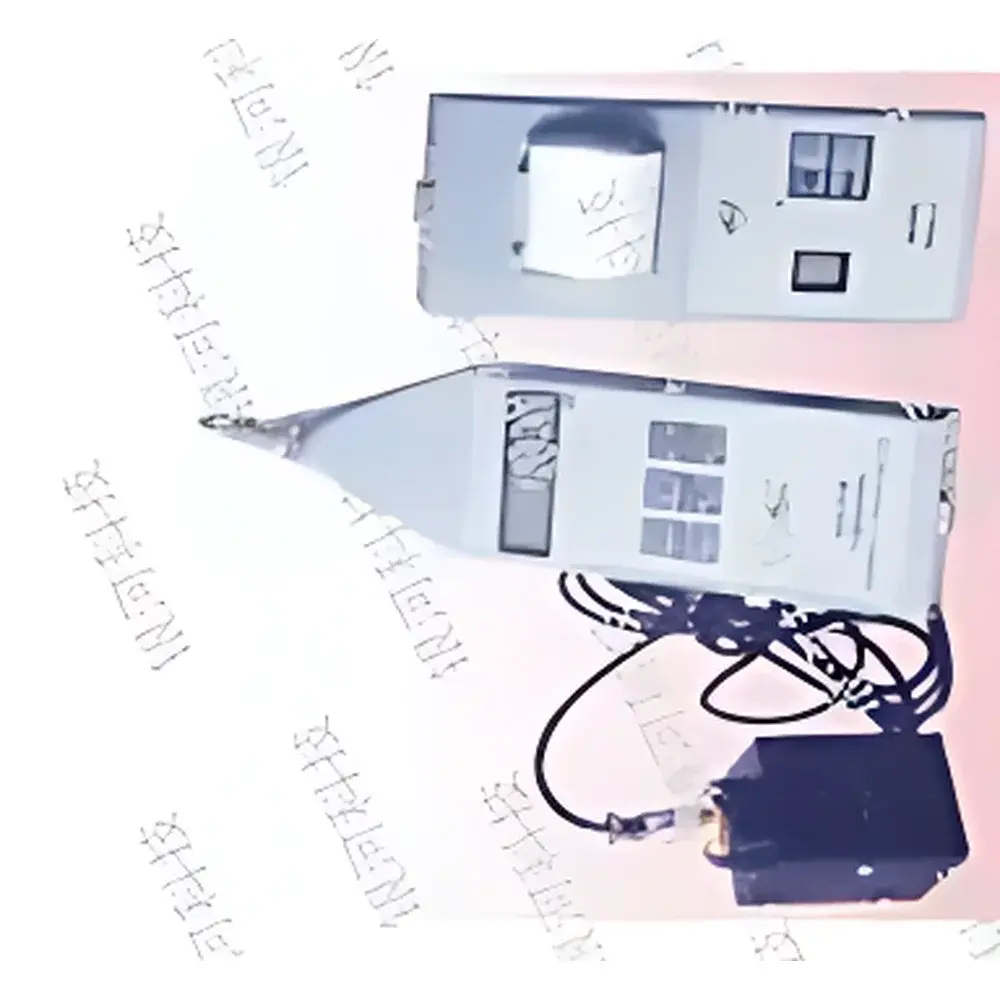
HS5933A Environmental Vibration Level Analyzer by Yinhé Technology
| Origin | Jiangsu, China |
|---|---|
| Manufacturer Type | Authorized Distributor |
| Country of Origin | China |
| Model | HS5933A |
| Pricing | Available Upon Request |
| Sensor | Piezoelectric Accelerometer |
| Sensitivity | 400 mV (peak) per g |
| Frequency Range (Measurement) | 1–80 Hz |
| Frequency Range (Transducer Response) | 1–160 Hz |
| Lateral Sensitivity Ratio | ≤5% |
| Amplitude Linearity | <5% |
| Vibration Level Range | 60–140 dB (re 10⁻⁶ m/s²) |
| Frequency Weightings | VLZ (Whole-Body Vertical), VLX–Y (Whole-Body Horizontal), VAL (Linear Acceleration Level) |
| Time Weighting | 1 s time constant |
| Measurement Modes | Manual, 10 s, 1 min, 5 min, 10 min, 15 min, 20 min, 1 h, 8 h, 24 h, 24-h Scheduled |
| Stored Parameters per Session | VLEQ, VL₁₀, VL₅₀, VL₉₀, VL<sub>MIN</sub>, VL<sub>MAX</sub>, Standard Deviation (SD), Peak Hold, Overload Indication |
| Data Storage Capacity | 127 measurement sets |
| Display | 4-digit LCD with status symbols |
| Power Supply | 7.5 V DC (5 × AA alkaline batteries) + external DC input port |
Overview
The HS5933A Environmental Vibration Level Analyzer is a portable, microprocessor-controlled instrument engineered for compliant field assessment of human-exposed vibration in occupational and environmental contexts. It operates on the principle of piezoelectric acceleration sensing, converting mechanical vibration into proportional electrical signals, which are then digitally conditioned, frequency-weighted, time-weighted, and processed in accordance with internationally recognized biodynamic models. The analyzer implements ISO 8041:1990 (Type II specification for human response vibration meters), ISO 2631 series (evaluation of whole-body vibration exposure), and GB 10071–1988 (Chinese national standard for urban environmental vibration measurement). Its dual-unit architecture—comprising a handheld main unit and an integrated thermal printer—enables real-time acquisition, on-device computation, and immediate hardcopy output without reliance on external PCs or software.
Key Features
- Automatic range switching and real-time peak-hold functionality for transient event capture
- Comprehensive vibration metrics calculation: equivalent continuous vibration level (VLEQ), statistical percentiles (VL₁₀, VL₅₀, VL₉₀), minimum/maximum levels (VLMIN, VLMAX), and standard deviation (SD)
- Three standardized frequency weightings: VLZ (vertical whole-body), VLX–Y (horizontal whole-body), and VAL (linear acceleration level) to support regulatory alignment across industrial hygiene and community noise ordinances
- Configurable measurement durations from 10 seconds to 24-hour scheduled logging, including integer-hour and full-day modes for long-term monitoring compliance
- Onboard 127-set non-volatile memory with timestamping (year/month/day/hour/minute) and internal electrical calibration reference
- High-stability piezoelectric accelerometer with 400 mV/g sensitivity, ≤5% lateral sensitivity ratio, and <5% amplitude linearity over its operational bandwidth
- 4-digit LCD display with dedicated status indicators for overload, battery level, weighting selection, and time constant
Sample Compatibility & Compliance
The HS5933A is validated for use on floor surfaces, building foundations, railway platforms, and industrial workstations where vibration transmission to occupants must be quantified per human biodynamic response criteria. It meets the metrological requirements for Type II instrumentation under ISO 8041:1990, ensuring traceable performance for workplace health surveillance and environmental impact assessments. Its 1–80 Hz effective measurement bandwidth aligns with ISO 2631-1 and ISO 2631-2 for evaluation of seated, standing, and supine occupants. The device satisfies GB 10071–1988 for urban environmental vibration surveys—including residential zones adjacent to transportation corridors or construction sites—and supports documentation required for municipal environmental reporting and occupational safety audits. While not certified to IEC 61260 Class 1, its frequency weighting filters conform to the defined transfer functions specified in ISO 5349 and ISO 2631 annexes.
Software & Data Management
Data handling is fully embedded: no proprietary PC software is required for basic operation or report generation. All measurement results—including timestamps, weighting selections, and computed parameters—are stored internally and directly printable via the integrated thermal unit. Each printed record includes instrument ID, date/time stamp, measurement duration, selected weighting, VLEQ, statistical levels, and peak hold value. The internal memory retains up to 127 complete datasets with metadata, enabling sequential field deployment without data loss. For laboratory integration, raw analog outputs (via optional interface cable) may be routed to third-party DAQ systems supporting voltage-input acquisition at sampling rates ≥200 Hz. Audit-ready documentation complies with GLP-aligned practices through deterministic timestamping and immutable parameter logging; however, native support for FDA 21 CFR Part 11 electronic signatures or encrypted audit trails is not implemented.
Applications
- Ongoing monitoring of building-borne vibration near rail lines, subways, or heavy industrial facilities per urban environmental standards
- Workplace exposure assessment for operators of vibrating machinery (e.g., presses, pile drivers, road rollers) under occupational health frameworks
- Pre- and post-construction baseline studies for vibration-sensitive facilities (e.g., laboratories, hospitals, precision manufacturing)
- Verification of vibration isolation system performance in retrofit or new-build projects
- Field validation of finite element models predicting ground-borne wave propagation
- Teaching and training in acoustics and human factors engineering programs requiring ISO-compliant instrumentation
FAQ
Does the HS5933A support real-time spectral analysis or FFT-based frequency decomposition?
No. The instrument performs time-domain weighted averaging and statistical processing only; it does not include real-time octave-band or 1/3-octave spectrum analysis capabilities.
Is external calibration traceable to national metrology institutes supported?
Yes—while internal electrical calibration is provided for daily verification, the sensor and electronics are compatible with standard shaker-table calibration per ISO 16063-21 using accredited laboratories.
Can measurement data be exported digitally (e.g., CSV, USB)?
No. Data export is limited to thermal printout; the device lacks USB, Bluetooth, or serial communication interfaces.
What is the typical battery life under continuous operation?
Approximately 12 hours when using fresh alkaline AA cells, depending on backlight usage and print frequency.
Is the printer module replaceable or serviceable in the field?
The thermal printer is integrated and not user-replaceable; maintenance requires return to authorized service centers.
Related Products







