HTNMR GY-CTNMR-10 Benchtop Educational Nuclear Magnetic Resonance Imaging System
| Brand | HTNMR (Huantong NMR) |
|---|---|
| Origin | Shanghai, China |
| Manufacturer Type | OEM Manufacturer |
| Country of Origin | China |
| Model | GY-CTNMR-10 |
| Price | Upon Request |
| Magnetic Field Strength | 0.45 T (nominal) |
| ¹H Resonance Frequency | 19.1 MHz |
| Magnet Pole Diameter | 100 mm |
| Field Homogeneity | 0.8 ppm over Ø5 mm DSV |
| Sample Diameter Limit | <10 mm |
| Image Matrix | 128×128 (standard), up to 512×512 (interpolated) |
| Temperature Stability | ±0.06 K over 2 h (post-warmup) |
| RF Frequency Tuning Range | 10–20 MHz |
| Resolution | 1 Hz |
| RF Coil Options | Standard 10 mm birdcage coil |
| Pulse Sequence Capabilities | Programmable, including spin echo, inversion recovery, gradient echo, frequency/phase-encoded 2D imaging |
Overview
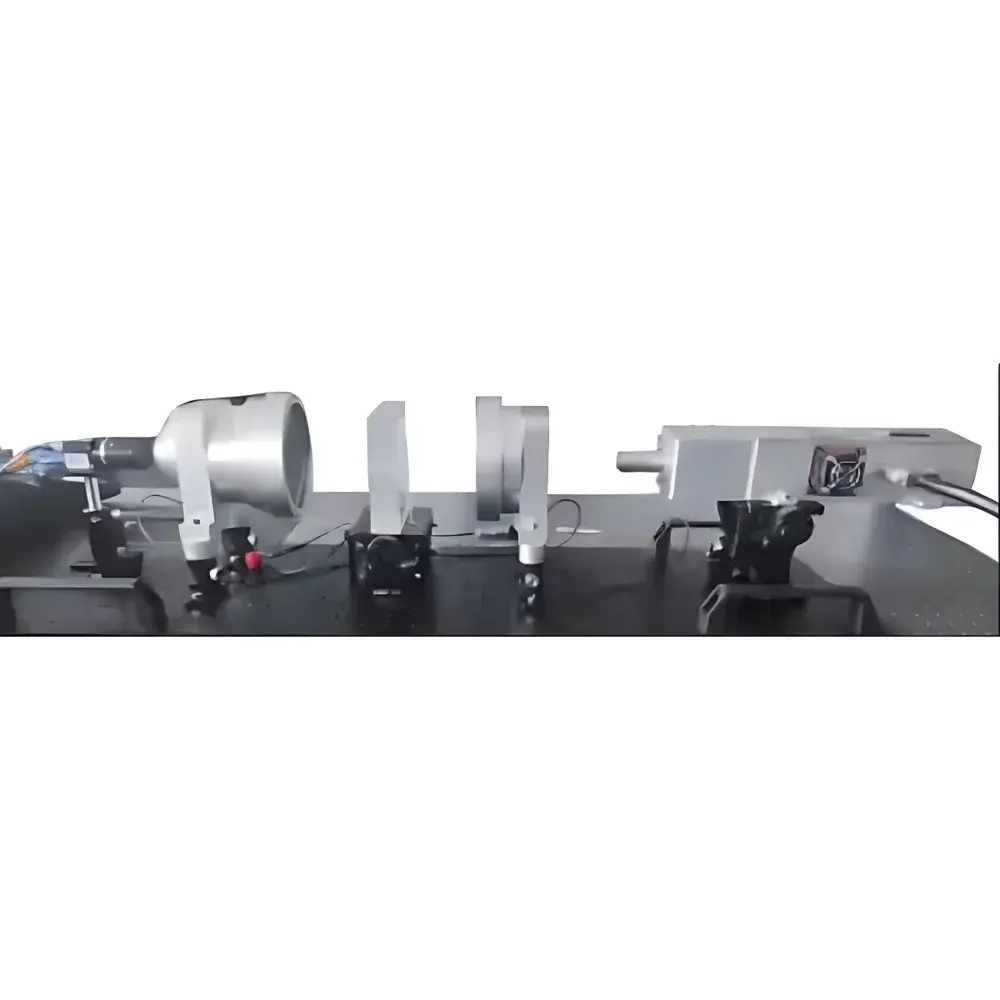
The HTNMR GY-CTNMR-10 is a compact, permanent-magnet-based benchtop nuclear magnetic resonance (NMR) imaging system engineered specifically for undergraduate and graduate-level instruction in physics, biomedical engineering, and medical imaging curricula. Unlike clinical MRI systems or high-field superconducting NMR spectrometers, this instrument operates at a fixed static field of 0.45 T—corresponding to a 1H Larmor frequency of 19.1 MHz—enabling safe, low-cost, and maintenance-free operation in teaching laboratories. Its core architecture implements classical pulsed NMR principles: spin excitation via resonant RF pulses, spatial encoding using programmable magnetic field gradients, and signal detection through quadrature demodulation. The system supports both time-domain relaxation measurements (T1, T2) and spatially resolved imaging modalities, providing students with hands-on experience in quantum mechanical spin dynamics, Bloch equation modeling, k-space trajectory design, and image reconstruction algorithms.
Key Features
- High-energy NdFeB permanent magnet assembly with sub-micron surface machining, delivering field homogeneity of 0.8 ppm over a 5 mm spherical volume (DSV) and 5 ppm over 10 mm DSV—sufficient for robust pedagogical demonstrations of spectral dispersion and image fidelity trade-offs.
- Integrated high-stability temperature control system maintaining magnet temperature within ±0.06 K over 2 hours post-equilibration, minimizing thermal drift during multi-hour lab sessions.
- Direct digital synthesis (DDS)-based RF transmitter supporting precise, software-tunable output from 10–20 MHz at 1 Hz resolution—ideal for exploring frequency dependence, off-resonance effects, and calibration procedures.
- Quadrature detection architecture enabling accurate phase-sensitive measurement of free induction decay (FID) and spin echo signals—critical for visualizing coherent spin evolution and verifying quantum state transitions in introductory NMR theory modules.
- Programmable pulse sequence generator compliant with standard NMR timing conventions (e.g., TR, TE, TI, flip angle), allowing users to implement and modify foundational sequences including Hahn echo, inversion recovery, and gradient echo without hardware modification.
- Dual RF probe compatibility: standard 10 mm diameter birdcage coil optimized for imaging small biological specimens; optional 5 mm probe with ≤1 ppm field uniformity for basic chemical shift resolution experiments (e.g., distinguishing water vs. lipid proton environments).
Sample Compatibility & Compliance
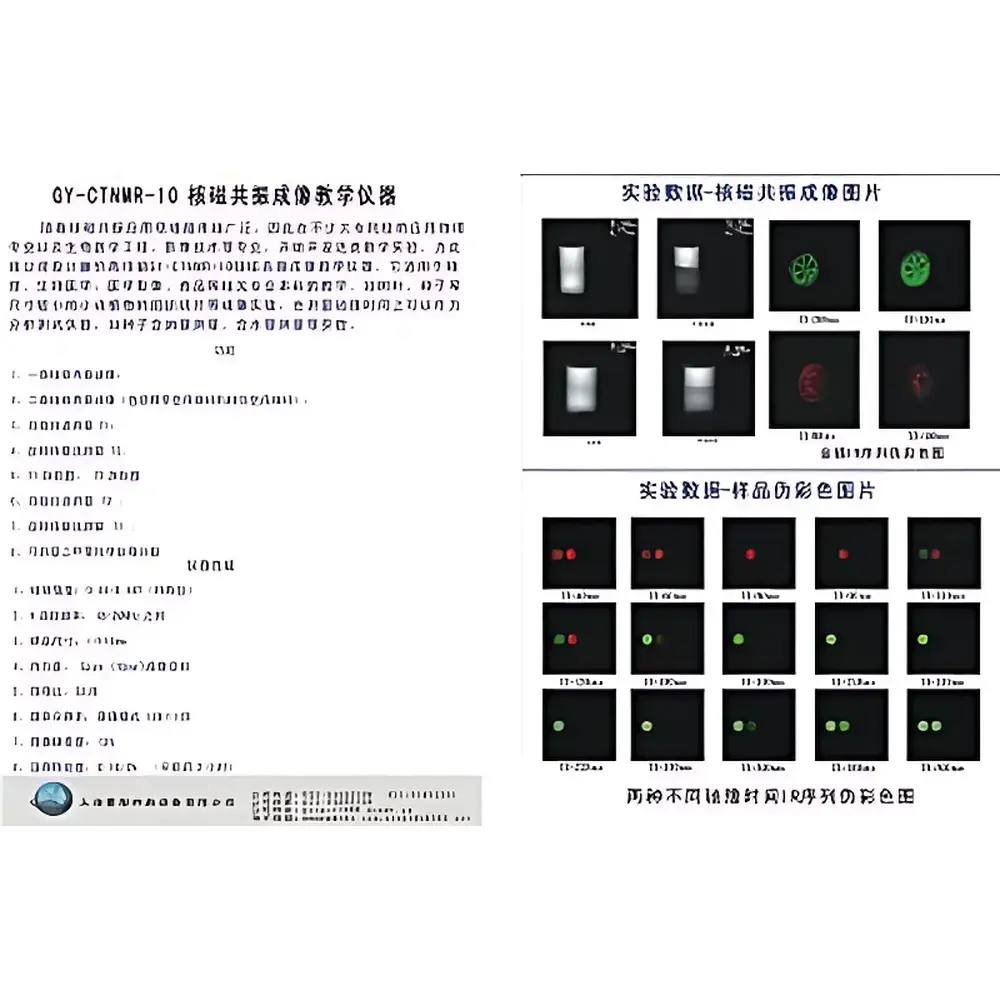
The GY-CTNMR-10 accommodates cylindrical samples up to 10 mm in diameter and ≤30 mm in length—including plant tissues (e.g., leaf cross-sections, seed embryos), ex vivo animal tissue slices (e.g., rodent brain or muscle sections), hydrogel phantoms, and polymer-based reference standards. Its open-access bore geometry facilitates rapid sample insertion and alignment under optical guidance. While not intended for human or in vivo use, the system adheres to IEC 61000-6-3 (EMC emission limits) and meets CE marking requirements for laboratory equipment. All pulse sequences and acquisition parameters are fully documented and reproducible, supporting GLP-aligned data recording practices in academic research settings. Data export formats (e.g., raw FID, k-space matrices, DICOM-compatible image stacks) enable integration with MATLAB, Python (NumPy/Nibabel), or ImageJ for quantitative analysis.
Software & Data Management
Control and visualization are managed via a Windows-based native application with intuitive graphical workflow navigation. The software provides real-time oscilloscope-style display of RF waveforms and detected signals, interactive parameter adjustment (pulse width, delay, gradient amplitude), and on-the-fly Fourier transformation. Acquired datasets include full metadata logging (timestamp, temperature, field setting, sequence ID) to satisfy traceability requirements in accredited teaching labs. Image reconstruction supports magnitude, phase, and complex-mode outputs; T1/T2 mapping is performed via mono-exponential curve fitting with user-defined ROI selection. Export options include CSV (relaxation curves), NIfTI (volumetric images), and PNG/JPEG (annotated reports)—all compatible with institutional learning management systems (LMS) and electronic lab notebooks (ELN). Audit trails and user authentication are configurable to align with ISO/IEC 17025 documentation expectations for educational instrumentation.
Applications
- Undergraduate physics labs: Visualizing spin precession, Rabi oscillations, and resonance conditions via swept-frequency absorption experiments.
- Biomedical engineering courses: Quantifying T1 and T2 relaxation times in plant seeds (oil/water content estimation) or agarose gels (cross-link density correlation).
- Radiology and medical physics training: Comparing frequency-encoding vs. phase-encoding strategies, analyzing point spread function (PSF) and geometric distortion in reconstructed images.
- Materials science modules: Characterizing porosity and pore-size distribution in low-permeability solids using diffusion-weighted sequences (with optional gradient upgrade).
- Independent student projects: Developing custom pulse sequences in Python using provided API hooks; validating image reconstruction pipelines against analytical k-space models.
FAQ
Is this system suitable for clinical or diagnostic use?
No. The GY-CTNMR-10 is strictly designated for educational and non-clinical research applications. It does not comply with FDA 21 CFR Part 892 or IEC 62304 for medical devices.
Can the system be upgraded to support spectroscopy beyond imaging?
Yes—when equipped with the optional 5 mm RF probe and shimming accessories, it supports basic 1H NMR spectroscopy with chemical shift resolution ≤1 ppm, sufficient for distinguishing functional groups in simple organic mixtures.
What level of technical support is available for academic institutions?
HTNMR provides comprehensive curriculum integration packages—including lab manuals, instructor guides, safety protocols, and virtual setup simulations—as well as remote troubleshooting and annual calibration verification services.
Does the software support automated batch processing for student lab submissions?
Yes. The acquisition software includes scriptable batch mode for standardized parameter sets, automatic file naming conventions, and folder-based dataset archiving aligned with course section identifiers.
Are consumables or cryogens required for operation?
No. As a permanent-magnet system with solid-state RF electronics and air-cooled temperature regulation, it requires no liquid nitrogen, helium, or replaceable RF components under normal instructional use.