
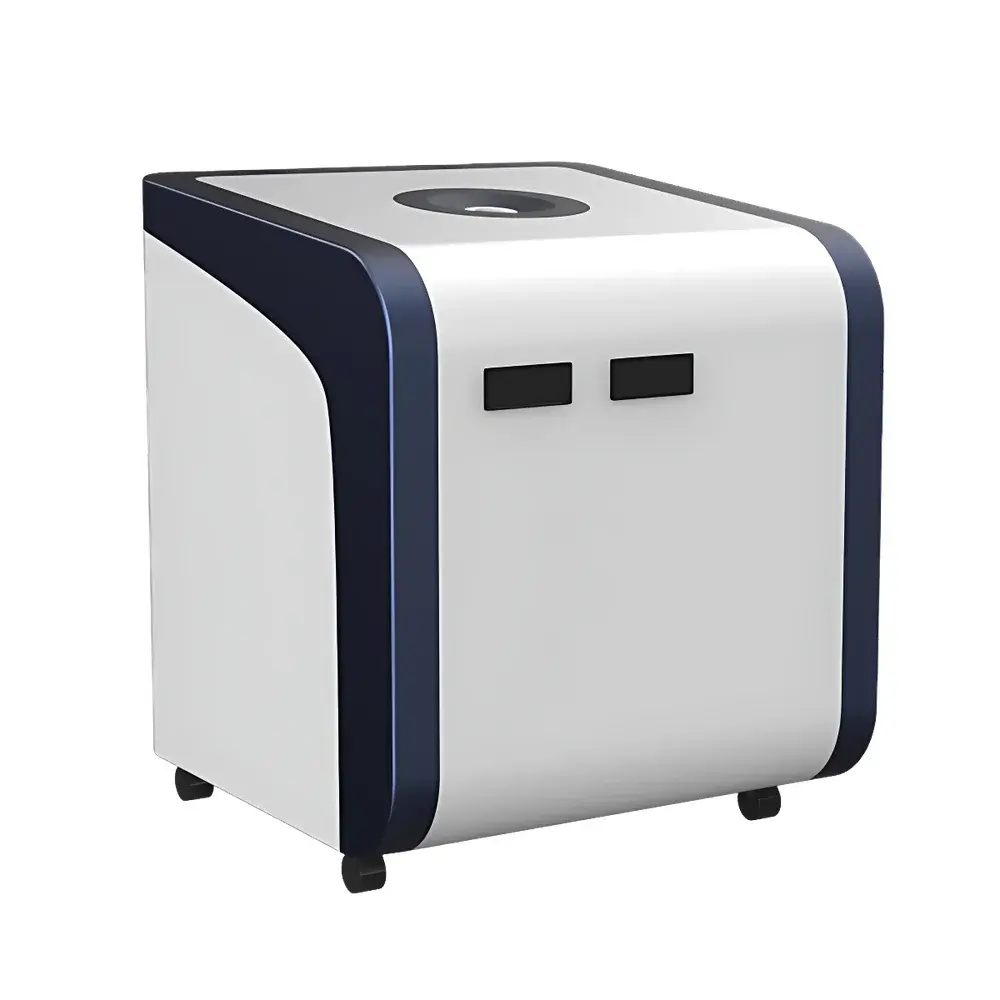
HTNMR GY-PNMR12-6 60 MHz Benchtop Nuclear Magnetic Resonance Spectrometer
| Brand | HTNMR (Huanton NMR) |
|---|---|
| Origin | Shanghai, China |
| Manufacturer Type | Direct Manufacturer |
| Instrument Category | Domestic Benchtop NMR |
| Model | GY-PNMR12-6 |
| Price Range | USD 70,000 – 140,000 |
| Instrument Type | Low-Field Pulsed Fourier Transform NMR Spectrometer |
| Sample Form | Liquid Solutions Only |
| Operating Frequency | 60 MHz (¹H resonance) |
| Excitation Method | Pulsed Fourier Transform (PFT-NMR) |
| Sensitivity | 10,000:1 (S/N ratio, CH₃ signal of 98% ethanol, 32 scans) |
| Resolution | ≤ 0.03 ppm (full width at half maximum, FWHM, in ¹H spectrum of CHCl₃ in CDCl₃) |
| Quantitative Reproducibility (¹H) | < 1% RSD (relative standard deviation, n = 10) |
Overview
The HTNMR GY-PNMR12-6 is a compact, permanent-magnet-based benchtop nuclear magnetic resonance (NMR) spectrometer operating at a proton resonance frequency of 60 MHz. Engineered for routine structural verification and quantitative analysis of small organic molecules in solution, it employs pulsed Fourier transform (PFT) methodology to acquire high-fidelity ¹H, ¹³C, ¹⁹F, and ³¹P spectra without cryogenic cooling. Unlike superconducting high-field systems, this instrument utilizes a temperature-stabilized rare-earth permanent magnet assembly—eliminating liquid helium or nitrogen consumption, reducing infrastructure dependencies, and enabling deployment in non-dedicated laboratory spaces including QC labs, pilot plants, and field service environments. Its design complies with fundamental NMR physics principles: nuclei with non-zero spin quantum number (e.g., ¹H, ¹³C) undergo Zeeman splitting under a static magnetic field (B₀ ≈ 1.41 T at 60 MHz), and resonant absorption of radiofrequency (RF) pulses induces coherent spin transitions detectable as free induction decay (FID) signals. Subsequent Fourier transformation yields frequency-domain spectra where chemical shift (δ, ppm) reports local electronic environment, and integrated peak area correlates linearly with nucleus concentration—enabling both qualitative identification and absolute quantification.
Key Features
- Rare-earth permanent magnet system with active temperature stabilization—no cryogens, no compressor, no vacuum maintenance
- Robust mechanical architecture rated for operation in ambient temperatures from 15–30 °C and relative humidity ≤ 70% RH (non-condensing)
- Dual-channel RF electronics supporting broadband excitation and detection across ¹H (60 MHz), ¹³C (15.1 MHz), ¹⁹F (56.4 MHz), and ³¹P (24.3 MHz) frequencies
- High signal-to-noise ratio of 10,000:1 (measured on CH₃ quartet of 98% ethanol, 32 transients, 1 s relaxation delay)
- Resolution ≤ 0.03 ppm (FWHM, CHCl₃ in CDCl₃, 90° pulse, 64k data points, exponential line broadening = 0.3 Hz)
- Quantitative repeatability < 1% RSD for ¹H peak integrals across ten consecutive acquisitions under identical experimental conditions
- Integrated 10 mm diameter sample tube holder accommodating standard 5 mm OD glass NMR tubes (with optional adapters for 3 mm or 10 mm tubes)
Sample Compatibility & Compliance
The GY-PNMR12-6 is validated for analysis of homogeneous liquid-phase samples dissolved in deuterated or protonated solvents (e.g., CDCl₃, DMSO-d₆, MeOD, acetone-d₆, or neat liquids). It supports routine compliance with pharmacopeial monographs requiring NMR-based identity confirmation (e.g., USP , EP 2.2.33) and quantitative assay (e.g., ICH Q2(R2) guidelines for method validation). Data acquisition and processing adhere to ALCOA+ principles (Attributable, Legible, Contemporaneous, Original, Accurate, Complete, Consistent, Enduring, Available) and support audit-trail-enabled workflows compatible with GLP and GMP environments. While not certified to FDA 21 CFR Part 11 out-of-the-box, the instrument’s software architecture allows integration with validated electronic lab notebook (ELN) and LIMS platforms meeting regulatory requirements.
Software & Data Management
The proprietary HTNMR ControlSuite v3.x provides intuitive pulse sequence selection (including single-pulse, inversion recovery, DEPT-135, and ¹⁹F/³¹P-specific sequences), real-time FID visualization, automatic phasing and baseline correction, and customizable integration regions. All raw FIDs and processed spectra are saved in vendor-neutral JCAMP-DX (.jdx) and NMR-Data Exchange Format (NMR-DEF) compliant files. The software includes built-in calibration routines using internal reference standards (e.g., tetramethylsilane, TMS, or residual CHCl₃), supports batch processing of multi-sample datasets, and exports peak tables in CSV format for statistical analysis in external tools (e.g., MATLAB, Python pandas). Audit trail logs record operator ID, timestamp, parameter changes, and processing steps—essential for traceability in regulated laboratories.
Applications
- Identity verification and purity assessment of pharmaceutical intermediates and APIs (e.g., aspirin, ibuprofen, ethyl crotonate)
- Fluorine-19 NMR quantification of perfluoropolyethers (PFPEs) and fluorinated surfactants in lubricant formulations
- Phosphorus-31 characterization of phosphine ligands, phosphate esters, and organophosphorus catalysts
- Reaction monitoring of hydrogenation, esterification, and condensation processes via time-resolved ¹H acquisition
- Teaching and training applications in undergraduate chemistry curricula—demonstrating spin-spin coupling, chemical shift anisotropy, and relaxation phenomena
- Quality control screening of solvent composition, residual moisture, or degradation products in polymer synthesis batches
FAQ
Does the GY-PNMR12-6 require liquid nitrogen or helium?
No. It operates exclusively with a passively stabilized permanent magnet—zero cryogen dependency.
Can it analyze solid or heterogeneous samples?
No. It is designed strictly for homogeneous liquid solutions; solid-state or gel-phase samples are incompatible.
Is ¹³C NMR quantitatively reliable on this platform?
Yes—when combined with inverse-gated decoupling and sufficient signal averaging (typically ≥ 2048 scans), ¹³C integrals meet ICH Q2(R2) precision criteria for impurity profiling.
What sample volume is required?
Standard 5 mm OD NMR tubes require 500–600 µL; minimum usable volume is 300 µL with reduced S/N.
How is magnetic field homogeneity maintained?
Via passive shimming using fixed ferromagnetic shim elements and active temperature regulation within ±0.02 °C of setpoint.
Is remote operation supported?
Yes—ControlSuite v3.x includes secure TCP/IP interface for LAN-based instrument control and data retrieval from Windows/Linux clients.





