
HTNMR HT-3DNMR-25 Small Animal In Vivo MRI System
| Brand | HTNMR |
|---|---|
| Origin | Shanghai, China |
| Manufacturer | HTNMR (Huantong NMR) |
| Model | HT-3DNMR-25 |
| Instrument Type | Benchtop Permanent-Magnet MRI System |
| Field Strength | 0.45–0.5 T |
| ¹H Resonance Frequency | 18–22 MHz |
| Bore Diameter | 150 mm |
| Effective Imaging Volume (FOV) | 25 mm × 25 mm × 25 mm |
| Gradient Strength | 10 G/cm (max 70 mT/m per axis) |
| Spatial Resolution (isotropic) | 0.08 mm (high-res mode) |
| Image Matrix | Up to 256 × 256 × 128 |
| Magnetic Homogeneity | < 8 ppm over 25 mm DSV |
| Temperature Stability | ±0.06 K/h (after 2 h warm-up) |
| Field Drift | ≤100 Hz/h (Larmor frequency) |
| Linearity | >98% in X/Y/Z over 20 mm DSV |
| RF Probe ID | 25 mm diameter solenoid or saddle coil |
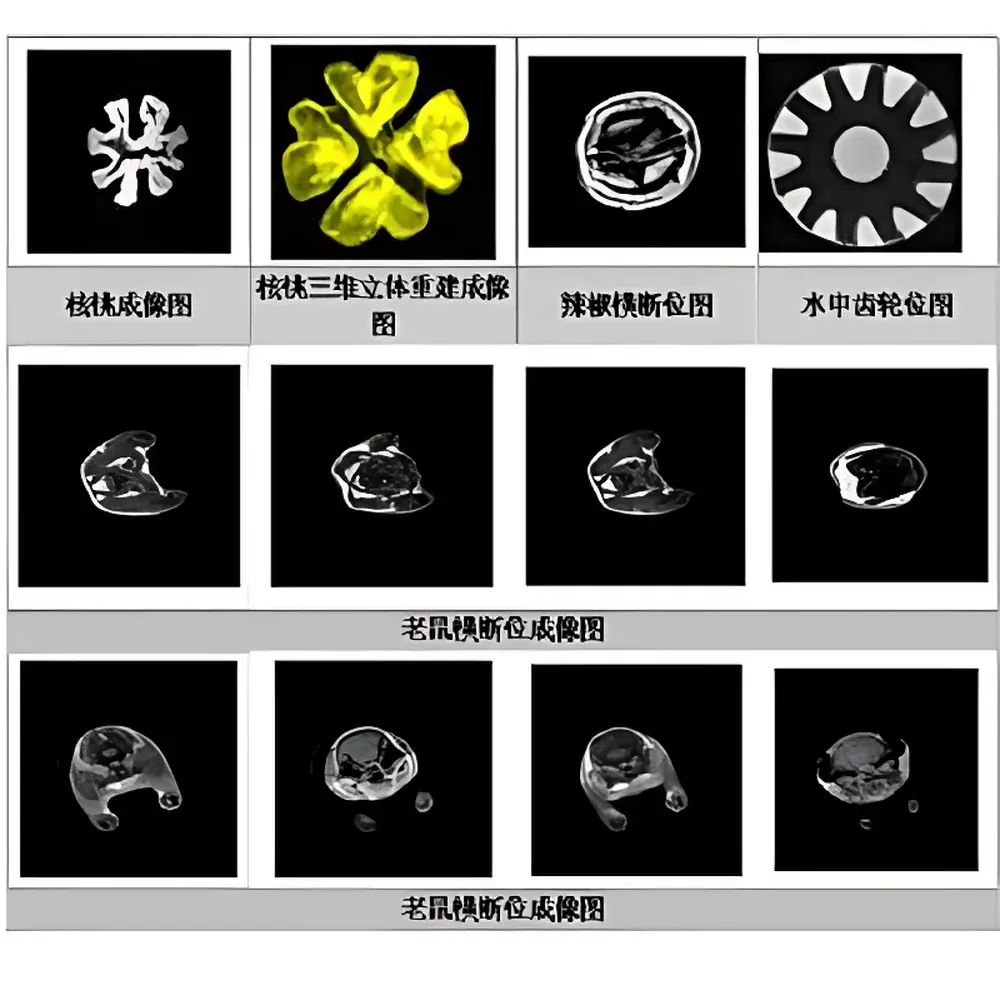
| Sample Compatibility | Live mice (≥4 weeks), plant tissues, insects, hydrogels, food samples, polymer phantoms |
Overview
The HTNMR HT-3DNMR-25 is a compact, permanent-magnet-based benchtop magnetic resonance imaging (MRI) system engineered for educational and preclinical research applications in life sciences. Operating at a static field strength of 0.45–0.5 Tesla—corresponding to a proton Larmor frequency of 18–22 MHz—the instrument employs pulsed radiofrequency (RF) excitation and gradient-encoded spatial encoding to generate quantitative, non-invasive, radiation-free 2D and 3D MR images. Unlike clinical MRI systems, the HT-3DNMR-25 is purpose-built for high-reproducibility small-sample imaging with a defined 25 mm spherical imaging volume (DSV), enabling consistent acquisition across biological specimens ranging from murine models to botanical tissues and soft biomaterials. Its integrated permanent magnet assembly features active temperature stabilization (±0.06 K/h), passive shimming, and calibrated gradient coils (X/Y/Z max 70 mT/m), ensuring field homogeneity <8 ppm over the full 25 mm DSV—a critical requirement for reliable T₁/T₂ quantification and artifact-minimized reconstruction.
Key Features
- Programmable pulse sequence engine supporting standard and user-defined sequences including Spin Echo (SE), CPMG (for multi-exponential T₂ analysis), Inversion Recovery (IR), and 3D Gradient Echo (3DGE)
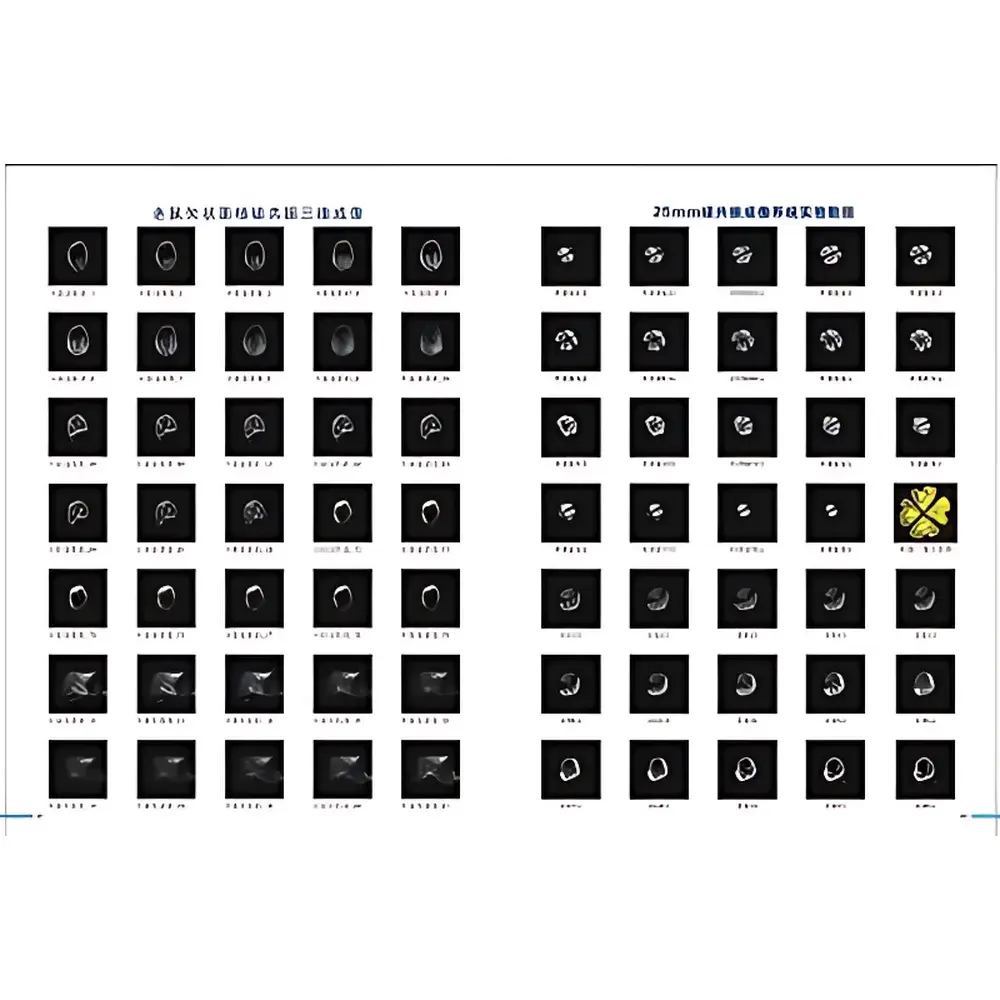
- Dual-mode imaging capability: 2D slice-selective acquisition (128×128 up to 256×256) and volumetric 3D acquisition (up to 256×256×128 matrix)
- High-fidelity RF subsystem with 25 mm internal-diameter transmit/receive probe optimized for small-animal and ex vivo tissue sensitivity
- Real-time data acquisition and on-board reconstruction with adjustable echo time (TE), repetition time (TR), flip angle, and number of averages (NEX)
- Quantitative relaxation mapping: integrated T₁ (IR-based) and T₂ (CPMG-based) fitting algorithms with mono- and bi-exponential decay modeling
- Hardware-level gradient control with independent X/Y/Z channel calibration and linearity verification over 20 mm DSV (>98% linearity)
- Stable thermal management system ensuring magnetic field drift ≤100 Hz/h post-equilibration (2-hour warm-up period)
Sample Compatibility & Compliance
The HT-3DNMR-25 supports live and fixed specimens within its 25 mm isotropic FOV, including but not limited to: C57BL/6 mice ≥4 weeks old (with compatible restraint holders), rodent organs (brain, liver, kidney), insect pupae, seed embryos, leaf cross-sections, fungal mycelia, agarose phantoms, hydrogel scaffolds, and food-grade emulsions. All acquisitions comply with non-ionizing radiation safety standards (ICNIRP 2020 guidelines for static and time-varying fields). The system architecture enables traceable experimental protocols suitable for GLP-aligned workflows; raw k-space data, acquisition parameters (TR/TE/TI/flip angle), and DICOM-compliant image exports are timestamped and metadata-annotated to support audit readiness. While not FDA-cleared for diagnostic use, the platform conforms to ISO/IEC 17025 principles for measurement uncertainty reporting in academic and industrial R&D settings.
Software & Data Management
The HT-3DNMR-25 runs on a dedicated Linux-based acquisition workstation with real-time visualization and offline processing suite. Core software modules include: (1) PulseSequence Studio — a GUI-driven environment for editing, compiling, and validating custom pulse sequences using C-style syntax and hardware-triggered timing logic; (2) RelaxoFit — a MATLAB-compatible toolbox for mono-/bi-exponential T₁/T₂ fitting with confidence interval estimation; (3) 3DReconPro — GPU-accelerated 3D Fourier reconstruction engine supporting zero-filling, phase correction, and isotropic voxel resampling; (4) ImageAnalyze — DICOM viewer with region-of-interest (ROI) quantification, intensity histogram analysis, and pseudo-color mapping (e.g., T₂-weighted contrast overlay). All datasets are stored in hierarchical HDF5 format with embedded metadata (field strength, gradient calibration coefficients, temperature logs), ensuring FAIR (Findable, Accessible, Interoperable, Reusable) data practices. Export options include NIfTI, ANALYZE, and TIFF stacks for integration with ImageJ/Fiji, ITK-SNAP, or commercial PACS viewers.
Applications
This system serves as both a pedagogical tool and a research-grade platform across multiple domains. In undergraduate and graduate physics laboratories, it facilitates hands-on instruction in NMR fundamentals—including Larmor precession, RF excitation, spin-lattice/spin-spin relaxation, k-space traversal, and Fourier image reconstruction. In biomedical engineering curricula, students perform comparative studies of contrast mechanisms (T₁ vs. T₂ weighting), motion artifact generation, and partial volume effects. For applied research, the HT-3DNMR-25 supports longitudinal monitoring of tumor xenograft growth in murine models, water distribution mapping in drought-stressed plant tissues, microstructural characterization of bioengineered cartilage, and diffusion anisotropy assessment in insect neural tracts. Its non-destructive nature makes it particularly valuable for food science applications such as oil migration in baked goods or ice crystal evolution during freeze-thaw cycles.
FAQ
What is the maximum recommended specimen size for optimal SNR and resolution?
The system is optimized for specimens fully contained within a 25 mm diameter spherical volume. For highest-resolution 3D imaging (0.08 mm isotropic), samples should be ≤18 mm in all dimensions to maintain signal uniformity and minimize susceptibility-induced distortions.
Does the system support diffusion-weighted imaging (DWI) or functional MRI (fMRI)?
While not equipped with ultra-fast EPI readouts or physiological monitoring interfaces, the programmable gradient controller and CPMG sequence module enable basic diffusion-sensitized acquisitions (b-values up to ~1000 s/mm²) for apparent diffusion coefficient (ADC) mapping in static tissues.
Can third-party software (e.g., AFNI, FSL) process HT-3DNMR-25 data?
Yes—raw k-space data and reconstructed NIfTI volumes are natively exportable. Metadata headers include BIDS-compatible fields (RepetitionTime, EchoTime, FlipAngle), facilitating pipeline integration.
Is remote operation supported?
The acquisition workstation supports SSH access and VNC-based GUI forwarding, allowing secure off-site experiment setup and monitoring via institutional networks.
What maintenance is required beyond routine calibration?
No cryogens or vacuum pumps are used. Annual gradient linearity verification and RF probe tuning are recommended; HTNMR provides traceable calibration phantoms and SOP documentation aligned with ISO 10993-18 for biomedical device validation.
Related Products




