
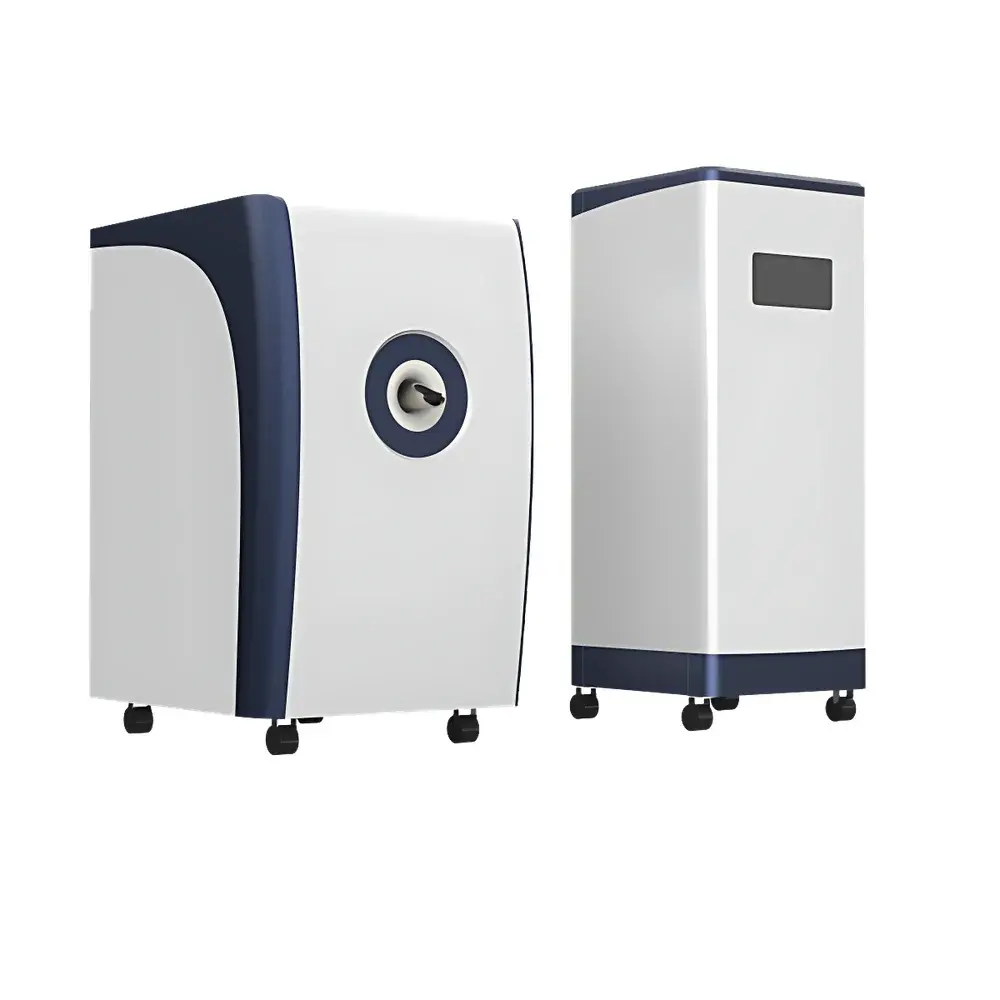
HTNMR HT-MRSI60-50A 1.5T Permanent Magnet Small Animal MRI System
| Brand | HTNMR |
|---|---|
| Origin | Shanghai, China |
| Manufacturer Type | Direct Manufacturer |
| Instrument Type | Magnetic Resonance Imaging (MRI) System |
| Animal Model Compatibility | Rat, Mouse |
| Field of View (FOV) | 50 mm diameter × 80 mm height |
| Maximum Sample Diameter | Φ50 mm |
| Detection Depth | 50 mm |
| Spatial Resolution | 0.15 mm (standard mode), 0.08 mm (high-resolution mode) |
| Image Matrix Options | 128×128×128, 256×256×128, 512×512×128 |
| Magnetic Field Homogeneity | ≤8 ppm over 20 mm DSV |
| Field Stability | Frequency drift ≤100 Hz/h |
| Multi-Nucleus Capability | ¹H, ¹⁹F, ³¹P |
| Magnet Type | Permanent Magnet (1.5 T) |
| Cryogen-Free Operation | Yes |
| Passive Shielding | Integrated self-shielding design |
| Compliance | Designed for GLP-compliant preclinical research environments |
Overview
The HTNMR HT-MRSI60-50A is a compact, cryogen-free permanent magnet small animal MRI system engineered for high-field (1.5 T) preclinical imaging in rodent models. Operating on the fundamental principles of nuclear magnetic resonance—where hydrogen (¹H), fluorine (¹⁹F), and phosphorus (³¹P) nuclei align under a static magnetic field and emit radiofrequency signals upon RF excitation—the system delivers quantitative, non-invasive, three-dimensional anatomical and functional contrast without ionizing radiation. Unlike superconducting systems requiring liquid helium and active shielding infrastructure, this platform utilizes a high-stability permanent magnet assembly with integrated passive self-shielding, eliminating the need for dedicated RF rooms or magnetic containment zones. Its 50 mm clear bore accommodates intact rats (up to ~500 g) and mice in standardized physiological positioning, supporting longitudinal studies under controlled thermoregulation and respiration-gated acquisition protocols.
Key Features
- 1.5 Tesla permanent magnet architecture with <8 ppm field homogeneity over a 20 mm diameter spherical volume (DSV), enabling robust signal-to-noise ratio (SNR) and spectral fidelity across multi-nuclear acquisitions
- Cryogen-free operation: No liquid nitrogen or helium required; zero routine cryogenic maintenance or associated safety hazards
- Integrated self-shielding design reduces fringe field extension to <0.5 mT at 1 m distance—compliant with IEC 61000-4-8 and local occupational exposure limits
- Multi-nucleus support (¹H, ¹⁹F, ³¹P) with broadband RF transmit/receive capability, facilitating dual-contrast molecular imaging and quantitative pharmacokinetic tracking using fluorinated or phosphorus-labeled probes
- High-fidelity gradient subsystem with slew rate ≥100 T/m/s and maximum amplitude ≥300 mT/m, optimized for diffusion-weighted imaging (DWI), perfusion mapping (ASL), and functional MRI (fMRI)
- Three-tier resolution configuration: Standard (128³), high-res (256²×128), and ultra-high-res (512²×128) matrix support, achieving isotropic voxel sizes down to 80 µm in optimized 3D FLASH or RARE sequences
Sample Compatibility & Compliance
The HT-MRSI60-50A is validated for in vivo imaging of Sprague-Dawley and Wistar rats (body weight ≤500 g), C57BL/6 and BALB/c mice, and ex vivo tissue specimens up to 50 mm in diameter and 80 mm in height. All hardware and sequence libraries comply with ISO 10993-1 (biocompatibility of animal-contact components) and are designed to meet Good Laboratory Practice (GLP) documentation requirements for regulatory submissions. The system supports DICOM 3.0 export with embedded acquisition metadata (TR/TE/TI, flip angle, bandwidth, FOV, matrix size), ensuring traceability for FDA 21 CFR Part 11–aligned audit trails when integrated with compliant PACS or LIMS platforms.
Software & Data Management
Acquisition and reconstruction are managed via HTNMR’s proprietary MR Studio v4.x software suite, built on a real-time Linux RTOS platform. The interface provides full pulse sequence programming (including user-defined C++-compiled modules), interactive shimming, automatic B₀/B₁ mapping, and GPU-accelerated iterative reconstruction (IR-SENSE). Raw k-space data is stored in NIfTI-1 format with JSON sidecar metadata, compatible with FSL, AFNI, SPM12, and MRtrix3 pipelines. DICOM archives include modality-specific SOP classes (MR Image Storage, MR Spectroscopy Storage) and support configurable anonymization filters for IRB-mandated de-identification prior to external data sharing.
Applications
- Longitudinal tumor xenograft monitoring with T₂-weighted and contrast-enhanced T₁ mapping
- Cardiac function assessment in murine models: cine-MRI for ejection fraction, wall thickness, and strain analysis
- Neuroimaging: hippocampal volumetry, cortical lesion quantification, and diffusion tensor imaging (DTI) of white matter tracts
- Multimodal contrast agent validation: simultaneous ¹H anatomical + ¹⁹F cell tracking or ³¹P metabolic spectroscopy in single-scan sessions
- Ex vivo organ phenotyping: high-resolution 3D rendering of lung, kidney, and liver microstructure at ≤100 µm isotropic resolution
- Preclinical biomarker development aligned with NIH/NIBIB standards for MRI method validation (e.g., NIST-traceable phantom calibration)
FAQ
Does the system require liquid helium or external cooling infrastructure?
No—this is a permanent magnet platform with zero cryogen dependency. Thermal stability is maintained via precision temperature-controlled housing and active air-cooling of gradient coils.
Can it perform dynamic contrast-enhanced (DCE) MRI?
Yes. With temporal resolution down to 3–5 s per 3D volume (depending on matrix and acceleration factor), the system supports standard DCE-MRI protocols using Gd-based or novel non-Gd agents.
Is sequence source code accessible for academic modification?
HTNMR provides documented C/C++ API access to pulse sequence compiler and reconstruction kernels under institutional licensing agreements, subject to export control review.
What level of technical support and training is included?
Installation includes on-site engineer commissioning, 5-day hands-on operator training, and remote diagnostics via encrypted VNC with SLA-backed response time (<4 h for critical acquisition failure).
Are there regulatory certifications for use in GLP-compliant facilities?
The system meets ISO 13485 design controls framework for Class IIa medical devices and includes full traceability logs for IQ/OQ/PQ documentation packages required by OECD GLP Principles.



