
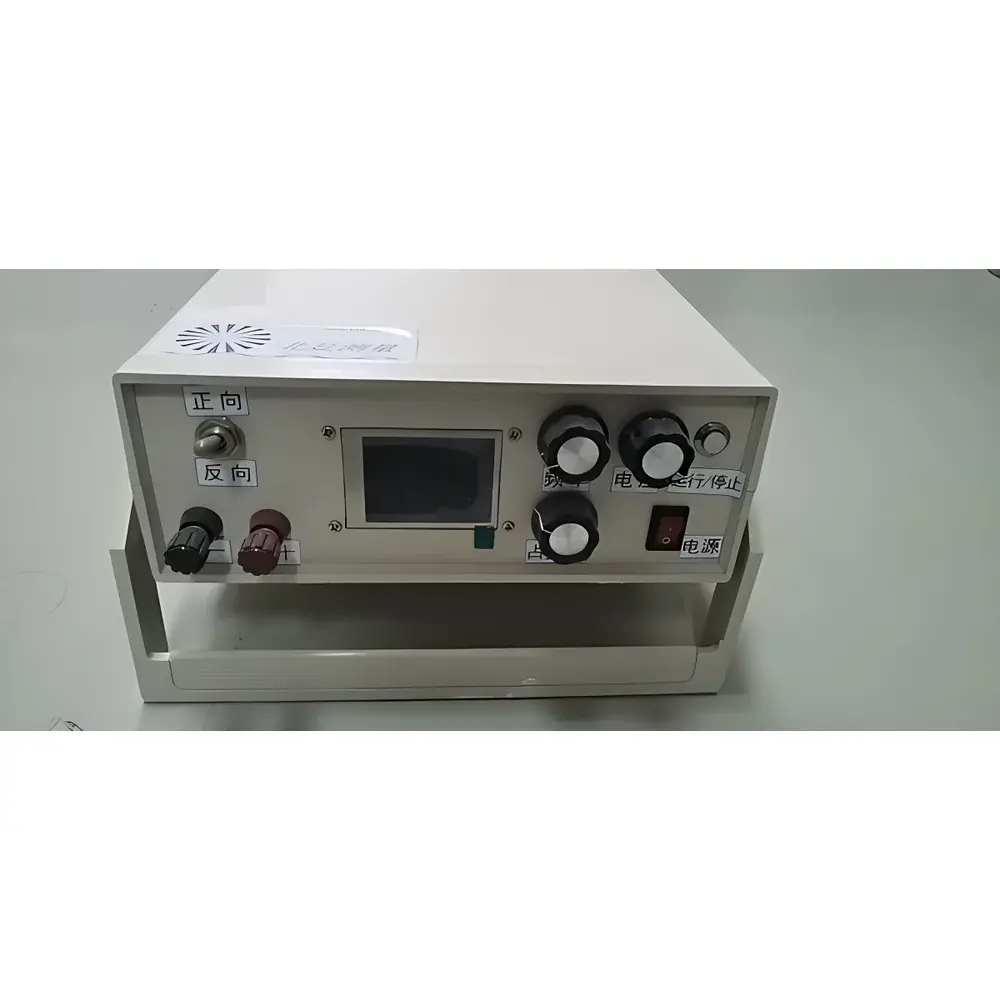
Hydrogen Bubble Generator H Bubble by BT Fluid
| Brand | BT Fluid |
|---|---|
| Origin | Beijing, China |
| Model | H Bubble |
| Voltage Range | 0–220 V (adjustable in 0.1 V steps) |
| Frequency Range | 1–100 Hz (continuously adjustable) |
| Platinum Wire Options | 25 µm (10 m), 50 µm (10 m), 100 µm (5 m) |
| Duty Cycle | 10–90% (continuously adjustable) |
| Gas Output Mode | Switchable between H₂ and O₂ |
| Includes | Customizable platinum wire mounting bracket (size-matched to water channel/tank), power cable, instrument case |
| Compliance | Designed for laboratory-scale fluid visualization under controlled aqueous conditions |
Overview
The BT Fluid H Bubble Hydrogen Bubble Generator is an engineered electrochemical flow visualization tool designed for quantitative and qualitative analysis of fluid dynamics in transparent aqueous environments—primarily water channels, towing tanks, and recirculating water tunnels. It operates on the principle of controlled electrolysis of deionized or low-conductivity water, where a pulsed or continuous DC voltage applied across a fine platinum wire cathode generates discrete, micron-scale hydrogen gas bubbles via the reduction reaction: 2H₂O + 2e⁻ → H₂↑ + 2OH⁻. These bubbles serve as neutrally buoyant, low-inertia tracers with near-zero slip velocity relative to the local flow field, enabling high-fidelity visualization of laminar boundary layers, vortex shedding, separation zones, transition onset, and turbulent structures. Unlike dye-based methods, hydrogen bubbles introduce no density or viscosity perturbation, preserving flow integrity while offering sub-millisecond temporal resolution when synchronized with high-speed imaging systems.
Key Features
- Programmable pulse generation: Adjustable frequency (1–100 Hz) and duty cycle (10–90%) allow precise control over bubble train spacing, density, and temporal coherence—critical for PIV seeding synchronization and transient flow capture.
- High-resolution voltage regulation: 0–220 V range with 0.1 V step resolution ensures stable, repeatable bubble nucleation across varying water conductivity and electrode aging states.
- Modular platinum wire system: Standard kit includes three calibrated wire gauges (25 µm, 50 µm, 100 µm), each optimized for distinct applications—fine wires for low-velocity laminar tracing; thicker wires for robust operation in higher-flow or longer-duration experiments.
- Dual-gas capability: Integrated H₂/O₂ output mode switch enables comparative studies using oxygen bubbles (for oxidizing environments or safety-critical setups where hydrogen accumulation must be avoided).
- Customizable mechanical integration: Mounting brackets are fabricated to match user-specified water channel cross-sections (width × depth), ensuring orthogonal wire alignment and minimizing flow disturbance from support structures.
- Lab-grade portability: All components—including power supply, control unit, and wire spools—are housed in a rugged, ESD-safe instrument case compliant with IEC 61000-4 electromagnetic compatibility standards.
Sample Compatibility & Compliance
The H Bubble generator is validated for use in deionized water (resistivity ≥ 1 MΩ·cm) and low-conductivity tap water (< 50 µS/cm). It is incompatible with saline, acidic, or alkaline solutions due to accelerated electrode corrosion and non-stoichiometric gas evolution. The system conforms to ISO 8502-9 for laboratory electrochemical instrumentation safety protocols and meets CE marking requirements for low-voltage equipment (LVD Directive 2014/35/EU). While not certified for hazardous area use, its design incorporates current-limiting circuitry and thermal cutoff protection to prevent wire burnout or uncontrolled gas release. For GLP-compliant research workflows, the device supports traceable parameter logging when interfaced with external data acquisition systems via analog TTL trigger outputs.
Software & Data Management
The H Bubble operates as a standalone hardware module with front-panel digital controls; no proprietary software is required for basic operation. However, it provides 0–5 V analog modulation inputs and TTL sync outputs compatible with LabVIEW, MATLAB, or Python-based experimental control frameworks (e.g., NI DAQmx, PyVISA). Users may log voltage, frequency, and duty cycle settings alongside high-speed camera timestamps for full experiment metadata reconstruction. Audit trails are maintained externally—no onboard storage or FDA 21 CFR Part 11 electronic signature functionality is included, consistent with its role as a physical stimulus generator rather than a regulated analytical instrument.
Applications
- Boundary layer transition detection in flat-plate and airfoil testing
- Vortex identification in bluff-body wakes and cavity flows
- Qualitative validation of CFD simulations (e.g., OpenFOAM, ANSYS Fluent)
- Undergraduate and graduate fluid mechanics pedagogy—demonstrating Reynolds number effects, flow separation, and instabilities
- Calibration of particle image velocimetry (PIV) systems using known bubble drift velocities
- Microfluidic flow pattern mapping in shallow-depth chambers (with miniaturized wire configurations)
FAQ
What water purity is required for stable hydrogen bubble generation?
Deionized water with resistivity ≥ 1 MΩ·cm is strongly recommended. Conductivity above 50 µS/cm increases parasitic current paths and reduces bubble size consistency.
Can the platinum wire be reused after multiple experiments?
Yes—provided the wire is rinsed in DI water and stored dry after each use. Gradual oxidation may occur after >50 hours of cumulative operation; visual inspection for darkening or kinking is advised.
Is hydrogen accumulation in enclosed test sections a safety concern?
Hydrogen concentrations remain well below the 4% lower flammability limit (LFL) in standard open-top water channels with ambient ventilation. For sealed systems, O₂ mode or active exhaust integration is recommended.
Does the H Bubble support remote triggering via Ethernet or USB?
No native network interface is provided. Remote control requires external relay or DAQ-based voltage/frequency modulation using the analog input terminals.
Are calibration certificates available for the voltage and frequency outputs?
Factory calibration reports (traceable to NIM, China) can be supplied upon request at time of order; annual recalibration is advised for metrology-critical applications.





