
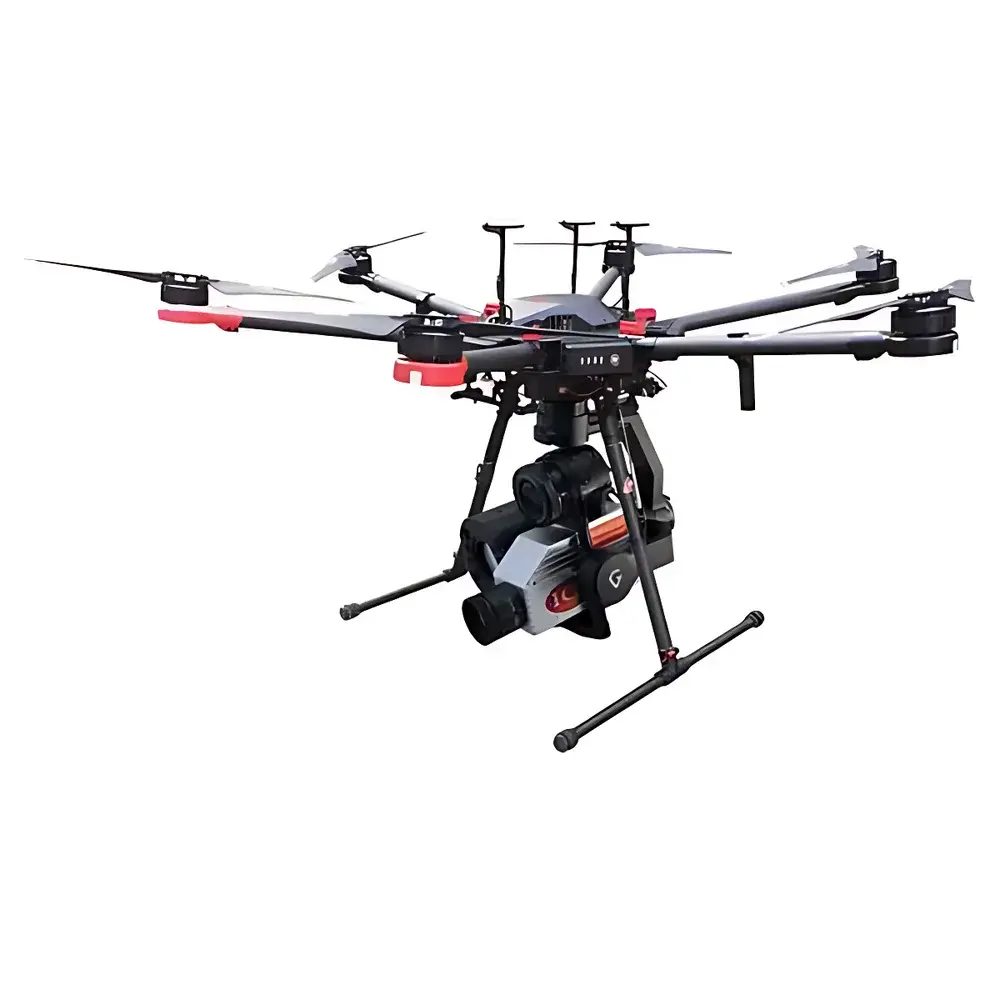
ICI Mirage HC OGI Optical Gas Imaging System for VOCs Detection and Leak Source Localization
| Brand | ICI / Infrared Cameras Inc |
|---|---|
| Origin | USA |
| Model | Mirage HC |
| Detector Type | Cooled InSb FPA (640 × 512) |
| Spectral Band | 3.2–4.2 µm (MWIR) |
| Effective Detection Range | Up to 1000 m (under optimal atmospheric conditions) |
| Compatible Platform | DJI Matrice 600 Pro with OGI Inspector (Plus) payload integration |
| Software | IR Flash Pro v5.2 (video-based spectral contrast enhancement, multi-angle analysis, audit-ready export) |
| Compliance | ASTM D7520-22 (Standard Practice for Optical Gas Imaging), ISO 17776:2016 (Offshore safety – Risk assessment), supports GLP/GMP-aligned metadata logging |
Overview
The ICI Mirage HC OGI System is a high-sensitivity, passive mid-wave infrared (MWIR) optical gas imaging platform engineered for real-time, non-contact detection and spatial localization of volatile organic compound (VOC) plumes in industrial, environmental, and emergency response settings. Leveraging the fundamental principle of absorption spectroscopy—where gaseous VOCs exhibit characteristic vibrational-rotational absorption bands in the 3.2–4.2 µm MWIR region—the system visualizes escaping gas clouds as thermal contrast anomalies against background radiance. Unlike active laser-based methods (e.g., TDLAS), the Mirage HC operates entirely passively: it detects naturally emitted or reflected infrared radiation modulated by VOC absorption, eliminating electromagnetic interference risks and enabling covert, regulatory-compliant operation in explosion-hazard zones (ATEX/IECEx Zone 1 compatible when integrated per OEM guidelines). Its core detector—a cooled indium antimonide (InSb) focal plane array with 640 × 512 resolution—delivers fourfold pixel density over legacy 320 × 256 handheld units, directly enhancing minimum detectable concentration (MDC) performance. At 1000 m standoff distance under clear, low-humidity conditions, the system achieves effective detection limits in the low hundreds of ppm for common hydrocarbons (e.g., methane, propane, benzene, ethylene) based on ASTM D7520-22 test protocols.
Key Features
- Cooled InSb MWIR detector (640 × 512 pixels) with 90% of regulated VOCs including aliphatics, aromatics, and chlorinated solvents.
- Passive imaging architecture: zero emitted radiation; fully compliant with electromagnetic compatibility (EMC) requirements for refinery, petrochemical, and LNG facility environments.
- Integrated OGI Inspector (Plus) payload for DJI Matrice 600 Pro: synchronizes Mirage HC MWIR video with Sony R10C visible-light imagery and optional TDLAS path-integrated concentration data for correlative plume characterization.
- Real-time onboard contrast enhancement algorithms enable immediate field-level leak identification without post-processing dependency.
- Ruggedized housing rated IP67, operating temperature range −20 °C to +50 °C, qualified for continuous airborne deployment with vibration damping compliant with MIL-STD-810G.
Sample Compatibility & Compliance
The Mirage HC OGI System is validated for qualitative and semi-quantitative detection of gaseous VOC emissions from process equipment—including flanges, valves, pumps, compressors, storage tanks, and pipeline right-of-ways. It meets ASTM D7520-22 methodology requirements for optical gas imaging surveys and aligns with EPA Method 21 supplemental guidance for LDAR (Leak Detection and Repair) programs. When deployed in accordance with ISO 17776:2016 Annex B (risk-based inspection planning), the system supports HAZOP/LOPA documentation workflows. Video metadata—including GPS timestamp, altitude, camera angle, ambient temperature, and relative humidity—is embedded in each frame per IR Flash Pro export protocol, satisfying audit trails required under ISO 9001:2015 and FDA 21 CFR Part 11 (when configured with electronic signature modules).
Software & Data Management
IR Flash Pro v5.2 serves as the dedicated post-acquisition analysis engine. It enables frame-by-frame spectral contrast tuning (e.g., dynamic range compression, false-color LUT mapping, temporal differencing), multi-angle re-projection of plume geometry, and side-by-side MWIR/visible overlay for precise source attribution. All processed videos retain original raw data integrity; no lossy compression is applied during analysis. Export formats include AVI (uncompressed), CSV (plume centroid coordinates + confidence metrics), and PDF reports with embedded georeferenced thumbnails—structured to integrate with CMMS platforms (e.g., SAP PM, IBM Maximo) via standard API hooks. Audit logs record every parameter adjustment, user ID, and timestamp, supporting GLP/GMP traceability.
Applications
- LDAR program execution across refineries, chemical plants, and pharmaceutical manufacturing sites.
- Aerial surveillance of offshore platforms and subsea pipeline corridors using drone-deployed systems.
- Post-incident VOC dispersion mapping during chemical release emergencies (e.g., rail derailments, tank ruptures).
- Pre-commissioning verification of seal integrity in new construction projects (e.g., ethylene crackers, hydrogen facilities).
- Regulatory compliance reporting for EPA Subpart VV, EU IED Directive, and China’s GB 31571–2015 standards.
FAQ
What VOC compounds can the Mirage HC detect?
The system detects gases with strong absorption features in the 3.2–4.2 µm band—including methane, ethane, propane, butane, benzene, toluene, xylene, vinyl chloride, and many chlorofluorocarbons—provided sufficient column density and thermal contrast exist.
Does the system require calibration gas or reference sources?
No. As a passive imager, it requires no on-site calibration gases. Factory spectral responsivity calibration is performed annually per ISO/IEC 17025-accredited procedures.
Can IR Flash Pro quantify leak rates?
It does not provide direct mass flow quantification. However, plume volume estimation and comparative ranking (e.g., “leak A is 3× more intense than leak B”) are supported via normalized intensity metrics calibrated against known release tests.
Is the system compatible with other UAV platforms besides DJI M600 Pro?
Yes—via custom gimbal integration kits and SDK support for Pixhawk-based autopilots (e.g., Auterion, Blue Robotics), subject to payload weight and power interface validation.
How is data security handled during remote transmission?
All telemetry and video streams use AES-256 encryption; IR Flash Pro enforces role-based access control (RBAC) and optional FIPS 140-2 cryptographic module certification for classified deployments.







