
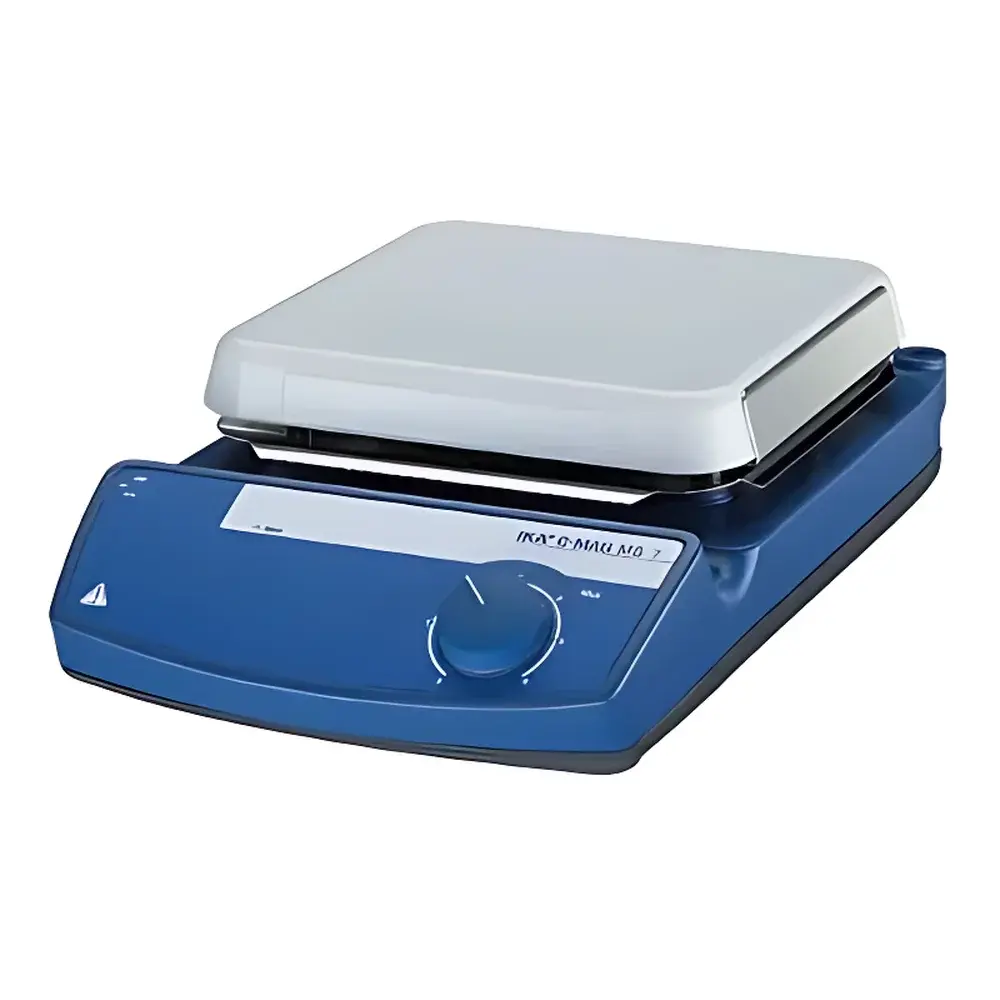
IKA C-MAG MS7 IKAMAG® Magnetic Stirrer
| Brand | IKA |
|---|---|
| Origin | Germany |
| Model | C-MAG MS7 |
| Instrument Type | Magnetic Stirrer |
| Max. Stirring Volume (H₂O) | 10 L |
| Speed Range | 100–1500 rpm |
| Speed Control | Analog dial (0–6) |
| Display | Mechanical speed scale |
| Max. Stir Bar Length | 80 mm |
| Heating | None |
| Plate Material | Ceramic |
| Plate Dimensions | 180 × 180 mm |
| Overall Dimensions | 220 × 105 × 330 mm |
| Weight | 5 kg |
| Input Power | 30 W |
| Motor Output Power | 1.5 W |
| Motor Input Power | 15 W |
| Protection Rating | IP21 |
| Ambient Temperature Range | 5–40 °C |
| Relative Humidity Limit | ≤80 % |
| Voltage | 230 V |
| Frequency | 50/60 Hz |
Overview
The IKA C-MAG MS7 IKAMAG® Magnetic Stirrer is a robust, single-position benchtop stirrer engineered for precision and reliability in routine laboratory mixing applications. Designed using Couette flow principles, it employs a rotating magnetic field generated by a permanent magnet array beneath a chemically inert ceramic plate to drive magnetic stir bars within vessels—enabling efficient, contactless agitation of liquids without mechanical shaft penetration. This configuration eliminates seal wear, contamination risk, and cleaning complexity associated with overhead stirrers, making it ideal for sterile workflows, solvent-based chemistry, and long-duration unattended operation. The unit operates without integrated heating, distinguishing it as a dedicated stirring platform optimized for temperature-controlled environments (e.g., water baths, climate chambers, or cold rooms), where external thermal management is preferred or required.
Key Features
- Ceramic Work Surface: A monolithic, seamless Al₂O₃ ceramic plate provides exceptional resistance to acids, bases, halogens, and organic solvents—ensuring long-term dimensional stability and surface integrity under aggressive chemical exposure.
- High-Torque DC Motor with Feedback Control: Equipped with microprocessor-regulated motor feedback, the system maintains consistent rotational speed across varying load conditions—including viscous solutions up to 10 L (H₂O equivalent)—minimizing drift during extended operation.
- Elevated Control Panel Design: The raised analog control interface reduces liquid splash ingress, improves visibility of the engraved speed scale, and enhances tactile access during gloved handling—supporting ergonomic lab practice and GLP-compliant documentation.
- IP21 Ingress Protection: Rated per DIN EN 60529, the enclosure safeguards against vertically falling drips and solid objects >12.5 mm, ensuring operational safety in standard laboratory environments with moderate humidity and incidental splashes.
- Compact & Stable Footprint: With base dimensions of 180 × 180 mm and total height of 330 mm, the unit integrates seamlessly into fume hoods, biosafety cabinets, and crowded benchtop layouts while maintaining low center-of-gravity stability.
Sample Compatibility & Compliance
The C-MAG MS7 accommodates standard cylindrical and conical glassware (e.g., beakers, Erlenmeyer flasks, and reaction vessels) ranging from 50 mL to 10 L capacity. Compatible stir bars include PTFE- or PTFE/glass-coated models up to 80 mm in length; optimal performance is achieved using cross-shaped or flea-type bars for high-viscosity media. The device complies with IEC 61010-1 (Safety Requirements for Electrical Equipment for Measurement, Control, and Laboratory Use) and carries CE marking for use within the European Economic Area. While not intrinsically rated for explosive atmospheres or cleanroom ISO Class 5+ environments, its non-shedding ceramic surface and absence of moving external parts support ISO/IEC 17025-aligned calibration traceability when operated within validated environmental parameters.
Software & Data Management
As an analog-controlled instrument, the C-MAG MS7 does not feature digital connectivity, firmware, or onboard data logging. Speed selection is performed manually via a calibrated 0–6 dial corresponding to 100–1500 rpm, with no electronic speed readout or remote interface. This design prioritizes operational simplicity, electromagnetic compatibility (EMC) robustness, and immunity to software obsolescence—making it suitable for regulated environments where audit trails are maintained externally (e.g., via lab notebooks or LIMS entries). For laboratories requiring electronic speed recording or integration with automated workflows, IKA offers digitally enabled variants (e.g., RCT basic or HS7 models) compliant with FDA 21 CFR Part 11 when paired with validated software platforms.
Applications
This stirrer supports a broad scope of non-heating mixing tasks across pharmaceutical QC, academic research, and industrial R&D settings. Typical use cases include homogenization of buffer solutions prior to HPLC analysis; suspension of nanoparticles in aqueous colloids; dissolution testing of solid dosage forms under USP apparatus II conditions; pH adjustment and titrant dispersion in electrochemical cell preparation; and gentle agitation of cell culture media in CO₂ incubators. Its chemical resilience also enables safe use with concentrated HNO₃, NaOH (≤50 % w/w), and chlorinated solvents—provided appropriate personal protective equipment and fume extraction are employed per institutional EHS protocols.
FAQ
Does the C-MAG MS7 include a temperature probe or heating function?
No. It is a non-heating magnetic stirrer. Temperature control must be achieved externally (e.g., via water bath or environmental chamber).
What is the maximum viscosity this unit can handle effectively?
While not specified as a formal parameter, the motor delivers stable rotation for aqueous glycerol solutions up to ~1000 mPa·s at 10 L volume—subject to appropriate stir bar geometry and vessel geometry.
Is the ceramic plate replaceable if damaged?
Yes. IKA supplies the ceramic plate (Order No. 3020000) as a field-replaceable component, enabling full functional restoration without unit replacement.
Can it operate continuously for 24/7 applications?
Yes. Rated for continuous duty under ambient conditions ≤40 °C and ≤80 % RH, with no duty-cycle limitations specified in the manufacturer’s technical documentation.
What stir bar size is recommended for 10 L mixing?
A 60–80 mm cross-shaped PTFE-coated stir bar is recommended for optimal torque transfer and vortex minimization in tall-form 10 L vessels.



