
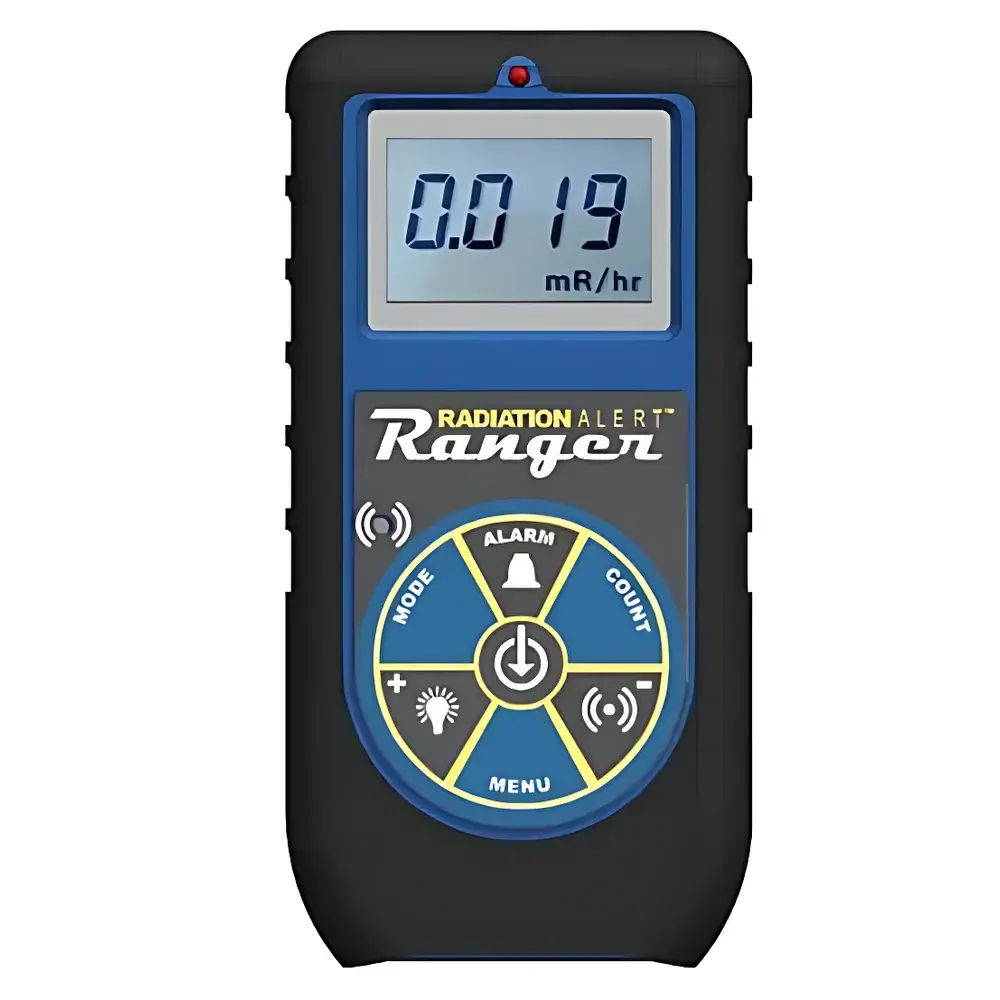
Inspector USB Digital Multi-Function Radiation Detector by SE
| Key | Origin: USA |
|---|---|
| Manufacturer Type | Authorized Distributor |
| Origin Category | Imported |
| Model | Inspector USB |
| Instrument Type | Dose Rate / Contamination Meter |
| Detector | Halogen-quenched Geiger-Müller tube, 1.77" (45 mm) active diameter, mica window density 1.4–2.0 mg/cm² |
| Sensitivity | 3340 CPM per mR/hr (Cs-137 reference) |
| Energy Response | α ≥ 2.0 MeV, β ≥ 40 keV, γ/X ≥ 10 keV |
| Dose Rate Range | 0.001–100.0 mR/hr (0.001–1000 µSv/hr) |
| Count Rate Range | 0–350,000 CPM |
| Total Count Capacity | 1–9,999,999 counts |
| Display | 4-digit LCD with mode indicators |
| Update Interval | 3 s (adaptive averaging over prior 30 s at low levels) |
| Accuracy | ±10% to ±15% (traceable to NIST standards) |
| Alarm Thresholds | Adjustable 0.001–50 mR/hr or 1–160,000 CPM |
| Audio Alert | 70 dB @ 1 m (user-disableable) |
| Data Interface | USB 2.0 compliant port + CMOS audio output |
| Power | 9 V alkaline battery (typical life: 2160 h background, ~600 h at 1 mR/hr) |
| Operating Temperature | –10 °C to +50 °C |
| Dimensions | 150 × 80 × 30 mm |
| Weight | 275 g (battery excluded) |
| Compliance | CE marked |
| certified per ISO 6980-1 | 2020 (reference radiation fields), calibrated and verified per ANSI N42.33-2021 for portable radiation detection instruments |
Overview
The Inspector USB Digital Multi-Function Radiation Detector by SE is a field-deployable, microprocessor-controlled radiation monitoring instrument engineered for precise, real-time measurement of alpha (α), beta (β), gamma (γ), and X-ray emissions. It employs a halogen-quenched Geiger-Müller (GM) detector with a large-area (45 mm diameter), ultra-thin mica end-window—optimized for high-efficiency detection of low-penetrating radiation, including α particles down to ≥2.0 MeV and low-energy β particles ≥40 keV. Unlike scintillation or semiconductor-based systems, the GM tube architecture delivers robust linearity, intrinsic stability, and immunity to electromagnetic interference—critical attributes for emergency response, regulatory inspection, and environmental screening where operational reliability supersedes spectral resolution. The device operates on fundamental ionization principles: incident radiation ionizes gas within the tube, triggering discrete, quantifiable electrical pulses proportional to event count rate. These pulses are processed via an embedded high-speed microcontroller to compute dose rate (mR/hr, µSv/hr), surface contamination activity (CPM, Bq, DPM), cumulative exposure, and pulse-per-second (CPS) metrics—all traceable to NIST-traceable calibration sources.
Key Features
- Large-Area High-Sensitivity Detection: LND 7300-series GM tube (1.77″ active diameter, 1.4–2.0 mg/cm² mica window) provides industry-leading sensitivity for α/β surface contamination surveys and low-dose-rate environmental monitoring.
- Multi-Parameter Real-Time Measurement: Simultaneous display of dose rate (mR/hr, µSv/hr), count rate (CPS, CPM), total accumulated counts, and activity (Bq, DPM)—with automatic unit conversion aligned to ICRP and IAEA reporting conventions.
- Adaptive Averaging Algorithm: Dynamic update interval (3 s nominal, compressing at elevated count rates) ensures statistically stable readings while preserving responsiveness during rapid flux changes.
- Real-Time Monitoring Engine (RME): Continuous background subtraction and threshold-triggered logging enable unattended operation in fixed-location safety zones—supporting OSHA 1910.120 and IAEA RS-G-1.8 compliance protocols.
- Configurable Dual-Stage Alarms: Independent adjustable thresholds for dose rate (0.001–50 mR/hr) and count rate (1–160,000 CPM), with visual (LED flash) and audible (70 dB @ 1 m) alerts—fully disableable for silent operation.
- Integrated Data Logging & USB Interface: Onboard memory stores time-stamped measurement sequences; USB 2.0 port enables direct connection to Windows/macOS/Linux hosts for live streaming, firmware updates, and post-acquisition analysis using SE’s validated data acquisition software.
Sample Compatibility & Compliance
The Inspector USB is validated for quantitative assessment of radioactive surface contamination on stainless steel, concrete, plastic, and porous substrates per ASTM D7282-18 (Standard Practice for Alpha and Beta Surface Contamination Measurements). Its energy response profile satisfies ANSI N42.33-2021 requirements for portable survey meters used in nuclear medicine, decommissioning, and border security applications. Calibration is performed using traceable 137Cs, 90Sr/90Y, and 241Am sources, with optional user-defined correction factors for non-standard radionuclides (e.g., 226Ra, 238U series). The instrument carries CE marking under Directive 2014/30/EU (EMC) and 2014/35/EU (LVD), and its metrological performance has been independently verified by the China National Institute of Metrology (CNIM) in accordance with JJG 854-2015 (Calibration Specification for Portable Radiation Survey Meters).
Software & Data Management
SE’s proprietary RadiationLog Pro software (v3.2+, Windows/macOS compatible) supports full bidirectional communication with the Inspector USB. Functions include real-time graphing of dose rate vs. time, automated Bq/cm² conversion for α/β contamination using substrate-specific efficiency curves, batch export to CSV/Excel, GLP-compliant audit trails (user ID, timestamp, instrument serial, calibration status), and configurable PDF report generation meeting ISO/IEC 17025 documentation requirements. All data transfers comply with FDA 21 CFR Part 11 through digital signature-enabled session logs and immutable record timestamps—ensuring integrity for regulatory submissions and QA/QC archives.
Applications
- Routine radiological surveys in nuclear medicine departments (X-ray room shielding verification, PET tracer spill detection)
- Environmental site assessments: radon progeny in soil gas, 226Ra in groundwater, uranium mill tailings characterization
- Regulatory inspections: customs radiation portal monitoring, scrap metal screening, NORM/TENORM identification in oilfield equipment
- Emergency response: rapid source localization following transportation incidents or lost industrial gauges
- Consumer product testing: radioactivity screening of ceramics, granite countertops, antique glassware (uranium glaze), and vintage luminous dials
- Decommissioning support: clearance measurements per IAEA RS-G-1.7, verifying residual activity below unconditional release limits
FAQ
Is the Inspector USB suitable for quantitative alpha surface contamination measurements?
Yes. With its thin mica window and optimized geometry, it achieves ≥25% detection efficiency for 241Am alpha particles under controlled geometry conditions, enabling direct Bq/cm² calculation when paired with SE’s validated calibration templates.
Does the device support external probe connectivity?
No. The Inspector USB integrates a fixed GM tube; however, its USB interface allows synchronization with third-party environmental sensors (e.g., temperature, humidity) via SE’s API toolkit.
How is calibration traceability maintained?
Each unit ships with a NIST-traceable calibration certificate. Field recalibration is supported using check sources; coefficients are stored in non-volatile memory and logged with every measurement.
Can data be exported in formats compatible with LIMS systems?
Yes. CSV exports include ISO 8601 timestamps, instrument metadata, and SI-unit-normalized values—structured for direct ingestion into LabWare, Thermo Fisher SampleManager, or custom SQL-based LIMS platforms.
What is the maximum continuous operating time on a single 9 V battery?
At ambient background (~0.01 mR/hr), typical runtime exceeds 90 days (2160 hours); at 1 mR/hr, runtime reduces to approximately 25 days (600 hours), consistent with ANSI N42.33 power consumption specifications.







