
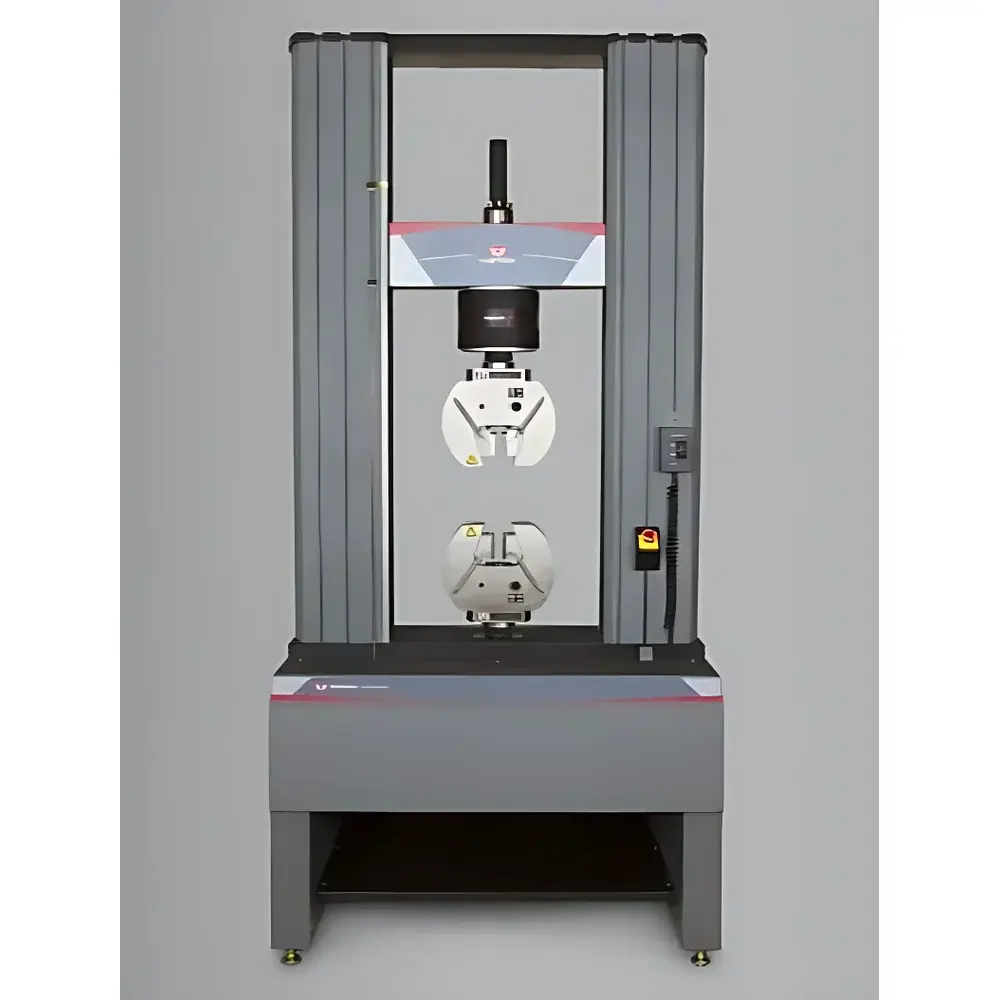
Instron 2380 Series Electromechanical Universal Testing System
| Brand | Instron |
|---|---|
| Origin | USA |
| Model | 2380 Series |
| Load Capacity | 100 kN (2382) / 300 kN (2386) |
| Load Accuracy | ±0.5% of indicated load |
| Force Resolution | 1/200 to full scale without accuracy loss |
| Data Acquisition Rate | 500 Hz |
| Crosshead Speed | up to 500 mm/min (20 in/min) |
| Vertical Test Space | 1323 mm (2382) / 1282 mm (2386) |
| Compliance | CE-marked |
| Sensor Recognition | Automatic |
| Software Control | Fully integrated via Bluehill Universal |
| Fixture Compatibility | Thousands of standardized and custom test fixtures available |
| Instrument Type | Electromechanical Tensile and Compression Testing System |
Overview
The Instron 2380 Series is a high-performance, floor-mounted electromechanical universal testing system engineered for routine and demanding mechanical property evaluation across research laboratories, quality control departments, and production environments. Built on Instron’s decades-long heritage in materials testing, the 2380 platform employs precision ball-screw actuation, high-stiffness structural frames, and closed-loop servo control to deliver repeatable, traceable force and displacement measurements under tension, compression, flexure, and shear loading conditions. Its design adheres to fundamental principles of ISO 7500-1 (static calibration of force-proving instruments) and ASTM E4 (standard practices for force verification of testing machines), ensuring metrological integrity for compliance-critical applications. The system supports both standard-compliant testing per ASTM D638, ISO 527, ASTM C39, and ISO 604, as well as custom protocol execution for internal specifications or regulatory submissions.
Key Features
- High-fidelity load measurement: Integrated load cells calibrated to ±0.5% of indicated load across the full range — from 0.5% to 100% of capacity — with no interpolation or range-switching required.
- Real-time data fidelity: 500 Hz synchronized acquisition of force, displacement, and extensometer signals enables accurate capture of transient mechanical events, including yield onset, necking propagation, and fracture initiation.
- Intelligent hardware integration: Automatic recognition of load cells, extensometers, and environmental chambers via digital interface eliminates manual configuration errors and accelerates test setup.
- Rigid, low-deflection frame architecture: Optimized for minimal compliance and high lateral stability, supporting consistent results even during high-speed or high-force cyclic tests.
- Modular motion control: Programmable crosshead speeds up to 500 mm/min (20 in/min) with sub-micron positioning resolution, accommodating both quasi-static and dynamic rate-dependent characterization.
- Scalable test envelope: Two primary configurations — the 2382 (100 kN) and 2386 (300 kN) — offer vertical test spaces of 1323 mm and 1282 mm respectively, enabling large-part evaluation and multi-specimen staging.
Sample Compatibility & Compliance
The 2380 Series accommodates an extensive range of specimen geometries and material classes — including metals, polymers, composites, elastomers, textiles, biomedical devices, and construction materials — through Instron’s comprehensive portfolio of mechanical grips, pneumatic clamps, wedge-action fixtures, and specialized tooling (e.g., peel, shear, tear, and creep fixtures). All systems are CE-marked and designed in accordance with Machinery Directive 2006/42/EC and Low Voltage Directive 2014/35/EU. When configured with validated software and audit-trail-enabled hardware, the platform supports GLP and GMP environments compliant with FDA 21 CFR Part 11 requirements for electronic records and signatures.
Software & Data Management
Controlled exclusively by Bluehill Universal software, the 2380 Series provides intuitive test method development, real-time visualization, automated pass/fail evaluation, and customizable reporting. Bluehill Universal includes pre-built methods aligned with ASTM, ISO, and EN standards, and supports user-defined calculations (e.g., modulus, elongation at break, secant modulus, energy absorption). All test data are stored in a secure, timestamped database with full revision history, user access logs, and export capability to CSV, PDF, XML, and industry-standard formats such as ASTM E1434. Optional IQ/OQ/PQ documentation packages facilitate installation and operational qualification for regulated industries.
Applications
- Quality assurance of incoming raw materials and finished goods in automotive, aerospace, and medical device manufacturing.
- Mechanical validation of thermoplastics, thermosets, and fiber-reinforced composites per ISO 527-2 and ASTM D3039.
- Compression testing of concrete cylinders (ASTM C39), foam resilience (ISO 3386), and orthopedic implant components.
- Tensile fatigue and cyclic loading studies using optional high-cycle test modules and environmental enclosures.
- Creep and stress-relaxation characterization with extended-duration test scheduling and temperature-controlled chamber integration.
- Educational use in university materials science labs for hands-on instruction in mechanical behavior fundamentals.
FAQ
What load capacities are available in the 2380 Series?
The 2380 Series comprises two primary models: the 2382 (100 kN maximum force) and the 2386 (300 kN maximum force), each optimized for distinct application scales and specimen sizes.
Is the system compatible with extensometers and environmental chambers?
Yes — all 2380 systems support analog and digital extensometers (including video, clip-on, and non-contact options) and integrate seamlessly with Instron’s line of environmental chambers (−70°C to +350°C) and humidity control units.
Can Bluehill Universal generate reports compliant with ISO/IEC 17025?
When deployed with appropriate validation documentation, audit trails, and electronic signature workflows, Bluehill Universal meets the data integrity and reporting requirements specified in ISO/IEC 17025:2017 Clause 7.7.
Does the system require annual recalibration?
Per ISO/IEC 17025 and internal quality procedures, periodic verification against traceable standards is recommended at least annually — though frequency may increase based on usage intensity, criticality of test outcomes, and organizational SOPs.
Are third-party fixtures supported?
While Instron-certified fixtures guarantee optimal performance and warranty coverage, mechanically compatible third-party fixtures may be used if they meet dimensional, alignment, and safety specifications outlined in the system’s mechanical interface documentation.



