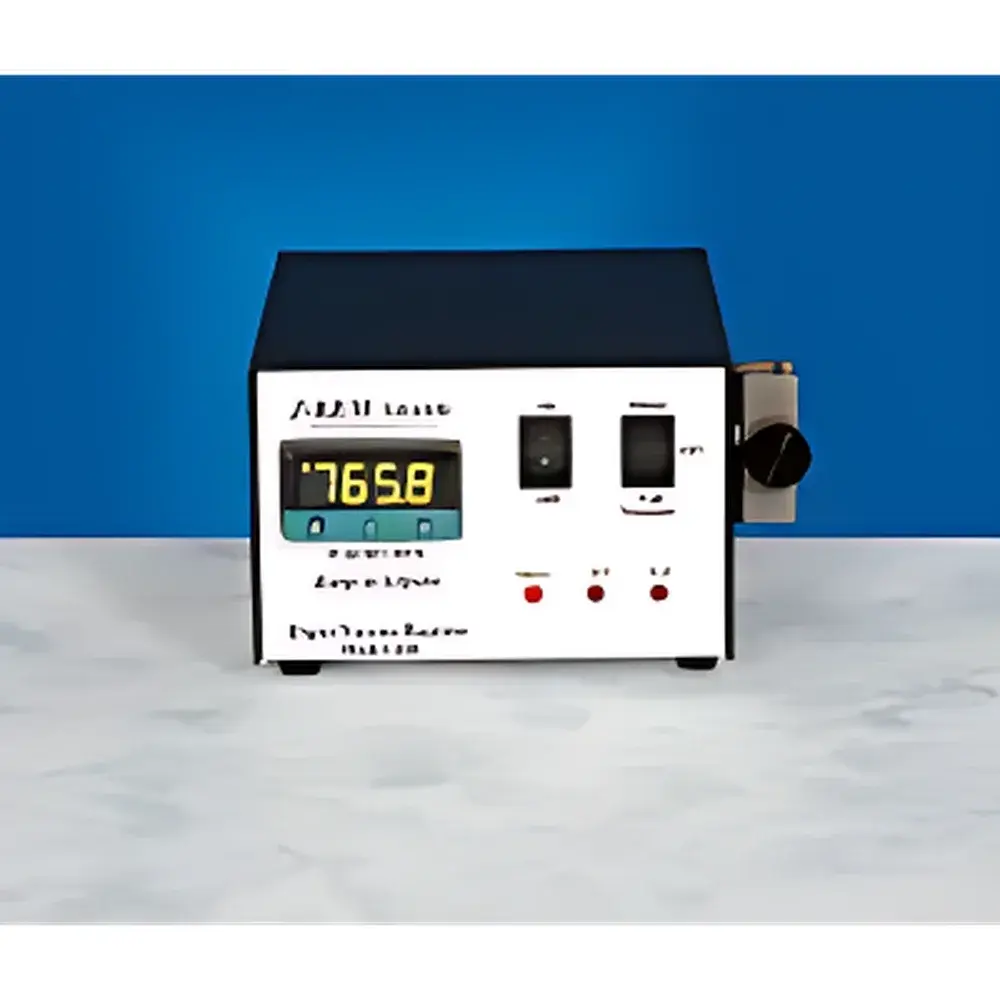
J-KEM DVR-300 / DVR-380 Continuous Electronic Vacuum Regulator
| Brand | J-KEM |
|---|---|
| Origin | USA |
| Model | DVR-300, DVR-380 |
| Control Accuracy | ±1 torr |
| Actuation Principle | Solid-state electronic pressure regulation |
| Construction Materials | 316 stainless steel and PTFE for all wetted parts |
| Control Mode | Digital setpoint input with ramp rate control |
| Power Supply | 100–240 VAC, 50/60 Hz |
| Operating Range | 0.1 to 760 torr (absolute) |
| Enclosure Rating | IP65 |
| Compliance | CE, RoHS |
Overview
The J-KEM DVR-300 and DVR-380 Continuous Electronic Vacuum Regulators are precision-engineered instruments designed for stable, programmable vacuum control in laboratory and pilot-scale process environments. Unlike legacy mercury-based or mechanical diaphragm regulators, these units employ solid-state semiconductor control architecture to deliver repeatable, drift-free vacuum regulation across a wide dynamic range—from rough vacuum (0.1 torr) up to atmospheric pressure (760 torr absolute). The core operating principle relies on closed-loop feedback between an integrated high-stability capacitance manometer and a fast-response proportional solenoid valve, enabling real-time pressure correction with minimal overshoot. This architecture eliminates hysteresis and thermal lag commonly observed in analog vacuum controllers, making the DVR series particularly suitable for applications demanding tight process windows—such as solvent removal under controlled evaporation kinetics, thin-film deposition staging, or vacuum drying of moisture-sensitive pharmaceutical intermediates.
Key Features
- Solid-state electronics only—no mercury, no moving diaphragms, no oil seals—ensuring long-term calibration stability and zero maintenance downtime.
- Digital pressure setpoint entry via front-panel keypad or remote RS-232/RS-485 interface; supports ASCII command protocol for integration into LabVIEW, MATLAB, or SCADA systems.
- Programmable ramp rate control: users define vacuum descent or ascent slope (torr/min), preventing sudden pressure transients that could cause bumping, foaming, or sample disturbance during rotary evaporation or lyophilization.
- Full-wetted path constructed exclusively from electropolished 316 stainless steel and virgin PTFE—validated for compatibility with aggressive media including concentrated HCl, 98% H₂SO₄, THF, DMF, chlorinated solvents, and caustic NaOH solutions.
- Integrated temperature-compensated capacitance manometer with NIST-traceable calibration certificate (optional); typical long-term zero drift <0.05 torr/year.
- IP65-rated enclosure with corrosion-resistant aluminum housing—designed for continuous operation in fume hood or cleanroom environments.
Sample Compatibility & Compliance
The DVR-300/DVR-380 is compatible with standard KF-16, KF-25, and ISO-KF vacuum flanges and interfaces seamlessly with common lab vacuum sources (e.g., oil-sealed rotary vane pumps, dry scroll pumps, or hybrid turbomolecular systems). Its material construction meets ASTM F2217 (Standard Practice for Selection of Elastomers and Plastics for Vacuum Service) and complies with ISO 10100:2021 (Vacuum technology — Vocabulary and definitions). For regulated environments, the unit supports audit-ready operation when paired with optional firmware-enabled event logging (timestamped setpoint changes, alarm triggers, valve position history), satisfying GLP and GMP documentation requirements per FDA 21 CFR Part 11 when deployed with validated software clients.
Software & Data Management
J-KEM provides the free DVR Control Suite (Windows-compatible), offering real-time pressure trending, multi-channel logging (up to 4 simultaneous DVR units), and CSV export for post-processing in Excel or Python/Pandas. The embedded controller firmware includes non-volatile memory for storing up to 16 user-defined vacuum profiles—including ramp rates, hold times, and endpoint logic (e.g., “hold at 50 torr for 15 min, then ramp to 5 torr at 2 torr/min”). All communication protocols support Modbus RTU over RS-485, enabling integration into centralized facility monitoring systems without proprietary middleware.
Applications
- Controlled solvent evaporation in rotary evaporators—preventing bumping during low-boiling-point fraction recovery.
- Vacuum-assisted crystallization where nucleation onset is pressure-dependent.
- Staged degassing of polymer precursors prior to casting or extrusion.
- Calibration and validation of secondary vacuum gauges in metrology labs.
- Process development for continuous flow chemistry under sub-atmospheric conditions.
- Environmental simulation chambers requiring precise barometric profile replication.
FAQ
Does the DVR-300/DVR-380 require periodic recalibration?
Yes—annual verification against a NIST-traceable reference gauge is recommended; field calibration is supported via the front-panel menu using a known pressure standard.
Can the unit be used with corrosive vapors such as HCl or HF?
The DVR-380 variant includes optional Hastelloy C-276 valve internals and is rated for intermittent HF exposure; consult J-KEM Application Engineering for full chemical compatibility matrices.
Is remote monitoring possible without a PC?
Yes—the optional DVR-Net module adds Ethernet connectivity and a built-in web server for browser-based status viewing and setpoint adjustment.
What is the maximum allowable inlet pressure for the vacuum port?
The regulator is rated for continuous operation with inlet pressures up to 1.5 bar absolute; transient spikes up to 2.0 bar are tolerated for <5 seconds.
How does the ramp rate function interact with PID tuning?
Ramp rate operates as a feedforward constraint layer above the underlying PID loop; it limits the derivative term’s output magnitude to enforce smooth transitions without destabilizing the control algorithm.