
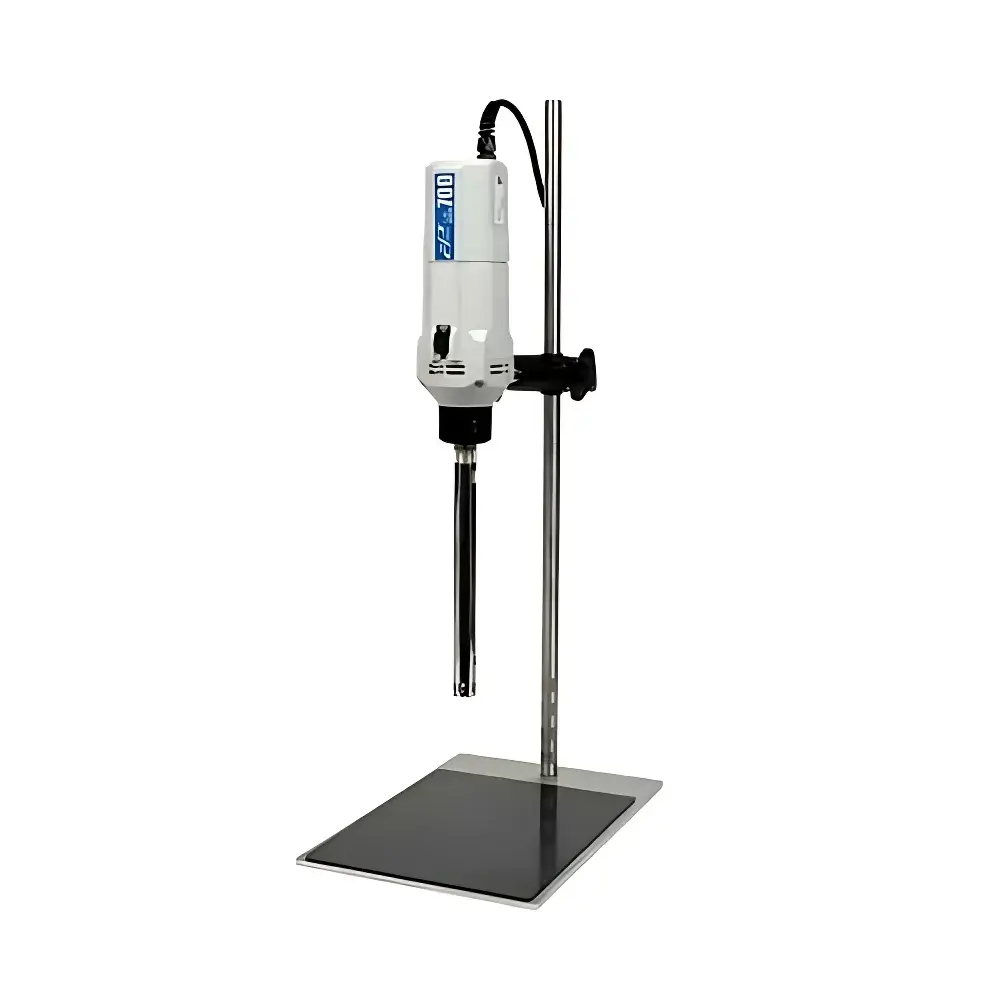
Labgen 700 Handheld Homogenizer
| Origin | USA |
|---|---|
| Manufacturer Type | Authorized Distributor |
| Origin Category | Imported |
| Model No. | 04727-04 |
| Instrument Type | Handheld Homogenizer |
| Instrument Subtype | Tissue Disruptor Homogenizer |
| Sample Volume Range | 0.05–10 L |
| Speed Range | 10,000–30,000 rpm |
| Power Input | 220 V, 50/60 Hz, 700 W |
Overview
The Labgen 700 Handheld Homogenizer is an engineered solution for high-shear mechanical homogenization in molecular biology, clinical diagnostics, and pre-analytical sample preparation laboratories. Based on rotor-stator shear principle, the system delivers controlled, reproducible cell lysis and tissue dispersion through high-speed rotation of precision-machined probes within a stationary sleeve—generating intense hydrodynamic forces, cavitation, and turbulent flow sufficient to disrupt membranes, nuclei, and fibrous matrices without significant thermal degradation when operated under appropriate duty cycles. Designed for flexibility across benchtop and mobile workflows, the Labgen 700 supports both handheld operation and fixed-position use with optional bench-mounted stands, enabling consistent processing from microliter-scale nucleic acid extractions to liter-volume suspension homogenization.
Key Features
- Variable speed control (10,000–30,000 rpm) with digital feedback circuitry ensures stable rotational velocity across load variations, critical for protocol reproducibility in RNA integrity preservation and protein extraction.
- Dual-probe compatibility: Stainless steel probes (F-series for soft tissues, C-series for cryo-hardened or fibrous samples) and autoclavable polypropylene probes (F/C variants) allow method-specific selection while maintaining sterility and minimizing cross-contamination risk.
- Modular probe architecture with standardized threading enables rapid interchange between 11 probe configurations—including micro-volume (0.05 mL), mid-range (0.25–100 mL), and large-batch (up to 10 L) options—each validated for dimensional tolerance and torque transmission efficiency.
- 700 W brushless motor provides high torque at low speeds and sustained power at maximum RPM, supporting viscous suspensions and particulate-laden samples without stalling or thermal cutoff.
- Ergonomic, balanced housing with non-slip grip and integrated trigger lock facilitates extended manual operation; optional 04727-89 benchtop base allows hands-free, vibration-dampened processing for time-sensitive assays.
Sample Compatibility & Compliance
The Labgen 700 accommodates diverse biological matrices including mammalian cell cultures, plant tissues, bacterial pellets, yeast, blood clots, and frozen tissue sections. Probe selection follows tissue hardness and thermal sensitivity criteria: F-type probes optimize shearing efficiency for soft, hydrated samples (e.g., liver, spleen, cultured cells); C-type probes feature reinforced geometry and cryo-compatible metallurgy for brittle or frozen specimens (e.g., muscle, brain, adipose). All stainless steel probes comply with ASTM F899 for surgical-grade stainless alloys (316L), and polypropylene probes meet USP Class VI biocompatibility standards. The system supports GLP/GMP-aligned workflows through traceable probe usage logs (when paired with Labgen Connect software), and its design facilitates cleaning validation per ISO 14644-1 cleanroom protocols.
Software & Data Management
While the Labgen 700 operates as a standalone instrument, it integrates with Labgen Connect—a PC-based configuration and monitoring platform supporting parameter logging (speed, duration, probe ID), user authentication, and audit trail generation compliant with FDA 21 CFR Part 11 requirements. Software-defined run profiles can be saved, version-controlled, and exported for SOP documentation. Optional USB data export enables synchronization with LIMS environments, and timestamped operational records support retrospective analysis during regulatory audits or method transfer activities.
Applications
- Pre-PCR and RT-qPCR sample prep: Efficient lysis of Gram-negative bacteria, mammalian cells, and viral particles while preserving nucleic acid integrity.
- RNA isolation workflows: Minimized RNase activation via rapid, low-heat disruption—validated for use with TRIzol® and similar phenol-chloroform reagents.
- Proteomics sample preparation: Controlled release of intracellular proteins from adherent and suspension cultures without excessive denaturation.
- Vaccine development: Homogenization of whole-cell lysates and adjuvant-emulsion blends for antigen consistency testing.
- Environmental microbiology: Processing of soil slurries, biofilm fragments, and waterborne pathogen concentrates for downstream culture or metagenomic analysis.
FAQ
What probe types are compatible with the Labgen 700?
The system accepts both F-series (soft-tissue optimized) and C-series (cryo/fibrous-tissue optimized) stainless steel probes, as well as autoclavable polypropylene probes requiring the 04727-88 adapter.
Can plastic probes be sterilized repeatedly?
Yes—polypropylene probes are rated for ≥50 cycles of saturated steam sterilization at 121 °C, 15 psi, per ISO 17665-1, and retain dimensional stability and chemical resistance post-sterilization.
Is the Labgen 700 suitable for GMP environments?
When used with Labgen Connect software, the instrument supports electronic signatures, audit trails, and parameter locking—enabling compliance with Annex 11 and 21 CFR Part 11 for regulated manufacturing and QC labs.
What is the minimum and maximum sample volume supported?
The system processes volumes from 0.05 mL (using 5 mm diameter F/C probes) up to 10 L (using the 35 mm diameter 191F/182C probe), with optimal homogenization achieved within manufacturer-specified volume-to-probe-diameter ratios.
Does the unit include a stand or probe by default?
No—the base model (04727-04) is supplied without probes or accessories; all probes, adapters, and the 04727-89 benchtop stand are configured separately based on application requirements.



