
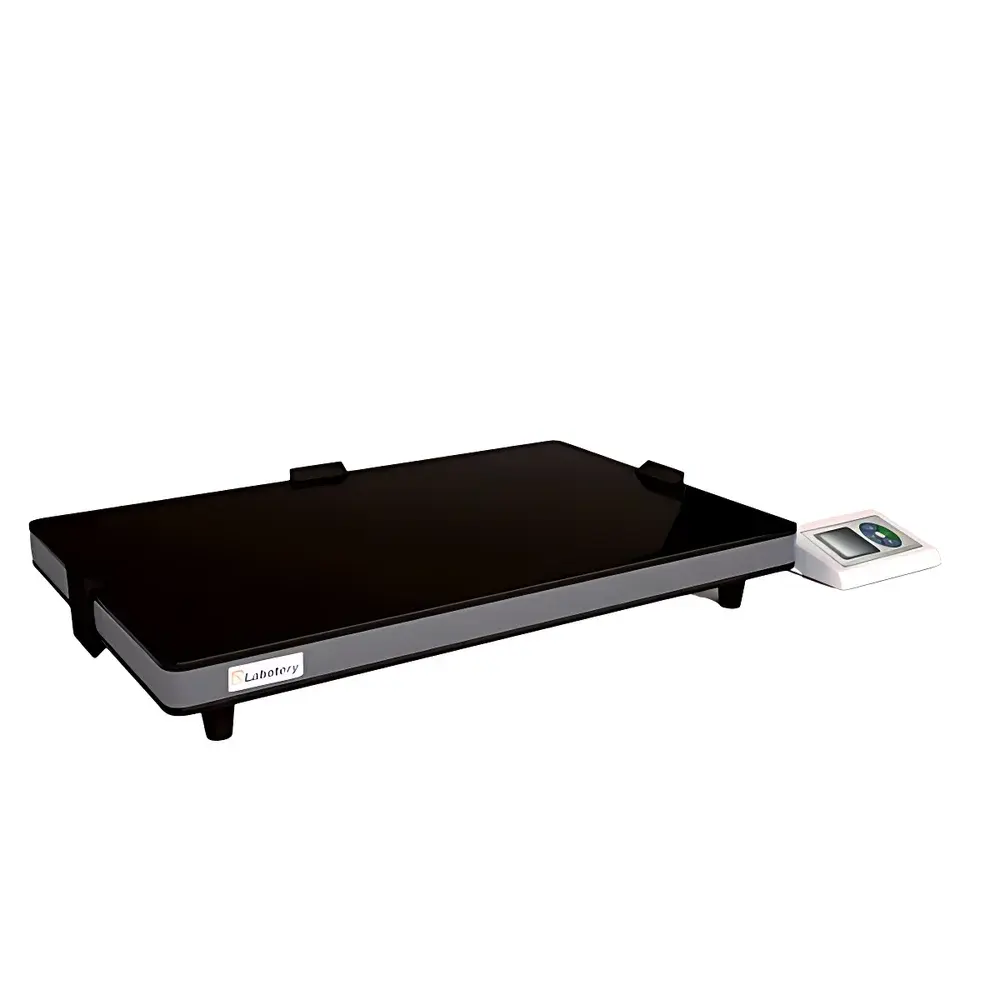
Labotery DW Series Constant-Temperature Electric Heating Plate
| Brand | Labotery |
|---|---|
| Model | DW-12F / DW-24F |
| Origin | Tianjin, China |
| Heating Power | 2.0 kW |
| Max Operating Temperature | Ambient +5°C to 400°C |
| Temperature Uniformity | ±1°C |
| Heating Surface Dimensions | 300 × 400 mm |
| Display | LCD Screen |
| Control System | PID Microprocessor with Dual Modes (Setpoint & Multi-Step Programming) |
| Safety Features | Over-Temperature Alarm, Power-Fail Memory, Timer, Auto-Tuning (AT), Scheduled On/Off |
Overview
The Labotery DW Series Constant-Temperature Electric Heating Plate is an engineered solution for precise, reproducible, and safe thermal sample preparation in analytical and research laboratories. Designed around resistive heating principles with closed-loop PID temperature regulation, the DW Series delivers stable thermal output across its full 300 × 400 mm microcrystalline glass heating surface — a critical requirement for consistent digestion, evaporation, acid reflux, and controlled drying protocols. Unlike open-coil hotplates, the DW Series integrates a fully sealed, chemically inert ceramic-glass top plate that resists corrosion from HNO₃, HCl, HF, and other aggressive reagents commonly used in EPA Method 3050B, ISO 11466, and ASTM D5178 sample digestion workflows. Its ambient-to-400°C operational range supports both low-temperature enzymatic incubation and high-temperature ashing pre-treatments, making it suitable for multi-step sample prep sequences without equipment switching.
Key Features
- Microcrystalline glass top plate: Non-porous, corrosion-resistant, and thermally stable up to 400°C; withstands repeated exposure to strong mineral acids and alkalis without etching or discoloration.
- Large uniform heating zone (300 × 400 mm): Enables simultaneous processing of multiple vessels — including 50–500 mL digestion tubes, crucibles, beakers, and Teflon®-lined vessels — with ≤±1°C spatial temperature deviation across the entire surface.
- Dual-mode PID controller: Supports both fixed-setpoint operation for routine heating and multi-segment programmable profiles (up to 8 steps) for complex thermal ramping, hold, and cooldown sequences — essential for method compliance in GLP/GMP environments.
- Detachable control unit: Separated from the heating base via shielded cable (standard 1.5 m length), allowing operators to position the interface outside fume hoods or away from corrosive vapors during digestion runs.
- Intuitive LCD interface: High-contrast, backlit display shows real-time temperature, setpoint, elapsed time, and active program stage; menu navigation follows IEC 61000-4-2 compliant touch logic for glove-compatible operation.
- Comprehensive safety architecture: Includes independent over-temperature cut-off (adjustable threshold), automatic power recovery after interruption, user-defined timer shutdown, and AT self-tuning to optimize response under varying load conditions.
Sample Compatibility & Compliance
The DW Series accommodates standard laboratory glassware (borosilicate, quartz), PTFE, PFA, and quartz crucibles — with no restrictions on vessel height or base geometry due to its flat, unobstructed heating surface. It complies with IEC 61010-1:2010 for electrical safety in laboratory equipment and meets EN 61326-1:2013 electromagnetic compatibility requirements. While not certified as a Class I Division 1 device, its sealed construction and absence of exposed heating elements make it suitable for use in non-explosive, ventilated lab settings per OSHA 1910.1200. The instrument supports audit-ready documentation when paired with external data loggers compliant with FDA 21 CFR Part 11 — particularly relevant for environmental testing labs accredited to ISO/IEC 17025:2017.
Software & Data Management
The DW Series operates as a standalone hardware platform with no embedded operating system or network connectivity. All configuration and monitoring occur locally via the front-panel LCD interface. For traceable recordkeeping, users may integrate optional RS-485 or analog 4–20 mA output modules (sold separately) to feed temperature and status signals into validated LIMS or SCADA systems. The controller stores up to 10 user-defined programs with timestamps and retains settings through power loss — satisfying basic ALCOA+ data integrity expectations for non-regulated applications. Full calibration logs and maintenance records are maintained manually per institutional SOPs.
Applications
- Environmental analysis: Acid digestion of soil, sediment, and sludge per EPA SW-846 Methods 3050B, 3051A, and 3052.
- Food and agricultural testing: Wet ashing of plant tissues, feedstuffs, and dairy products prior to heavy metal quantification by ICP-OES or AAS.
- Pharmaceutical QC: Solvent evaporation, residual solvent removal, and API drying under controlled thermal profiles.
- Academic research: Teaching labs requiring robust, low-maintenance heating platforms for general chemistry, inorganic synthesis, and materials science experiments.
- Water quality labs: Nitrate/nitrite distillation, Kjeldahl digestion, and COD reflux setups requiring sustained 150–350°C operation.
FAQ
Is the DW Series compatible with Teflon digestion vessels?
Yes — the microcrystalline glass surface is chemically inert and thermally matched to fluoropolymer materials, eliminating risk of adhesion or thermal stress cracking during prolonged heating.
Can the heating plate be calibrated internally?
No — calibration requires external reference thermometers (e.g., NIST-traceable Pt100 probes) and adjustment via service mode; field calibration is performed using the AT function and verified against ISO/IEC 17025-compliant procedures.
Does the DW Series support continuous operation at 400°C?
Yes — rated for uninterrupted duty at maximum temperature, provided ambient conditions remain below 35°C and airflow around the base is unrestricted.
What is the warranty coverage?
Labotery provides a 24-month limited warranty covering defects in materials and workmanship under normal laboratory use; consumables (e.g., fuse, power cord) and damage from chemical misuse are excluded.
Is RS-485 communication standard or optional?
RS-485 is an optional module — factory-installed upon order specification; default units operate in stand-alone mode only.



