
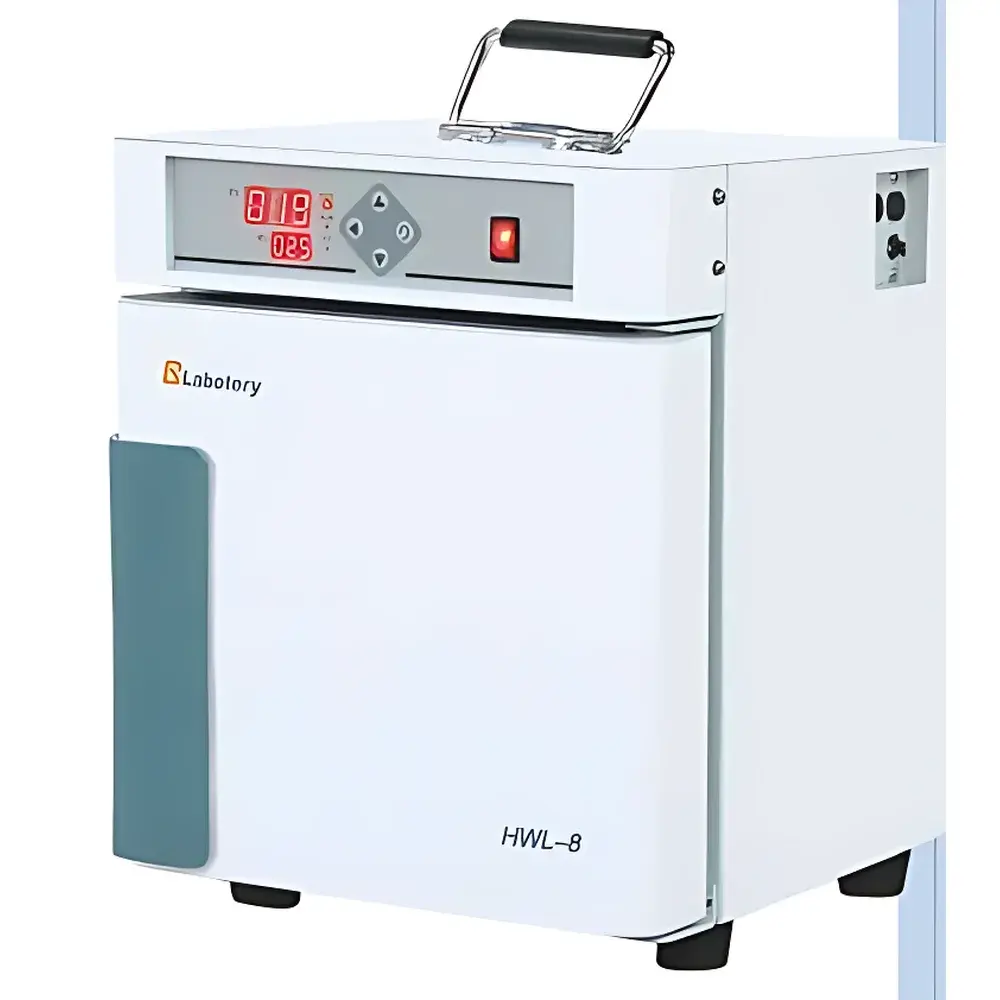
Labotery HWL-8 Portable Constant-Temperature Drying Oven
| Brand | Labotery |
|---|---|
| Origin | Tianjin, China |
| Model | HWL-8 |
| Instrument Type | Standard Benchtop Drying Oven |
| Temperature Range | RT+5°C to 300°C |
| Temperature Uniformity | ±1°C |
| External Dimensions (W×D×H) | 310 × 320 × 400 mm |
| Internal Chamber Dimensions (W×D×H) | 200 × 200 × 200 mm |
| Chamber Material | Mirror-Finish Stainless Steel (SUS304) |
| Heating Method | Encapsulated Tubular Heater |
| Power Supply | 220 VAC, 50 Hz |
| Rated Heating Power | 0.1 kW |
| Max Load Capacity | 10 kg |
| Net Weight | 10 kg |
| Operating Ambient Temperature | 5–40°C |
| Relative Humidity Limit | ≤80% RH (non-condensing) |
Overview
The Labotery HWL-8 Portable Constant-Temperature Drying Oven is a compact, benchtop-grade thermal processing instrument engineered for precise, repeatable drying, baking, sterilization, curing, and low-temperature heat treatment in resource-constrained or mobile laboratory environments. Unlike conventional floor-standing ovens, the HWL-8 employs a vertical, space-optimized architecture with integrated carrying handles and lightweight structural design—enabling seamless deployment in field labs, quality control vans, teaching laboratories, pharmaceutical cleanroom support zones, and R&D satellite stations. Its core thermal regulation system operates on proportional-integral-derivative (PID) feedback control, delivering stable chamber temperature maintenance within ±1°C across its full operating range (RT+5°C to 300°C), verified under standardized empty-chamber test conditions (20°C ambient, 50% RH). The unit complies with general electrical safety requirements per IEC 61010-1 and incorporates fail-safe thermal protection mechanisms aligned with laboratory equipment risk management frameworks.
Key Features
- Compact vertical form factor (310 × 320 × 400 mm external) with ergonomic top-mounted handle for one-handed portability
- Mirror-finish SUS304 stainless steel interior chamber (200 × 200 × 200 mm) ensuring corrosion resistance, easy decontamination, and minimal particulate shedding
- High-efficiency encapsulated tubular heating elements with explosion-resistant sheathing, minimizing thermal inertia and enabling rapid ramp-up
- PID microprocessor-based temperature controller with 1°C resolution, parameter retention across power cycles, and real-time digital LED display
- Integrated safety suite: over-temperature audible/visual alarm, automatic cut-off at preset limit, and thermally insulated door gasket for uniform heat retention
- Adjustable concealed door latch with silicone-sealed compression interface, achieving >95% thermal seal integrity during operation
- Low-power consumption design (0.1 kW rated) compatible with standard 220 VAC/50 Hz supply; optional 12 VDC conversion kit available for vehicle-mounted use
Sample Compatibility & Compliance
The HWL-8 accommodates standard laboratory glassware (e.g., Petri dishes, weighing boats, aluminum sample pans) and small-volume polymer, ceramic, or metal components up to 10 kg total load. It supports ISO 8573-1-compliant drying of moisture-sensitive instrumentation parts and ASTM E145-22 procedures for gravimetric moisture analysis when paired with calibrated analytical balances. While not certified for Class II biological safety or GMP manufacturing environments, its construction and control logic meet baseline GLP documentation requirements for non-critical thermal validation tasks—including calibration record traceability, operator access logs, and deviation flagging. Chamber material compliance adheres to USP for extractables testing of stainless steel surfaces.
Software & Data Management
The HWL-8 operates as a standalone analog-digital hybrid instrument with no embedded network connectivity. All operational parameters—including setpoint, dwell time, and alarm thresholds—are configured locally via tactile membrane keypad. The controller retains last-used settings after power interruption, supporting continuity in multi-shift workflows. For audit-ready documentation, users may integrate the oven into validated environmental monitoring systems via optional 4–20 mA analog output (available upon request). Raw temperature data logging requires external USB or Bluetooth-enabled data loggers compliant with FDA 21 CFR Part 11 for electronic records—no proprietary software or cloud platform dependency is introduced.
Applications
- Drying of filter papers, chromatography media, and desiccated reagents in environmental and food testing labs
- Pre-conditioning of polymeric substrates prior to tensile or adhesion testing (per ASTM D618)
- Thermal stabilization of reference standards and calibration weights before metrological assessment
- Baking of printed circuit board (PCB) assemblies during electronics prototyping
- Moisture content determination in agricultural samples using loss-on-drying methodology (AOAC 950.46)
- Low-temperature sterilization of non-critical lab tools where autoclaving is impractical
- Field-deployable thermal conditioning for geotechnical soil sampling kits and portable sensor calibration rigs
FAQ
Is the HWL-8 suitable for sterilization of medical devices?
No—it lacks validated cycle profiles, steam generation, or vacuum capability required for EN 285 or ISO 17665 compliance. It may be used for dry-heat depyrogenation of glassware only under user-defined, internally validated protocols.
Can the temperature be logged continuously without external hardware?
No—the unit does not feature built-in data storage or serial communication ports. Continuous logging necessitates third-party compliant data acquisition systems.
What is the maximum allowable ambient temperature for continuous operation?
The specified operating range is 5–40°C ambient. Operation above 40°C may compromise PID stability and reduce heater lifespan due to thermal derating.
Does the stainless steel chamber meet USP requirements for pharmaceutical contact surfaces?
Yes—the mirror-finish SUS304 interior satisfies elemental composition and surface finish criteria outlined in USP for non-reactive thermal contact applications.
Is the oven CE-marked for export to the European Union?
The base model is not CE-marked; however, CE-compliant variants with reinforced insulation and updated EMC shielding are available under separate regulatory documentation upon order confirmation.



