
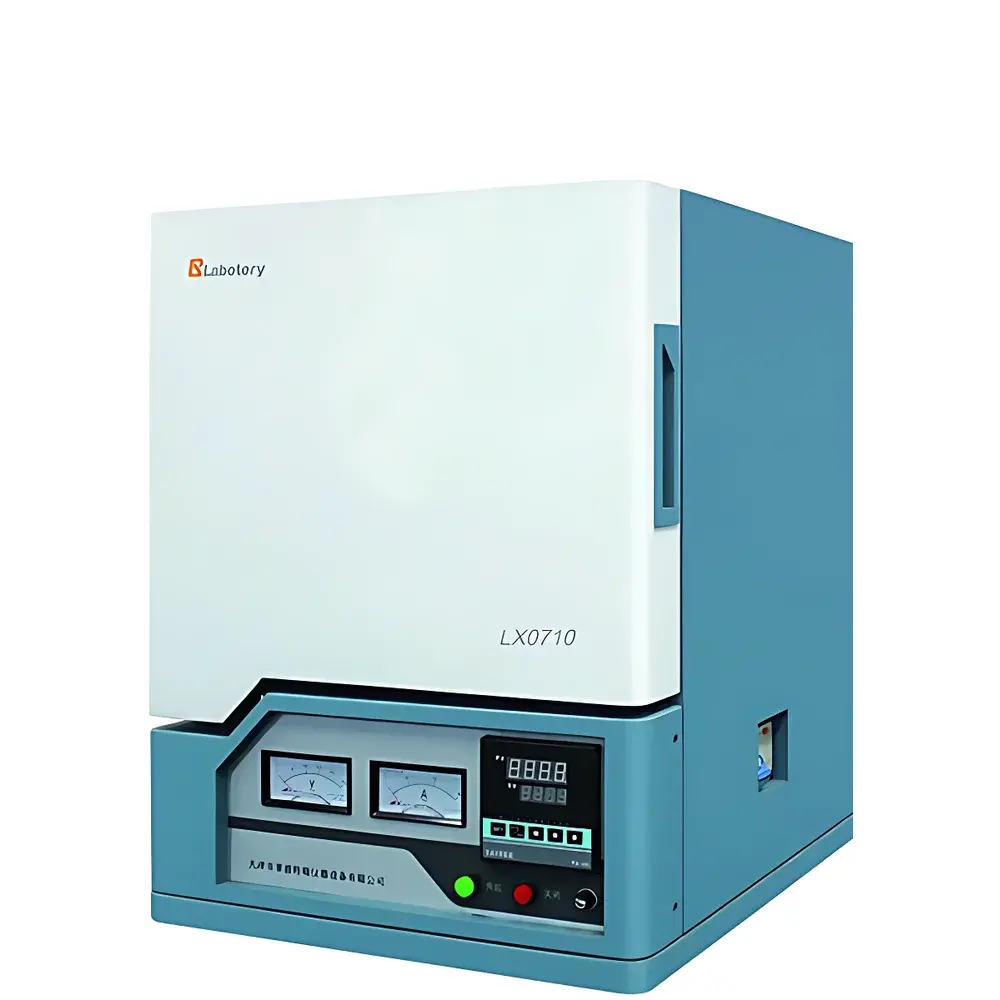
Labotery LX Series Box-Type High-Temperature Resistance Furnace
| Brand | Labotery |
|---|---|
| Origin | Tianjin, China |
| Type | Box-Type Muffle Furnace |
| Models | LX 0211 / LX 0711 / LX 1211 / LX 1811 / LX 3611 / LX 0414 / LX 1314 / LX 1814 |
| Max Temperature | 1200 °C / 1400 °C |
| Temperature Control Accuracy | ±1 °C |
| Max Power | 1.2–10 kW |
| Heating Rate (to Max Temp) | ≤10 °C/min |
| Heating Elements | Kanthal A1 Alloy Wire / Silicon Carbide Rods |
| Internal Chamber Dimensions | 120×200×80 mm to 300×400×300 mm |
| Insulation | Polycrystalline Molybdenum Fiber Blankets |
| Safety Features | Auto Power-Off on Door Opening, Over-Temperature Protection, Leakage Current Protection |
| Control System | Intelligent PID Controller with Fuzzy Logic, Self-Tuning, Parameter Memory, Optional 40-Step Programmable Ramp/Soak Profile |
Overview
The Labotery LX Series Box-Type High-Temperature Resistance Furnace is a precision-engineered thermal processing instrument designed for controlled high-temperature applications in research laboratories, quality control facilities, and industrial R&D environments. Operating on the principle of resistive heating—where electrical energy is converted into thermal energy via high-resistivity elements—the furnace delivers stable, uniform temperature fields across its insulated chamber. Its dual-element architecture supports both Kanthal A1 alloy wire (for ≤1200 °C models) and silicon carbide (SiC) rods (for 1400 °C variants), ensuring long-term stability under cyclic thermal stress. The furnace complies with fundamental safety and performance expectations outlined in IEC 61000-4 (EMC immunity), IEC 60529 (IP20 enclosure rating), and general laboratory equipment guidelines per ISO/IEC 17025–accredited calibration practices. It is routinely deployed in ASTM C114-compliant cementitious material testing, ISO 562 coal ash fusion analysis, USP heavy metal residue determination, and ISO 11358 polymer thermal degradation studies.
Key Features
- Monolithic double-walled steel housing with air-gap insulation and external surface temperature ≤45 °C at full operating temperature—ensuring operator safety and minimizing ambient heat load.
- Polycrystalline mullite fiber (PMF) insulation lining, achieving >60% thermal efficiency improvement over traditional ceramic fiber or firebrick linings; density optimized to minimize thermal mass while maintaining structural integrity at 1400 °C.
- Lateral sliding door mechanism with integrated microswitch interlock: power supply is automatically interrupted upon door displacement exceeding 2 mm, meeting EN 61000-6-2 functional safety requirements for lab instrumentation.
- Dual-stage over-temperature protection: primary control loop (PID-based) backed by independent mechanical limit switch set 25 °C above nominal maximum—preventing uncontrolled thermal runaway during controller failure.
- Intelligent digital controller featuring auto-tuning PID algorithm, real-time deviation compensation, and non-volatile memory for up to 10 user-defined temperature profiles; optional upgrade to 40-segment programmable ramp/soak controller compliant with FDA 21 CFR Part 11 audit trail requirements (electronic signature, event logging, data integrity).
- Front-panel LED display with dual-parameter readout (setpoint/actual temperature), intuitive navigation keys, and status indicators for heating phase, alarm condition, and door position.
Sample Compatibility & Compliance
The LX series accommodates a broad range of sample forms—including crucibles (alumina, quartz, graphite), ceramic boats, metal trays, and refractory containers—within its standardized chamber geometries. All internal dimensions are specified at cold state; dimensional stability is maintained within ±0.3% after 500 thermal cycles (25–1400 °C, 30 min dwell). The furnace meets essential regulatory prerequisites for GLP and GMP-aligned laboratories: traceable calibration certificates (NIST-traceable Pt100 sensor), documented thermal uniformity mapping (±5 °C across working zone per ASTM E220), and CE-marked electrical safety compliance. Note: Natural draft exhaust ports are available only on 1200 °C-rated models (LX 0211–LX 1811); SiC-heated 1400 °C units require forced-air or ducted venting due to elevated radiant flux and NOx generation potential during organic sample combustion.
Software & Data Management
Standard configuration includes RS485 Modbus RTU interface supporting integration into centralized lab monitoring systems (e.g., LabVantage, Thermo Fisher SampleManager). Optional USB-to-RS485 adapter enables direct connection to Windows-based PCs running Labotery FurnaceLog™ v3.2—a validated data acquisition suite that records timestamped temperature, power draw, and alarm events at user-selectable intervals (1–60 s). All exported CSV files include embedded metadata (instrument ID, operator ID, calibration due date) and support 21 CFR Part 11–compliant electronic signatures when paired with domain-authenticated login. Audit trails are immutable, time-stamped, and retain history for ≥12 months without manual intervention.
Applications
- Thermal gravimetric analysis (TGA) pre-conditioning of catalysts and battery electrode materials.
- ISO 1171 ash content determination in coal, biomass, and municipal solid waste.
- ASTM E119 fire resistance testing of construction materials (e.g., intumescent coatings, firestop sealants).
- Controlled oxidation of metallic powders prior to sintering or XRD phase identification.
- Heat treatment of tool steels and stainless alloys per AMS 2750E pyrometry requirements (Class 2 sensor qualification).
- Residue-on-ignition (ROI) assays in pharmaceutical excipient purity testing (USP ).
FAQ
What is the recommended maintenance interval for heating elements?
Kanthal A1 wire elements require visual inspection every 200 operational hours; SiC rods should be checked for surface cracking or resistance drift (>10% increase) every 100 cycles. Replacement is advised when cold resistance exceeds manufacturer-specified tolerance by ±15%.
Can the furnace be operated continuously at maximum temperature?
Yes—models rated for 1200 °C support continuous operation at rated max temperature for up to 1000 hours per element life cycle; 1400 °C units are rated for 500-hour continuous duty under clean-air conditions (≤20 ppm SO2).
Is third-party calibration certification included?
A factory-issued calibration report (traceable to NIST SRM 1750a) is provided with each unit; full ISO/IEC 17025 accreditation requires on-site verification by an accredited lab and is available as a billable service.
How is thermal uniformity validated across the chamber?
Uniformity is verified using a 9-point thermocouple array (Type S, 0.5 mm diameter) mapped at three vertical levels; results are reported in accordance with ASTM E220 Annex A3 and accompany all units shipped to regulated markets.
What ventilation requirements apply during organic sample combustion?
For samples containing halogens, sulfur, or nitrogen compounds, connection to a certified fume hood or dedicated scrubber system is mandatory; internal natural draft ports do not meet OSHA PEL or EU Directive 2004/108/EC emission thresholds for corrosive vapors.



