
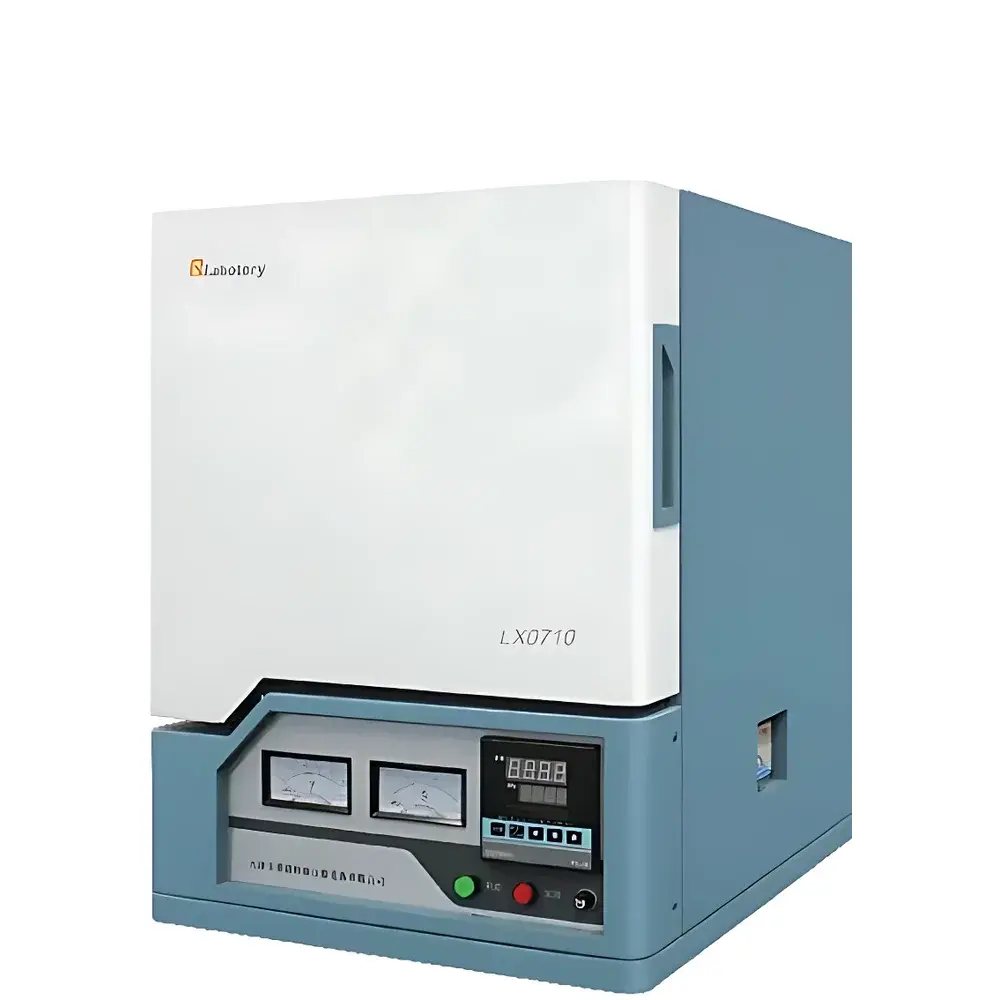
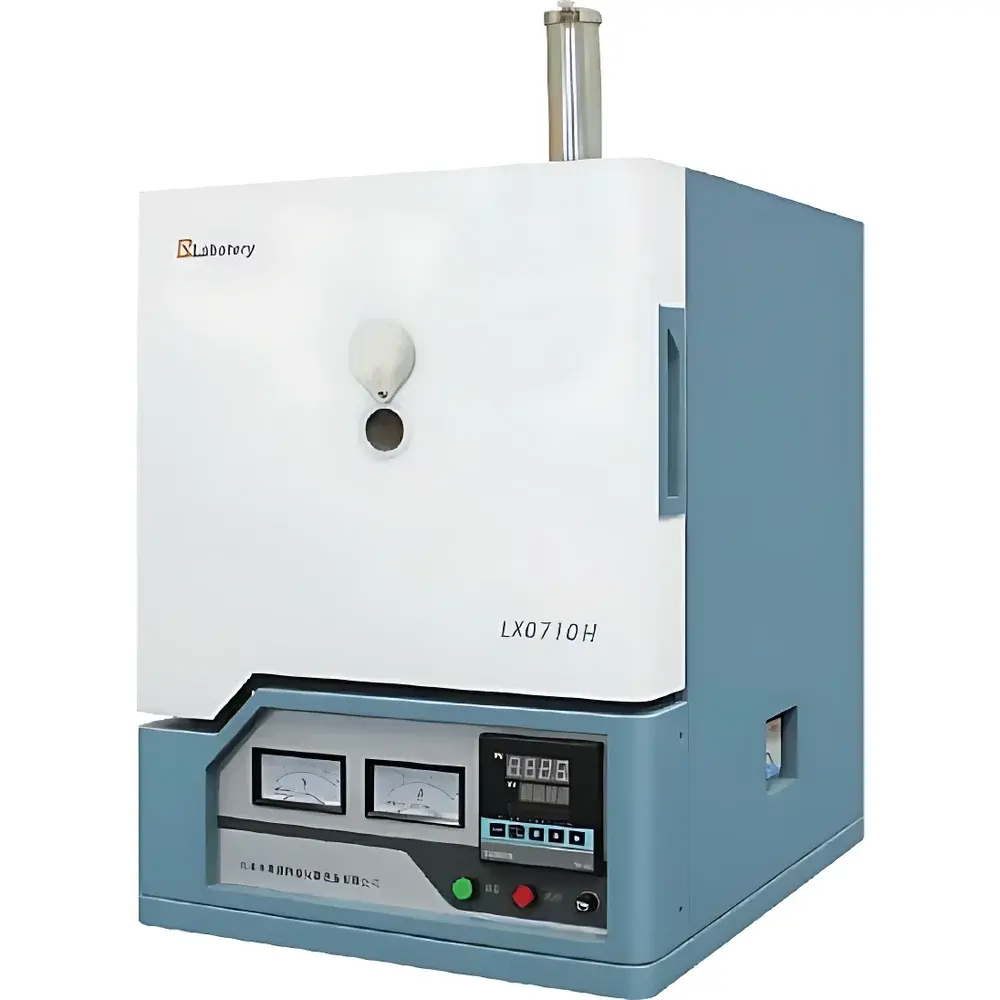
Labotery LX0711 Box-Type High-Temperature Resistance Furnace
| Brand | Labotery |
|---|---|
| Model | LX0711 |
| Type | Box Muffle Furnace |
| Max Temperature | 1200 °C |
| Temperature Control Accuracy | ±1 °C |
| Rated Power | 3000 W |
| Heating Rate to Max Temp | 20 min |
| Heating Element | Alloy Wire |
| Internal Chamber Dimensions | 200 × 300 × 120 mm (L×W×H) |
| Compliance | JB/T 8195.7–2007, GB/Z 18–2002 |
| Safety Features | Auto-Door Cut-off, Over-Temperature Protection, Leakage Current Protection, Dual-Skin Air-Cooled Casing |
Overview
The Labotery LX0711 Box-Type High-Temperature Resistance Furnace is a precision-engineered laboratory muffle furnace designed for controlled thermal processing in research, quality assurance, and industrial R&D environments. It operates on the principle of resistive heating via high-stability alloy wire elements, delivering uniform temperature distribution across its insulated chamber. Engineered for reproducible thermal treatment—such as ashing, sintering, annealing, calcination, and heat-treatment validation—the LX0711 conforms to internationally recognized standards for indirect resistance furnaces (JB/T 8195.7–2007) and thermal safety design (GB/Z 18–2002). Its maximum operating temperature of 1200 °C supports applications ranging from ceramic densification to metallurgical phase transformation studies, while the ±1 °C control accuracy ensures compliance with method-critical thermal protocols in GLP and GMP workflows.
Key Features
- Patented one-piece monolithic furnace body construction, minimizing thermal bridging and enhancing structural integrity.
- High-efficiency multi-crystalline mullite fiber insulation—vacuum-formed for low thermal mass—enabling rapid ramp rates (≤20 min to 1200 °C) and reducing energy consumption by >60% versus conventional refractory-lined units.
- Dual-layer steel casing with active air-gap thermal isolation; integrated thermal-sensing circuitry triggers automatic cooling fans when external surface temperature exceeds 45 °C, maintaining safe operator interface conditions.
- Side-sliding door mechanism engineered to position the hot inner face away from personnel during access—eliminating direct contact risk per GB/Z 18–2002 ergonomic safety requirements.
- Comprehensive electrical safety architecture: door-interlocked power cutoff, independent over-temperature cutout with audible/visual alarm, and residual-current device (RCD) protection against ground leakage.
- Intelligent PID-based temperature controller with self-tuning algorithm, fuzzy logic compensation, and power-failure parameter retention—ensuring uninterrupted thermal profiles during transient grid events.
Sample Compatibility & Compliance
The LX0711 accommodates crucibles, boats, and sample holders up to 200 × 300 × 120 mm (internal chamber), supporting standard platinum, alumina, silicon carbide, and quartz ware. Its inert muffle environment—free of combustion byproducts—ensures contamination-free processing for ASTM E167, ISO 562, USP , and coal ash content (ASTM D3174) analyses. All thermal performance metrics—including uniformity (±5 °C within working zone at 1100 °C), stability (±0.5 °C over 2 h), and recovery time (<3 min after door opening)—are verified per JB/T 8195.7–2007 test procedures. The unit is suitable for installation in ISO/IEC 17025-accredited labs and supports audit-ready documentation for FDA 21 CFR Part 11–compliant data systems when paired with optional programmable controllers.
Software & Data Management
While the base LX0711 features a standalone digital controller with manual setpoint operation, two optional upgrade paths enable full thermal protocol automation: a domestic 40-segment programmable controller (with RS485 Modbus RTU output) and an imported 40-segment system offering enhanced logging resolution (0.1 °C/1 s), CSV export, and integration into LIMS or SCADA platforms. Both options provide timestamped event logs—including door open/close, alarm triggers, and setpoint changes—required for GLP traceability and internal QA audits. Optional natural flue configuration (part no. 300) facilitates continuous off-gas venting during volatile residue analysis without compromising chamber integrity.
Applications
- Thermal gravimetric analysis (TGA) sample pre-conditioning and residue quantification in environmental and pharmaceutical labs.
- Metallurgical annealing and stress-relief treatments for small-scale alloy samples under inert or air atmospheres.
- Sintering of advanced ceramics, battery cathode precursors, and MOF-derived catalysts requiring precise ramp-hold-cool cycles.
- Coal and coke proximate analysis per ASTM D3172–D3176, including moisture, volatile matter, fixed carbon, and ash determination.
- Calibration verification of thermocouples and reference materials using certified temperature plateaus (e.g., Zn, Al, Ag fixed points).
- Quality control testing of refractory linings, fireproofing composites, and thermal barrier coatings under standardized heating schedules.
FAQ
What is the recommended maintenance interval for the LX0711 furnace?
Routine inspection of door gasket integrity, heating element continuity, and fan operation is advised every 200 operational hours or quarterly—whichever occurs first. Annual calibration verification against NIST-traceable reference thermocouples is recommended for regulated environments.
Can the LX0711 operate continuously at 1200 °C?
Yes, the furnace is rated for continuous operation at its maximum temperature; however, sustained use above 1100 °C may reduce heating element service life. For optimal longevity, prolonged runs are best conducted at ≤1100 °C unless process requirements mandate higher temperatures.
Is the internal chamber atmosphere controllable?
The standard LX0711 operates in ambient air. Optional inert gas inlet ports (not included) can be retrofitted to support nitrogen or argon purging for oxygen-sensitive processes—subject to third-party engineering review and local safety approval.
Does the unit comply with electromagnetic compatibility (EMC) directives?
The LX0711 meets China’s GB/T 18268.1–2010 requirements for laboratory equipment EMC. CE marking is not applicable; users requiring EU conformity must engage a Notified Body for full EN 61326-1 assessment prior to import.
How is temperature uniformity validated across the working zone?
Uniformity is measured per JB/T 8195.7–2007 using nine calibrated thermocouples positioned on a 3×3 grid at mid-height. Results are documented in the factory test report shipped with each unit and available upon request.
Related Products



