
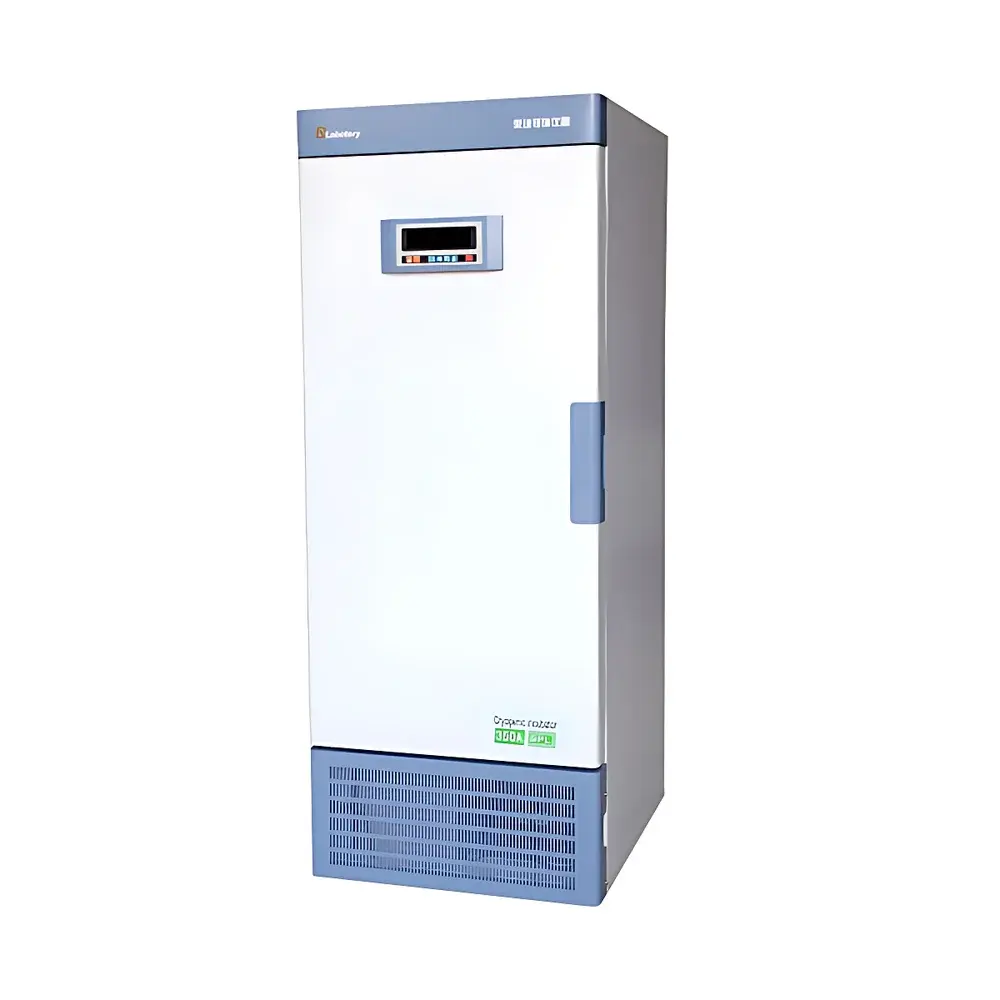
Labotery SPL-350A Low-Temperature Incubator Chamber
| Brand | Labotery |
|---|---|
| Model | SPL-350A |
| Temperature Range | −20 °C to +65 °C |
| Temperature Resolution | 0.1 °C |
| Temperature Uniformity & Fluctuation | ±0.3 °C |
| Heating Rate | 1–3 °C/min |
| Cooling Rate | 0.7–1 °C/min |
| Working Chamber Dimensions (W×D×H) | 550 × 550 × 1140 mm |
| External Dimensions (W×D×H) | 690 × 820 × 1800 mm |
| Power Supply | 220 V, 50 Hz |
| Input Power | 2.0 kW |
| Refrigerant | R-404A (eco-friendly) |
| Standard Shelving | 3 adjustable stainless-steel shelves |
| Safety Features | Over-temperature alarm, leakage protection, auto-defrost, power-fail recovery, parameter memory, scheduled on/off |
Overview
The Labotery SPL-350A Low-Temperature Incubator Chamber is a precision-engineered environmental test chamber designed for stable, long-term temperature-controlled storage and biological incubation under sub-zero conditions. Operating across a validated range of −20 °C to +65 °C, it employs a dual-stage refrigeration system with R-404A refrigerant and a high-efficiency condenser-fan assembly to ensure consistent thermal performance in demanding laboratory environments. Unlike general-purpose refrigerated cabinets, this unit integrates active air circulation via a centrifugal blower, enabling uniform temperature distribution (±0.3 °C) and rapid thermal response—critical for applications requiring strict adherence to ISO 17025-compliant environmental conditioning protocols or USP cold-chain validation studies. Its architecture complies with IEC 61000-4 electromagnetic compatibility standards and meets mechanical safety requirements per IEC 61010-1 for laboratory equipment.
Key Features
- Mirror-polished, seamless stainless-steel inner chamber (AISI 304) with fully radiused corners to eliminate microbial harborage zones and facilitate ISO 13485-compliant cleaning validation.
- PID-based microprocessor controller supporting both single-setpoint (constant-temp) and multi-segment programmable operation—enabling automated temperature ramping, dwell, and cycling sequences per ASTM E1545 or ICH Q5C stability testing guidelines.
- 7-inch full-color TFT-LCD touchscreen interface with intuitive menu navigation, real-time graphing of chamber temperature vs. time, and on-screen data logging (up to 10,000 records).
- Dual-door structure with magnetic silicone gasket and low-emissivity double-glazed observation window—minimizing thermal intrusion during visual inspection and reducing energy consumption by >22% versus single-door designs.
- Integrated UV-C germicidal lamp (254 nm) and interior LED illumination, both controllable via the main interface for routine decontamination and sample observation without opening the chamber.
- Comprehensive safety suite: over-temperature cut-off (independent hardware thermostat), ground-fault circuit interrupter (GFCI), auto-defrost cycle management, and brownout recovery with parameter retention.
- Left-side access port (φ50 mm) fitted with silicone plug—compatible with external temperature probes, humidity sensors, or gas analyzers for multi-parameter environmental monitoring per ISO 14644-3 cleanroom qualification workflows.
Sample Compatibility & Compliance
The SPL-350A accommodates a broad spectrum of temperature-sensitive materials, including but not limited to: lyophilized pharmaceuticals, cryopreserved cell lines (e.g., primary hepatocytes, PBMCs), diagnostic reagents (ELISA kits, monoclonal antibodies), nutrient agar and Mueller-Hinton media, and reference standards for QC/QA laboratories. Its chamber volume (350 L net) and three-tier adjustable shelving system support heterogeneous load configurations while maintaining spatial uniformity. The unit is designed to operate within ambient conditions of 5–35 °C and ≤70% RH (non-condensing), conforming to GLP Annex 11 data integrity expectations when paired with optional USB data export or RS-485 remote supervision. All electrical components meet CE marking requirements and RoHS Directive 2011/65/EU restrictions on hazardous substances.
Software & Data Management
- Onboard data logger stores timestamped temperature readings at user-selectable intervals (1 s to 60 min), with automatic overwrite protection and CSV export via USB 2.0 port.
- Optional RS-485 Modbus RTU interface enables integration into centralized lab infrastructure (e.g., LabVantage LIMS, Siemens Desigo CC) for audit-trail-enabled monitoring per FDA 21 CFR Part 11 requirements.
- Optional thermal printer module provides hard-copy output of real-time traces and event logs—including door-open alerts, alarm triggers, and defrost cycles—for SOP-driven documentation.
- Firmware supports firmware-over-the-air (FOTA) updates via secure HTTPS endpoint, ensuring continued alignment with evolving regulatory guidance such as WHO TRS 961 Annex 9 on cold chain management.
Applications
This incubator serves critical roles across regulated and research-intensive domains: microbiological culture maintenance at defined hypothermic setpoints (e.g., Listeria monocytogenes viability assays at 4 °C); accelerated stability testing of biologics per ICH Q1A(R3); cold-chain validation for vaccine transport containers; cryoprotectant optimization studies; and environmental stress screening of electronic components per MIL-STD-810H Method 502.7. Its thermal stability and repeatability make it suitable for use as a reference chamber in inter-laboratory comparison exercises coordinated under ILAC P14 or EURACHEM/CITAC guides.
FAQ
What is the verified temperature uniformity across the working chamber?
Measured per ISO 16744:2016 using nine calibrated PT100 sensors in a 3×3 grid, uniformity is ±0.3 °C at −20 °C and +37 °C under no-load conditions.
Does the unit support 21 CFR Part 11-compliant electronic records?
When equipped with the RS-485 module and validated third-party software (e.g., LabArchives eLogbook), full audit trail, role-based access control, and digital signature capability are achievable.
Can the chamber maintain −20 °C continuously in a 35 °C ambient room?
Yes—thermal load testing confirms sustained operation at −20 °C with ≤1.2 °C deviation during 72-hour continuous runtime at maximum ambient specification.
Is calibration certification included with delivery?
A factory-issued NIST-traceable calibration report (covering chamber setpoint accuracy and uniformity at −20 °C, 0 °C, and +37 °C) is provided standard; UKAS-accredited field calibration services are available upon request.



