
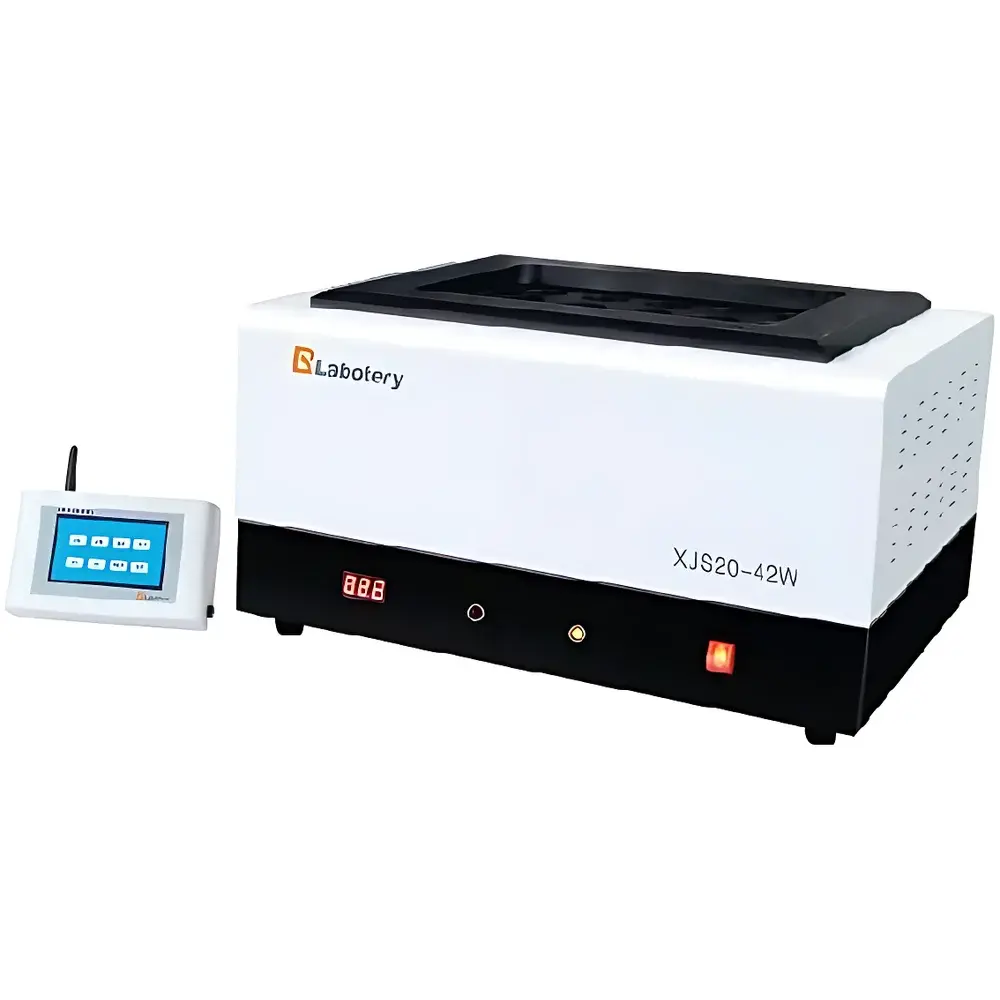
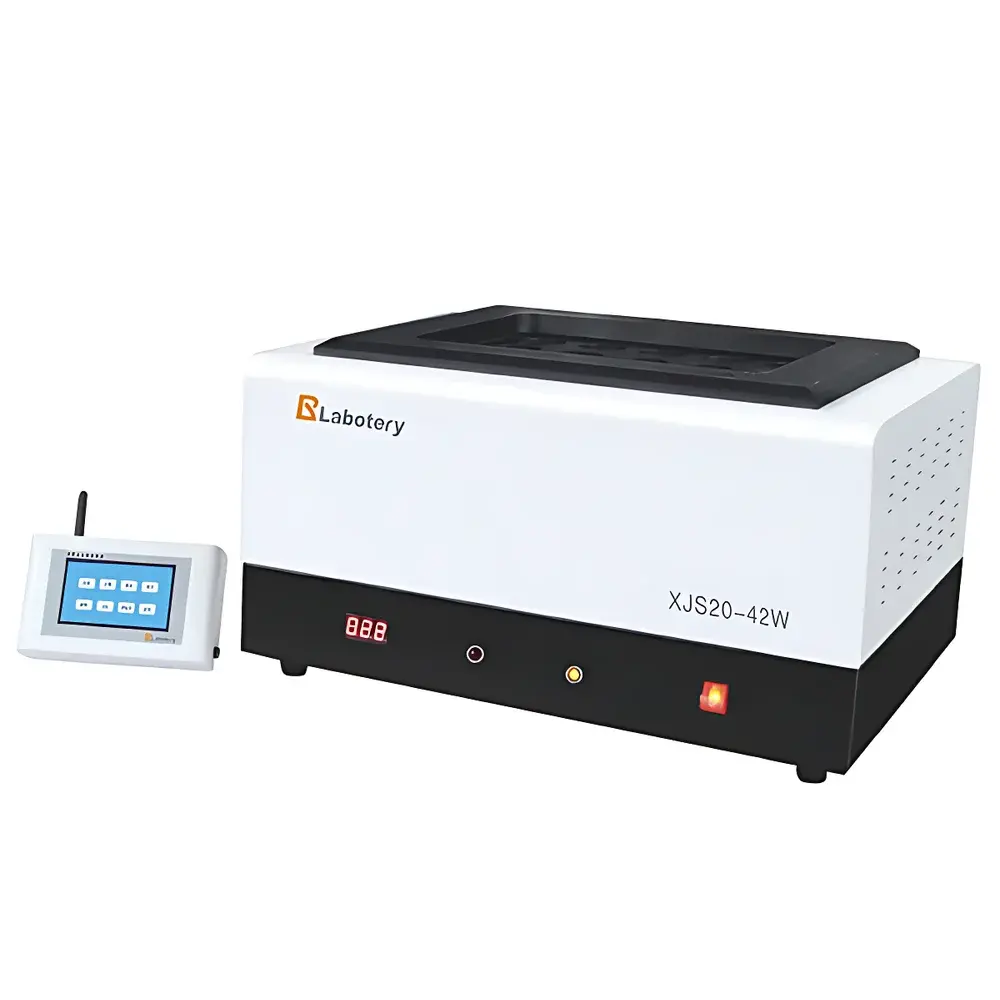
Labotery XJS36-42W Wireless Smart Graphite Block Digestion System
| Brand | Labotery |
|---|---|
| Origin | Tianjin, China |
| Model | XJS36-42W |
| Automation Level | Fully Automatic |
| Digestion Positions | 24 |
| Max Heating Temperature | 360 °C |
| Temperature Control Accuracy | ±0.2 °C |
| Heating Principle | High-Purity Graphite Block with PTFE Coating |
| Reagent Channels | 36 |
| Power Supply | 220 V / 50 Hz |
| Sample Capacity | 42 × 50 mL (compatible with standard digestion tubes) |
| Temperature Resolution | 0.1 °C |
| Inter-Position Uniformity | ±1.5 °C |
| Single-Position Temp. Stability | ±0.5 °C |
| Operating Ambient | 5–25 °C |
| Continuous Operation Duration | >48 h |
Overview
The Labotery XJS36-42W Wireless Smart Graphite Block Digestion System is a fully automated, benchtop sample preparation instrument engineered for high-throughput, reproducible acid digestion of environmental, geological, food, and biological matrices under atmospheric pressure. It employs a high-purity graphite heating block with electropolished PTFE coating to deliver uniform thermal distribution across all 24 digestion positions—enabling simultaneous processing of up to 42 × 50 mL samples via optimized tube arrangement. Unlike traditional hot plates or ceramic heaters, the graphite block architecture ensures rapid heat transfer, minimal thermal lag, and exceptional resistance to corrosion from HNO3, HCl, HF, and H2O2. The system operates on the principle of conductive heating, where temperature is regulated in real time using dual independent sensors—one embedded in the graphite block and one immersed directly in the sample solution (rated to 210 °C)—allowing users to select either reference point for closed-loop control. Designed for compliance with routine laboratory workflows, it supports open-vessel digestion protocols aligned with EPA Method 3050B, ISO 11466, and GB/T 5009 series standards.
Key Features
- Fully wireless operation via handheld tablet PC—enabling remote monitoring and control outside fume hoods, eliminating operator exposure to corrosive vapors and thermal hazards
- 4.3-inch full-color resistive touchscreen controller with 7 preloaded digestion method templates and up to 40 programmable temperature segments per method
- Real-time graphical display of temperature curves, elapsed time, ramp rate, hold duration, and active program status
- Dual-sensor temperature feedback system: block-integrated RTD + optional submersible probe for direct sample temperature validation
- Optimized reflux vent design reduces reagent consumption by ~50% compared to conventional open-digestion setups, while maintaining effective vapor condensation and acid recovery
- Integrated “one-vessel workflow” capability: digestion, acid evaporation (ashing), and final volume adjustment can be completed sequentially in the same digestion tube—minimizing cross-contamination and manual handling
- Advanced safety architecture including over-temperature audiovisual alarm, automatic power cutoff at 365 °C, and thermal runaway protection
- Energy-efficient insulation using multi-layer ceramic fiber composite—reducing standby heat loss and improving thermal stability during extended runs (>48 h continuous operation verified)
Sample Compatibility & Compliance
The XJS36-42W accommodates standard borosilicate glass or quartz digestion tubes (Φ31 mm × 50 mm or Φ44 mm × 50 mm), compatible with common digestion vessels used in ICP-OES, ICP-MS, AAS, and ion chromatography sample introduction. Its PTFE-coated graphite surface resists degradation from concentrated mineral acids, including hydrofluoric acid (HF) solutions up to 5% v/v. The system meets mechanical and electrical safety requirements per IEC 61010-1:2010 and is suitable for laboratories operating under GLP and ISO/IEC 17025 quality frameworks. While not certified to FDA 21 CFR Part 11 out-of-the-box, audit trails, user access logs, and electronic signature support can be implemented via optional software integration with LIMS platforms.
Software & Data Management
The embedded controller stores method parameters, run history, and temperature profiles locally with timestamped records. All methods are exportable as CSV files for traceability and regulatory reporting. Optional Ethernet or USB data export enables synchronization with laboratory information management systems (LIMS). No proprietary cloud service is required; data remains resident on-device unless explicitly transferred. Firmware updates are delivered via secure USB stick—ensuring air-gapped environments maintain integrity without internet dependency. The interface supports multilingual labels (English default) and complies with WCAG 2.1 AA contrast and navigation guidelines for accessibility.
Applications
- Heavy metal analysis (Pb, Cd, As, Cr, Hg) in soil, sediment, and sludge per EPA 3050B and ISO 11466
- Nutrient digestion (K, Ca, Mg, P) in plant tissue and agricultural feedstuffs
- Trace element quantification in seafood, dairy, and infant formula under GB 5009.12–5009.268
- Preparation of calibration standards and QC reference materials requiring matrix-matched digestion
- Method development for novel sample types—including polymer composites and electronic waste leachates—where controlled ramping and precise endpoint holding are critical
FAQ
Is the system compatible with hydrofluoric acid (HF)?
Yes—the PTFE-coated graphite block and sealed sensor housings are chemically resistant to HF concentrations up to 5% v/v when used with appropriate tube materials (e.g., PFA or quartz). Always verify tube compatibility separately.
Can digestion methods be validated for regulatory submissions?
Method parameters (ramp rates, hold times, final temperatures) are fully configurable and logged with timestamps. When paired with documented SOPs and analyst training records, the system supports method validation per ICH Q2(R2) and ISO/IEC 17025 clause 7.2.2.
What maintenance is required for long-term reliability?
Annual inspection of graphite block integrity, sensor calibration verification (using NIST-traceable reference thermometers), and cleaning of ventilation grilles with non-abrasive solvents. No consumable parts require scheduled replacement under normal use.
Does the wireless controller support multiple users with role-based access?
The base firmware supports password-protected administrator and operator modes. Full RBAC (role-based access control) with audit logging requires integration with external LIMS or custom middleware—available upon request.
How is temperature uniformity verified across all 24 positions?
Labotery provides a factory calibration certificate showing inter-position deviation ≤±1.5 °C at 120 °C and 250 °C, measured using 24-channel calibrated thermocouples per ASTM E220. Users may perform in-house verification using a portable multi-point thermometer kit.
Related Products



