
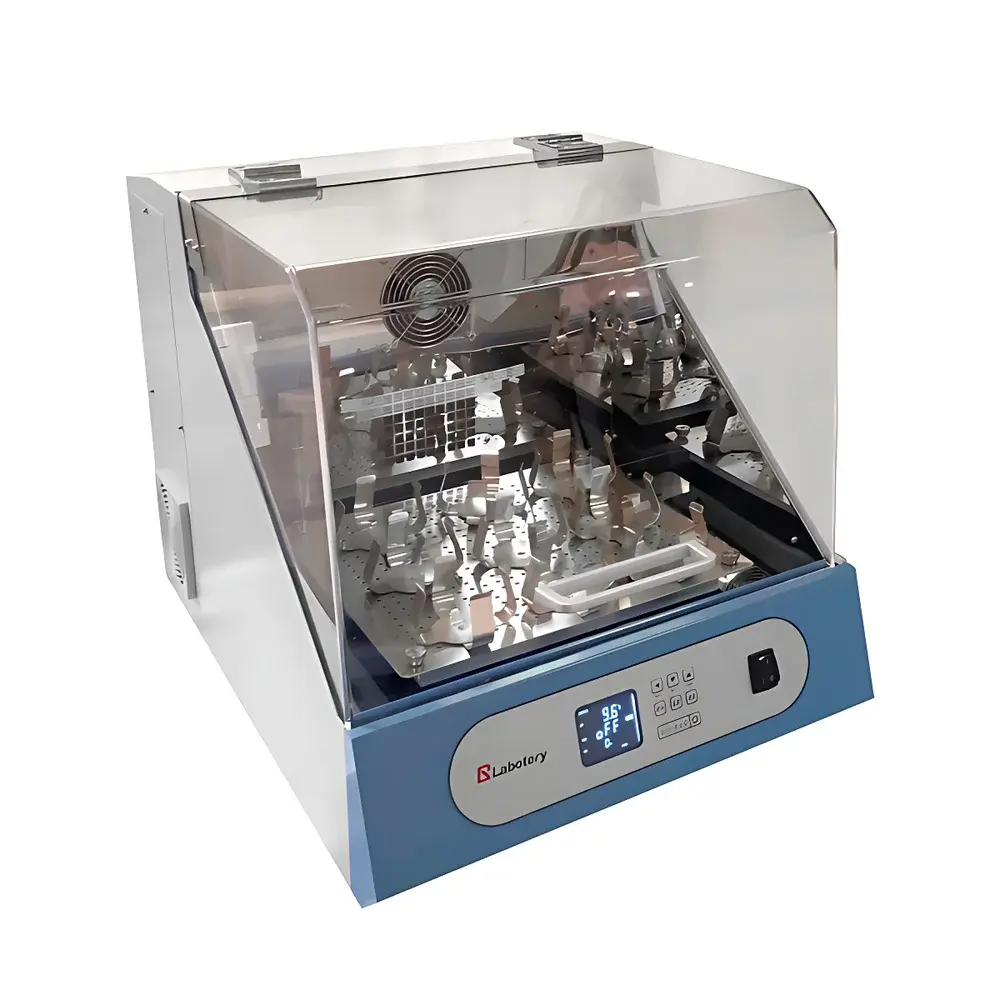
Labotery ZHP-100G Benchtop Orbital Shaking Incubator
| Brand | Labotery |
|---|---|
| Origin | Tianjin, China |
| Model | ZHP-100G |
| Temperature Range | Ambient +5°C to 60°C |
| Temperature Uniformity | ±0.3°C (at 37°C) |
| Humidity Range | 20–50% RH |
| Chamber Capacity | 100 L |
| Orbital Speed | 30–400 rpm |
| Speed Accuracy | ±1 rpm |
| Orbit Diameter | Φ0–50 mm (continuously adjustable) |
| Shelf Dimensions | 400 × 370 mm |
| Max Load Capacity | 100 mL × 23 or 250 mL × 16 or 500 mL × 9 or 1000 mL × 5 or 2000 mL × 4 |
| Timer Range | 0–999.9 min |
| Power Consumption | 0.8 kW |
| Input Voltage | AC 220 V ±10%, 50–60 Hz |
| External Dimensions | 550 × 780 × 640 mm |
| Temperature Resolution | 0.1°C |
| Temperature Stability | ±0.3°C (at 37°C) |
| Safety Features | Door-activated stop, over-temperature alarm & auto cut-off, motor over-current protection, power failure memory, self-diagnostic system |
| Control Interface | Full-color LCD touchscreen with navigational soft keys |
| Drive System | Brushless DC servo motor with reversible programmable operation (forward/reverse/stop cycles) |
| Air Circulation | Forced convection via optimized ducted airflow path |
Overview
The Labotery ZHP-100G Benchtop Orbital Shaking Incubator integrates precise temperature control, programmable orbital agitation, and robust environmental stability into a compact 100 L chamber—engineered for reproducible microbial growth, cell culture expansion, enzyme assays, and biochemical reaction kinetics under controlled aerobic conditions. Its core operational principle combines Peltier-assisted or resistive heating (depending on ambient conditions) with forced-air convection and closed-loop PID temperature regulation to maintain thermal homogeneity across the entire working volume. The orbital shaking mechanism employs a brushless DC servo motor driving a single large-format platform (400 × 370 mm), delivering smooth, low-vibration motion at speeds from 30 to 400 rpm with ±1 rpm repeatability. This architecture supports oxygen transfer optimization in liquid cultures while minimizing shear stress—a critical requirement for sensitive eukaryotic cells and recombinant protein expression systems.
Key Features
- Brushless DC servo motor drive ensures maintenance-free operation, extended service life (>20,000 hr MTBF), and precise bidirectional control—enabling user-defined forward/reverse/stop sequences with segment-specific timing (0.1–999.9 min per phase)
- Full-color LCD touchscreen interface with intuitive navigation menus simplifies parameter entry, real-time monitoring, and protocol recall—supporting up to 10 stored multi-step programs
- Optimized air circulation design utilizes a directional ducted flow path to achieve ±0.3°C temperature uniformity at 37°C across the full 100 L chamber volume
- Comprehensive safety architecture includes door-interlocked motion cessation, over-temperature cutoff with audible/visual alarm, motor over-current protection, and non-volatile memory retention during unexpected power loss
- Orbit diameter continuously adjustable from Φ0 to Φ50 mm to accommodate varying vessel geometries and mixing intensities—ideal for flasks, tubes, and deep-well plates
- High-resolution temperature control (0.1°C setpoint increment) with stability maintained within ±0.3°C at nominal incubation temperatures
Sample Compatibility & Compliance
The ZHP-100G accommodates standard laboratory vessels including Erlenmeyer flasks (100–2000 mL), test tubes, and microtiter formats, with maximum loading configurations supporting up to 23 × 100 mL flasks or 4 × 2000 mL bottles per cycle. Its humidity range (20–50% RH) is calibrated for non-condensing applications where evaporation control is secondary to thermal and mechanical consistency—suitable for long-term bacterial fermentations, yeast propagation, and suspension-based mammalian culture pre-expansion. While not certified for ISO 13485 or FDA 21 CFR Part 11 compliance out-of-the-box, the system’s audit-ready features—including timestamped event logging (power failure, door opening, alarm triggers), programmable lockout modes, and immutable parameter history—facilitate integration into GLP/GMP-aligned workflows when paired with validated SOPs and external data archiving protocols.
Software & Data Management
The embedded firmware records all operational events—including temperature deviations, speed fluctuations, door status transitions, and alarm activations—with timestamps compliant with ISO/IEC 17025 traceability requirements. No proprietary PC software is required for basic operation; however, optional RS-485 or USB-to-serial interfaces enable connection to third-party SCADA or LIMS platforms for centralized monitoring and CSV export of time-series temperature/shaking logs. All settings are retained in EEPROM memory, ensuring protocol integrity after reboot or grid interruption without manual reconfiguration.
Applications
- Aerobic cultivation of Escherichia coli, Bacillus subtilis, and other mesophilic bacteria for plasmid amplification and protein expression
- Pre-culture expansion of CHO, HEK293, and insect cell lines prior to bioreactor inoculation
- Enzymatic hydrolysis studies requiring simultaneous thermal stabilization and gentle mixing
- Environmental microbiology assays involving soil or water sample enrichment under standardized agitation
- Antibiotic susceptibility testing using broth microdilution formats with orbital agitation
- Yeast fermentation optimization for ethanol or metabolite production
FAQ
What is the maximum flask size supported on the ZHP-100G platform?
The unit accommodates up to four 2000 mL Erlenmeyer flasks simultaneously, provided they are evenly distributed and secured with appropriate clamps.
Does the incubator support CO₂ or O₂ control?
No—this model is designed for ambient-air environments only and does not include gas blending, humidification beyond 50% RH, or CO₂ sensing capabilities.
Can the shaking direction be reversed mid-program?
Yes—the brushless motor enables fully programmable reversal sequences, with independent duration and speed settings for each forward/reverse/stop segment.
Is calibration documentation available for regulatory submissions?
Factory calibration certificates (temperature and speed) are provided upon request; users must perform periodic verification per internal quality procedures or ISO/IEC 17025 guidelines.
What maintenance is required for long-term reliability?
No routine lubrication or belt replacement is needed; annual verification of temperature uniformity and speed accuracy using NIST-traceable sensors is recommended.





