
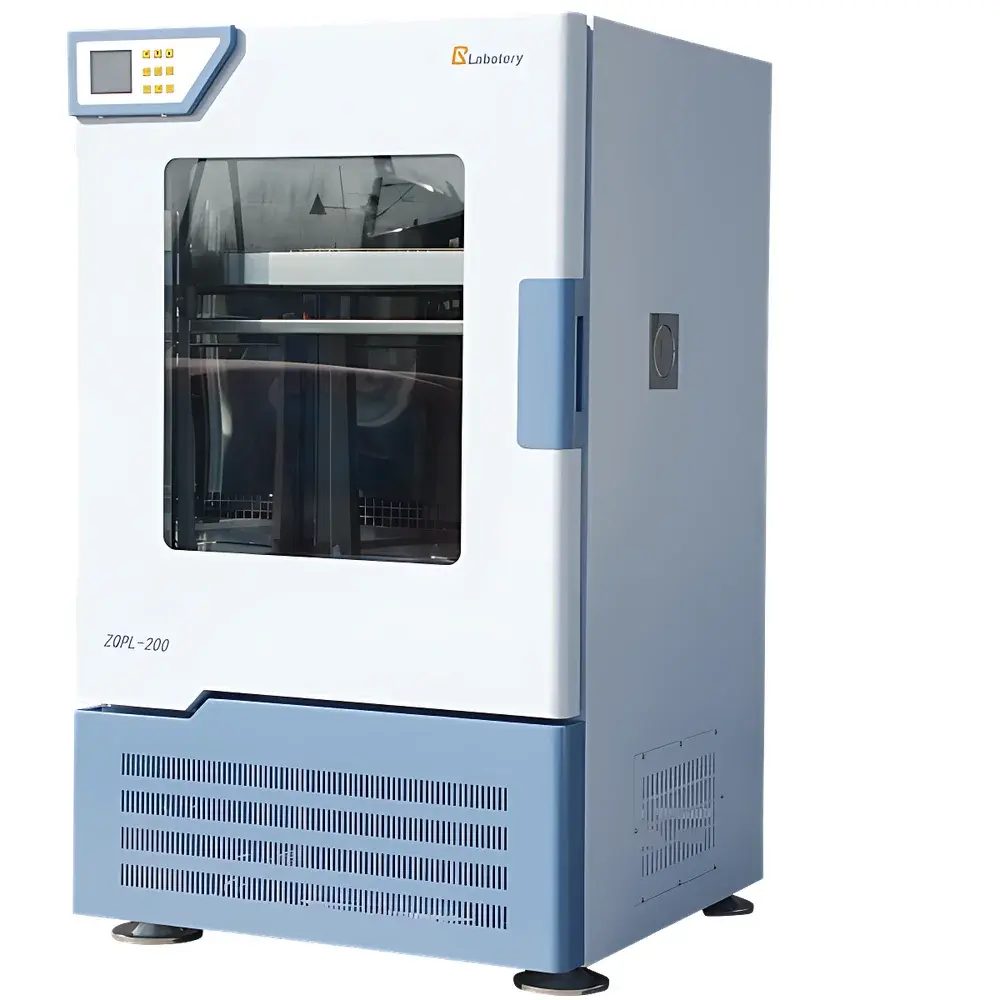
Labotery ZHPL-200 / ZQPL-200 Vertical Orbital Shaking Incubator
| Brand | Labotery |
|---|---|
| Origin | Tianjin, China |
| Model | ZHPL-200 (Heating-only), ZQPL-200 (Heating & Refrigeration) |
| Temperature Range | 4–65°C |
| Oscillation Frequency | 10–300 rpm ±1 rpm |
| Amplitude | Ø26 mm |
| Timer Range | 0–9999 minutes/hours |
| Shelf Quantity | 2 |
| Shelf Dimensions | 439 × 528 mm |
| Power Consumption | 11.3 kW |
| Input Voltage | AC 220 V ±10%, 50–60 Hz |
| External Dimensions (W×D×H) | 740 × 730 × 1235 mm |
| Temperature Uniformity | ±0.5°C at 37°C |
| Temperature Stability | ±0.3°C at 37°C |
| Control System | PID microcomputer with LCD or color touchscreen interface |
| Cooling System | R134a-free compressor with dust-filtered airflow and cross-flow air duct design |
| Drive Mechanism | Brushless servo motor with eccentric triple-wheel drive |
| Safety Features | Door interlock stop, over-temperature audiovisual alarm + auto power cutoff, motor overcurrent protection, self-diagnostic fault reporting, power-loss memory |
| Sterilization | Built-in UV lamp |
| Optional Interfaces | RS-485 remote control, USB data export, thermal printer module |
Overview
The Labotery ZHPL-200 and ZQPL-200 are vertically configured orbital shaking incubators engineered for precise temperature-controlled cultivation and agitation of biological samples under controlled environmental conditions. Designed for rigorous laboratory workflows in microbiology, molecular biology, biopharmaceutical development, and cell-based assay optimization, these units integrate dual-shelf orbital shaking with high-fidelity thermal regulation. The ZHPL-200 operates in heating-only mode (ambient +5°C to 65°C), while the ZQPL-200 extends operational range down to 4°C via a fluorocarbon-free refrigeration system—enabling low-temperature fermentation, cold-adapted enzyme studies, and thermosensitive protein expression protocols. Both models employ a PID-controlled microprocessor architecture that maintains thermal stability within ±0.3°C at 37°C and uniformity within ±0.5°C across the chamber volume, validated under ISO/IEC 17025-aligned test conditions (20°C ambient, 50% RH, empty chamber). The orbital motion—generated by a brushless servo motor and transmitted through a three-point eccentric cam drive—ensures consistent, low-vibration agitation without mechanical backlash or torque decay over extended duty cycles.
Key Features
- Dual-tier stainless steel shelves (439 × 528 mm each) with independent load capacity up to 2000 mL × 6 per shelf, accommodating standard Erlenmeyer flasks, culture bottles, and multi-well plates.
- Reinforced tempered glass door with integrated LED illumination and Ø30 mm access port for real-time probe insertion, gas exchange, or continuous monitoring without thermal disruption.
- Optimized airflow architecture featuring wide-range cross-flow ducting and rear-mounted fan array ensures homogeneous temperature distribution and minimizes stratification effects during prolonged incubation.
- UV-C sterilization module (254 nm) mounted inside the chamber enables routine decontamination between runs—critical for GLP-compliant cell culture and QC microbiology applications.
- Programmable oscillation logic supports bidirectional sequencing: users may define alternating forward/reverse/stop phases with individually adjustable durations and speed profiles—essential for shear-sensitive suspension cultures or synchronized metabolic cycling experiments.
- Comprehensive safety architecture includes door-activated motion interlock, over-temperature cut-off with audible/visual alert, motor overcurrent protection, and non-volatile memory retention for all setpoints and runtime logs following unexpected power loss.
- Two control interface options: high-contrast monochrome LCD with tactile keypad, or full-color capacitive touchscreen supporting intuitive drag-and-drop protocol editing and real-time parameter overlay.
Sample Compatibility & Compliance
The ZHPL/ZQPL series accommodates common laboratory vessels including 100–2000 mL glass and PETG flasks, baffled shake flasks, roller bottles, and deep-well microplates—validated for use with bacterial (E. coli, Bacillus spp.), yeast (S. cerevisiae, P. pastoris), mammalian (CHO, HEK293), and insect cell lines. Chamber construction uses medical-grade 304 stainless steel interior surfaces with seamless welds and electropolished finish—meeting ASTM F899 standards for corrosion resistance and cleanability. All electronic subsystems comply with IEC 61010-1 (Safety Requirements for Electrical Equipment for Measurement, Control, and Laboratory Use) and EMC Directive 2014/30/EU. Data integrity features—including timestamped event logging, user-access levels, and audit-trail-capable operation history—support alignment with FDA 21 CFR Part 11 requirements when paired with optional RS-485 or USB data export modules.
Software & Data Management
While standalone operation requires no external software, optional connectivity modules enable integration into centralized lab informatics infrastructure. The RS-485 interface supports Modbus RTU protocol for integration with SCADA systems or LIMS platforms, allowing remote start/stop, parameter adjustment, and alarm status polling. USB export generates CSV-formatted time-series logs containing temperature setpoint/actual, RPM setpoint/actual, elapsed time, and system fault codes—compatible with MATLAB, Python pandas, or commercial statistical analysis tools. Thermal printer output provides hard-copy verification for batch records in GMP environments. Firmware updates are performed via USB stick using signed binaries, preserving cryptographic integrity and rollback capability.
Applications
- High-density microbial fermentation and recombinant protein expression requiring strict O₂ transfer control and thermal consistency.
- Stem cell expansion and organoid differentiation protocols demanding low-shear, multi-day agitation under tightly regulated hypothermic or normothermic conditions.
- Antibiotic susceptibility testing (AST) and minimum inhibitory concentration (MIC) assays where reproducible mixing and incubation timing directly impact endpoint accuracy.
- Enzyme kinetics studies involving temperature-dependent conformational transitions, especially below 15°C where compressor-based cooling is indispensable.
- Environmental microbiology workflows—including wastewater bioreactor simulation and soil slurry enrichment—requiring long-term unattended operation with robust contamination control.
- Quality control release testing for biologics, vaccines, and sterile APIs in compliance with USP , , and EP 2.6.12 microbiological enumeration standards.
FAQ
What is the difference between the ZHPL-200 and ZQPL-200 models?
The ZHPL-200 provides heating-only capability (minimum temperature: ambient +5°C), whereas the ZQPL-200 integrates a R134a-free refrigeration system enabling operation from 4°C to 65°C.
Can both shelves operate at different temperatures or speeds simultaneously?
No—temperature and oscillation parameters are uniformly applied across both shelves; independent zone control is not supported.
Is the UV sterilization cycle validated for ISO 14644-1 Class 5 cleanroom equivalence?
The UV lamp meets IEC 62471 photobiological safety classification but is intended for surface decontamination only; it does not replace HEPA filtration or formal cleanroom certification.
Does the unit support GLP-compliant electronic signatures?
Not natively—the touchscreen interface lacks digital signature capture; however, exported CSV logs may be incorporated into third-party ELN systems with signature workflows.
What maintenance is required for the refrigeration system?
Annual inspection of the condenser filter and evaporator coil is recommended; no refrigerant recharging is necessary under normal operating conditions due to sealed-system design.
Related Products




