
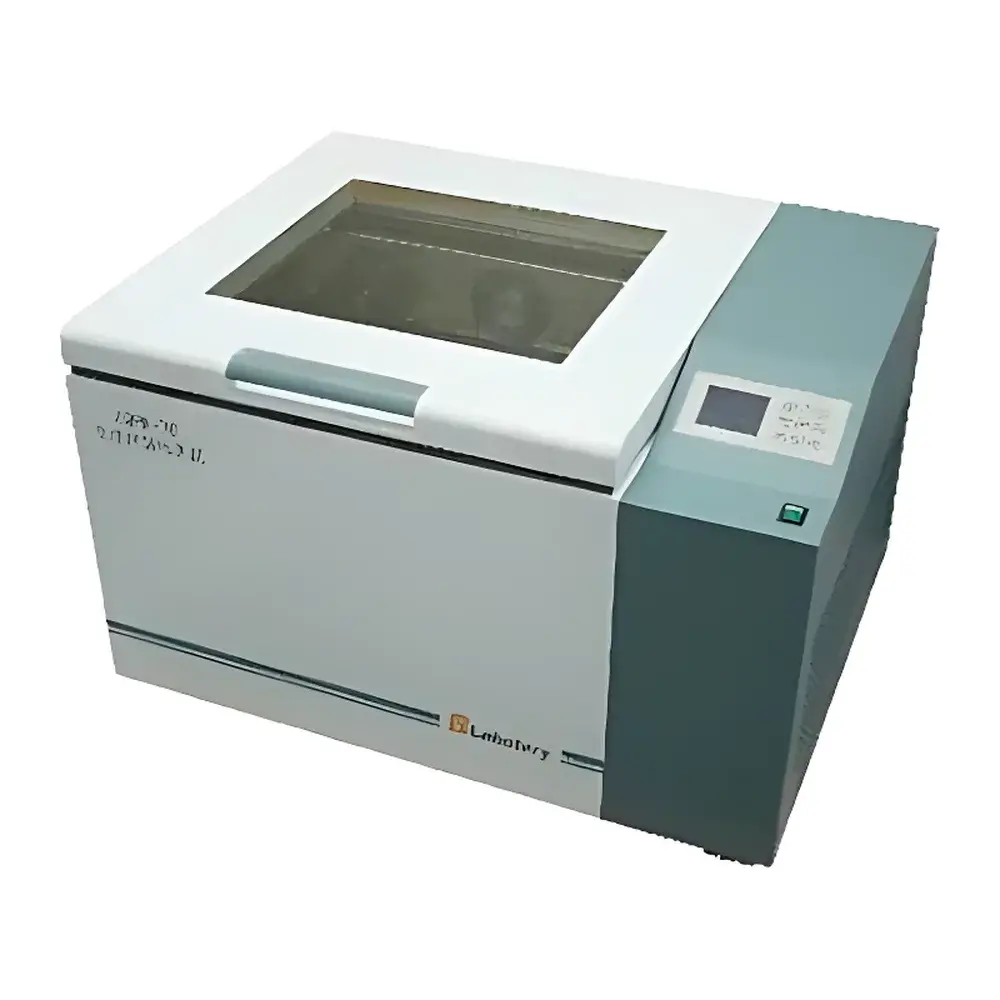
Labotery ZHPW-70 & ZQPW-70 Horizontal Orbital Incubator Shaker
| Brand | Labotery |
|---|---|
| Origin | Tianjin, China |
| Model | ZHPW-70 (Heating-only), ZQPW-70 (Heating & Refrigeration) |
| Timer Range | 0–9999 min |
| Oscillation Frequency | 10–400 rpm |
| Amplitude | 26 mm |
| Temperature Range | 4–65 °C (ZQPW-70), RT+5–65 °C (ZHPW-70) |
| Platform Quantity | 1 |
| Uniformity | ±0.8 °C at 37 °C |
| Stability | ±0.3 °C at 37 °C |
| Platform Size | 520 × 430 mm |
| Max Load Capacity | 100 mL × 42 / 250 mL × 30 / 500 mL × 20 / 1000 mL × 9 |
| Power | 0.4 kW (ZHPW-70), 0.71 kW (ZQPW-70) |
| Input | AC 220 V ±10%, 50–60 Hz |
| Dimensions (W×D×H) | 860 × 680 × 570 mm |
Overview
The Labotery ZHPW-70 and ZQPW-70 Horizontal Orbital Incubator Shakers are precision-engineered laboratory instruments designed for controlled microbial growth, cell culture expansion, enzyme assays, and biochemical reaction optimization under simultaneous temperature regulation and orbital agitation. These units operate on the principle of horizontal orbital shaking—generating uniform, low-shear motion ideal for aerobic suspension cultures, where consistent oxygen transfer and minimal mechanical stress are critical. The ZHPW-70 model provides heating-only capability (RT+5 to 65 °C), while the ZQPW-70 integrates a high-efficiency, fluorine-free refrigeration system enabling full-range thermostatic control from 4 to 65 °C—making it suitable for mesophilic, psychrophilic, and thermotolerant organism studies. Both models feature a robust stainless steel chamber with mirror-finish interior surfaces, double-layered tempered glass door with integrated viewing window, and a 30 mm diameter access port for real-time probe insertion or gas exchange—ensuring experimental flexibility without compromising environmental integrity.
Key Features
- High-precision PID microprocessor controller with 0.1 °C temperature resolution and ±0.3 °C stability (at 37 °C); programmable ramp-and-soak profiles supported via optional color touchscreen interface
- Brushless DC motor drive with closed-loop speed feedback; oscillation frequency adjustable from 10 to 400 rpm with ±1 rpm accuracy; reversible rotation and pause-interval programming enabled
- Dual-mode operation: continuous, reciprocal (forward/reverse), or static hold—each segment independently timed (0–9999 min per step) with seamless transition logic
- Forced-air convection via centrifugal blower and optimized ducting ensures ±0.8 °C temperature uniformity across the entire platform surface
- Integrated safety architecture includes door-open stop detection, over-temperature cut-off with audible/visual alarm, auto-recovery after power interruption, and self-diagnostic fault reporting
- UV germicidal lamp and internal LED illumination facilitate sterile handling and visual monitoring without chamber opening
- Front-accessible dust filter for refrigeration unit and maintenance-free motor design support long-term GLP-compliant operation
Sample Compatibility & Compliance
The 520 × 430 mm single-tier platform accommodates standard flask configurations including 100 mL (×42), 250 mL (×30), 500 mL (×20), and 1000 mL (×9) vessels using universal spring clamps. Optional custom fixtures support Erlenmeyer flasks, baffled bottles, microtiter plates, and bioreactor bags. The chamber meets ISO 13485-aligned manufacturing practices and complies with IEC 61010-1 for electrical safety in laboratory equipment. Its temperature and timing functions support audit-ready documentation when paired with the optional RS-485 or USB data export modules—enabling traceability required under FDA 21 CFR Part 11 for regulated QC/QA workflows in pharmaceutical and clinical diagnostics labs.
Software & Data Management
While the base LCD interface supports local parameter entry and real-time display of setpoint, actual temperature, speed, and elapsed time, optional connectivity modules extend functionality significantly. The RS-485 serial interface allows integration into centralized lab automation networks using Modbus RTU protocol for remote start/stop, parameter adjustment, and status polling. The USB port enables direct export of time-stamped log files (.csv) containing temperature, speed, and operational state history—compatible with LIMS platforms and statistical process control software. An optional thermal printer provides hard-copy records for SOP adherence in non-digital environments. All firmware versions maintain backward-compatible configuration storage with automatic power-loss recovery.
Applications
These incubator shakers serve core workflows in academic research, biopharmaceutical development, and industrial microbiology. Typical applications include bacterial and yeast biomass production (e.g., E. coli, S. cerevisiae), mammalian suspension cell line expansion (CHO, HEK293), recombinant protein expression under inducible promoters, antibiotic susceptibility testing (AST), biofilm formation assays, enzymatic kinetic profiling, and media optimization studies. The wide amplitude (26 mm) and broad speed range ensure compatibility with both low-viscosity broth cultures and higher-density fermentations requiring enhanced aeration. The refrigerated ZQPW-70 variant is routinely deployed in cold-adapted enzyme characterization, psychrophilic strain isolation, and cryopreservation protocol development.
FAQ
What is the difference between ZHPW-70 and ZQPW-70?
The ZHPW-70 is a heating-only incubator shaker (operating range: RT+5 to 65 °C), whereas the ZQPW-70 adds active refrigeration for full-range control from 4 to 65 °C.
Does the unit support GLP-compliant data recording?
Yes—when equipped with the USB or RS-485 module, all operational parameters are timestamped and exportable in .csv format for archival and audit purposes.
Can I run multi-step programs with alternating direction and dwell periods?
Yes—the controller supports up to 9 programmable segments with independent speed, direction (forward/reverse/stop), and duration settings per segment.
Is the chamber sterilizable with vaporized hydrogen peroxide (VHP)?
No—VHP is not recommended due to potential damage to electronic seals and display components; UV irradiation and 70% ethanol wiping are validated cleaning methods.
What is the maximum allowable load weight on the platform?
The platform is rated for up to 25 kg distributed load; exceeding this may affect thermal uniformity and mechanical longevity.
Related Products




