
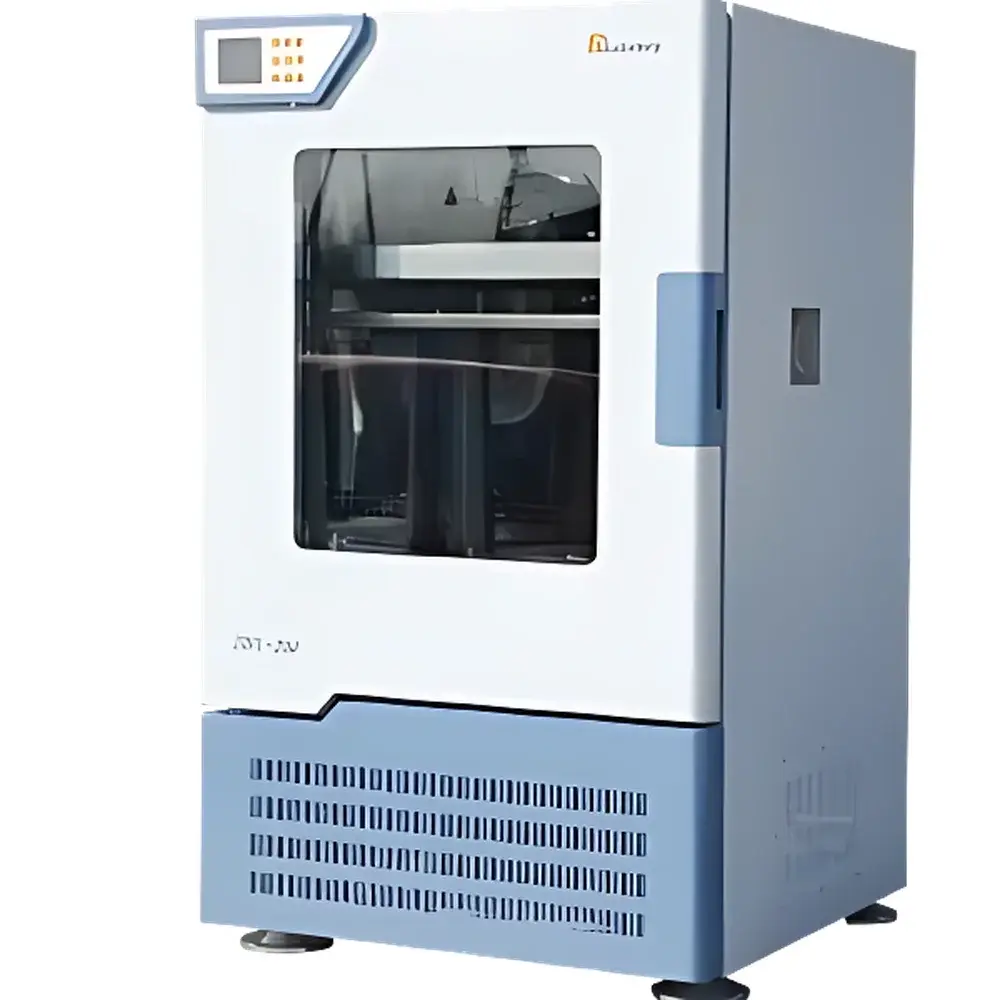
Labotery ZQPL-200 Vertical Temperature-Controlled Orbital Shaker Incubator
| Brand | Labotery |
|---|---|
| Origin | Tianjin, China |
| Model | ZQPL-200 |
| Instrument Type | Full-Temperature Orbital Shaker Incubator |
| Timer Range | 0–9999 h |
| Oscillation Speed | 10–300 rpm |
| Speed Accuracy | ±1 rpm |
| Orbit Diameter | 26 mm |
| Temperature Range | 4–65 °C |
| Temperature Resolution | ±0.1 °C |
| Temperature Uniformity | ±0.5 °C (at 37 °C) |
| Temperature Stability | ±0.3 °C (at 37 °C) |
| Control Method | PID Microprocessor-Based |
| Chamber Material | Stainless Steel Mirror Finish |
| Viewing Window | Tempered Double-Glass Door with Side Ø30 mm Access Port |
| Lighting | Integrated LED Illumination |
| Cooling System | R134a-Free Compressor with Thermal Protection Circuitry |
| Air Circulation | Centrifugal Forced-Air Duct System |
| Drive Mechanism | Brushless Servo Motor with Three-Eccentric-Cam Transmission |
| Safety Features | Door-Interlocked Stop, Over-Temperature Audiovisual Alarm + Auto-Cutout, Motor Overcurrent Protection, Self-Diagnostic Fault Detection |
| Programming | Bidirectional Rotation (Forward/Reverse/Stop), Multi-Stage Time-Programmable Speed & Temp Profiles |
| Display Options | LCD or True-Color Touchscreen Controller |
| Memory Function | Power-Failure Resume with Data Retention |
| Shelf Configuration | Dual-Deck Platform (Upper: Universal Spring Clamp |
| Lower | Fixed 500 mL × 12 Fixture) |
| Platform Dimensions | 439 × 528 mm per deck |
| Max Load Capacity per Deck | 100 mL × 42 / 250 mL × 25 / 500 mL × 16 / 1000 mL × 9 / 2000 mL × 6 |
| Rated Power | 11.3 kW |
| Input Voltage | AC 220 V ±10%, 50–60 Hz |
| External Dimensions (W×D×H) | 740 × 730 × 1235 mm |
| Net Weight | 170 kg |
| Operating Ambient | 5–25 °C, 50% RH (20 °C baseline test condition) |
Overview
The Labotery ZQPL-200 is a vertically oriented, full-temperature orbital shaker incubator engineered for precise, reproducible cultivation of microbial, mammalian, and suspension cell cultures under controlled thermal and mechanical agitation conditions. It operates on the principle of orbital shaking—generating uniform circular motion (26 mm diameter orbit) to suspend cells and enhance oxygen transfer while maintaining laminar mixing dynamics essential for scalable bioprocess development. Unlike benchtop shakers, its vertical architecture optimizes floor space without compromising chamber volume or thermal integrity. The unit integrates a fluorocarbon-free refrigeration system with intelligent compressor thermal management, enabling stable operation across the full 4–65 °C range—including sub-ambient temperatures critical for psychrophilic strain maintenance or enzyme kinetics studies. Its PID-based microprocessor controller ensures high-fidelity temperature regulation (±0.3 °C stability at 37 °C) and speed control (±1 rpm accuracy), meeting baseline requirements for GLP-compliant cell banking, QC microbiology, and upstream bioprocess qualification.
Key Features
- Brushless servo motor drive system: Eliminates carbon brush wear, delivers consistent torque across the 10–300 rpm range, and requires zero scheduled maintenance over >20,000 operational hours.
- Three-eccentric-cam transmission mechanism: Provides low-vibration, high-stability orbital motion with minimal harmonic resonance—critical for long-term suspension culture viability and reduced shear stress on sensitive eukaryotic cells.
- Dual-deck platform configuration: Upper deck equipped with universal spring clamps accommodating variable flask geometries (100–2000 mL); lower deck pre-configured with fixed 500 mL × 12 fixtures for standardized high-throughput workflows.
- Centrifugal forced-air circulation duct: Ensures uniform temperature distribution (±0.5 °C at 37 °C) throughout the stainless steel mirror-finish chamber, validated per ISO 13485 Annex A for medical device manufacturing environments.
- Integrated UV-C sterilization module: Mounted internally above the chamber ceiling, delivering programmable 254 nm irradiation cycles to decontaminate surfaces between runs—supporting aseptic technique in GMP-grade cleanroom-adjacent labs.
- Comprehensive safety architecture: Includes door-interlock shutdown, real-time motor current monitoring with automatic current-limiting response, over-temperature cut-off with audible/visual alarm, and self-diagnostic firmware that logs fault codes for traceable maintenance records.
Sample Compatibility & Compliance
The ZQPL-200 accommodates standard laboratory vessels including Erlenmeyer flasks (100–2000 mL), baffled flasks, roller bottles, and multi-well plates mounted on custom adapters. Its Ø30 mm side access port enables integration with external gas regulators (e.g., for CO2/O2 blending) or inline dissolved oxygen probes without compromising chamber seal integrity. The unit complies with IEC 61010-1:2010 for electrical safety in laboratory equipment and meets electromagnetic compatibility (EMC) requirements per EN 61326-1:2013. While not certified for ISO Class 5 cleanroom use out-of-the-box, its stainless steel chamber and HEPA-filtered optional air intake (accessory) support alignment with ISO 14644-1 Class 7 environments when deployed in controlled suites. All temperature and speed calibration points are traceable to NIST-certified references via factory documentation.
Software & Data Management
The ZQPL-200 supports two control interfaces: a 5.7-inch monochrome LCD with membrane keypad (standard) or an optional 7-inch true-color resistive touchscreen with graphical programming interface. Both versions enable up to 16-step time-programmable protocols—including bidirectional rotation sequences, ramp-and-soak temperature profiles, and synchronized start/stop triggers. Data logging records temperature, speed, and elapsed time at user-defined intervals (1–60 min), stored internally for ≥30 days. Export is supported via USB 2.0 port (CSV format), compatible with LIMS platforms such as Thermo Fisher SampleManager and LabVantage. Audit trail functionality—compliant with FDA 21 CFR Part 11—requires the touchscreen variant with password-protected user roles (Admin, Operator, Viewer) and immutable electronic signatures for protocol changes and calibration events.
Applications
- Mammalian cell expansion in serum-free or chemically defined media, where consistent orbital shear and dissolved O2 levels directly impact viable cell density and monoclonal antibody titer.
- Microbial fermentation optimization (E. coli, Pichia pastoris, Bacillus spp.) requiring precise temperature ramping during induction phases and tight RPM control during exponential growth.
- Environmental microbiology: BOD testing, activated sludge respiration assays, and antibiotic susceptibility screening under standardized agitation conditions per ASTM D5210-19.
- Vaccine adjuvant formulation development, where aluminum hydroxide or oil-in-water emulsions demand uniform dispersion kinetics validated by particle size tracking post-shaking.
- Bioburden reduction validation studies in pharmaceutical manufacturing, leveraging integrated UV-C cycles to establish log-reduction baselines per USP .
FAQ
Does the ZQPL-200 support remote monitoring or Ethernet connectivity?
No native Ethernet or Wi-Fi interface is included; however, third-party RS-485-to-Ethernet gateways may be integrated using the optional Modbus RTU communication port (available upon request). Remote access must be implemented via local network infrastructure and validated per organizational IT security policy.
Can the UV-C sterilization cycle be scheduled independently of temperature or shaking programs?
Yes—the UV lamp operates as a standalone function with programmable duration (1–120 min) and delay start, independent of incubation or agitation parameters. Activation requires manual confirmation via touchscreen or keypress to prevent accidental exposure.
Is the chamber humidity controlled?
No active humidification or dehumidification system is integrated. Relative humidity inside the chamber will equilibrate with ambient lab conditions (typically 30–60% RH); users requiring >80% RH should employ secondary containment (e.g., sealed trays with water reservoirs) validated for their specific application.
What validation documentation is supplied with the instrument?
Each unit ships with a Factory Calibration Certificate (temperature and speed), IQ/OQ templates aligned with ISO/IEC 17025 guidelines, and a complete set of electrical safety and EMC test reports. Installation qualification support is available through Labotery’s authorized service partners in North America and EU regions.
Are custom platform inserts or flask clamps available?
Yes—Labotery offers OEM-designed accessories including magnetic stir-bar-compatible platforms, 24-well plate holders, and silicone-coated universal clamps for irregular vessel shapes. Lead time is typically 4–6 weeks from order confirmation.
Related Products




