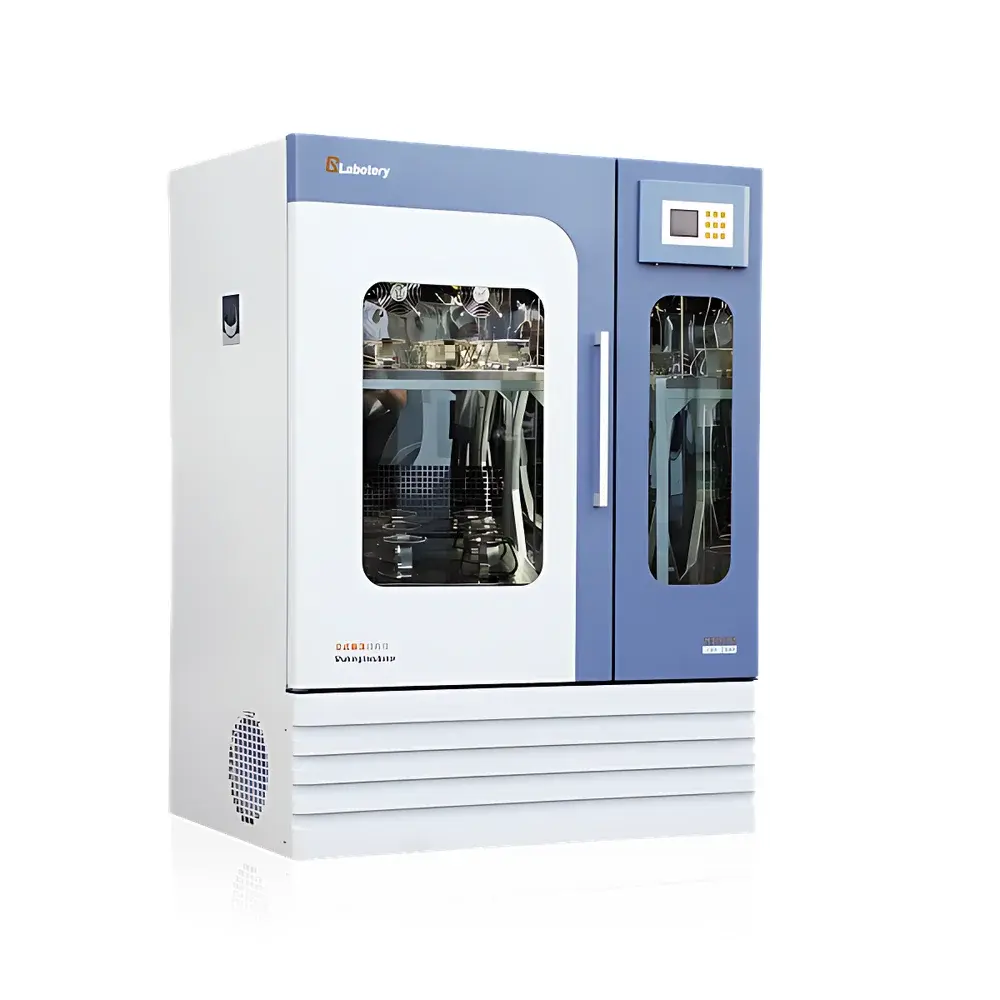
Labotery ZQPL-500 Vertical High-Capacity Full-Temperature Orbital Shaker Incubator
| Brand | Labotery |
|---|---|
| Origin | Tianjin, China |
| Model | ZQPL-500 |
| Instrument Type | Full-Temperature Orbital Shaker / Incubator Shaker |
| Timer Range | 0–9999 min (up to 166.6 h) |
| Oscillation Frequency | 10–300 rpm |
| Frequency Accuracy | ±1 rpm |
| Orbit Diameter | 26 mm / 50 mm |
| Temperature Range | 4–65 °C |
| Temperature Uniformity | ±0.5 °C (at 37 °C) |
| Temperature Fluctuation | ±0.3 °C (at 37 °C) |
| Temperature Resolution | 0.1 °C |
| Control Method | PID Microprocessor-Based Control |
| Shelf Quantity | 2 adjustable platforms |
| Platform Dimensions | 830 × 508 mm per shelf |
| Power Consumption | 2.1 kW |
| Input Voltage | AC 220 V ±10%, 50–60 Hz |
| External Dimensions (W×D×H) | 1080 × 850 × 1440 mm |
| Net Weight | 300 kg |
| Compliance | Designed for GLP-compliant laboratories |
Overview
The Labotery ZQPL-500 is a vertically oriented, high-capacity full-temperature orbital shaker incubator engineered for demanding life science applications requiring precise simultaneous control of temperature, oscillation frequency, and orbital amplitude. It operates on the principle of orbital shaking—generating gentle yet consistent circular motion to suspend and aerate cultures while maintaining thermal homogeneity across large sample volumes. Unlike benchtop units, its vertical architecture maximizes floor space efficiency without compromising working volume, making it ideal for labs scaling up microbial fermentation, mammalian cell expansion, enzyme kinetics, or bioprocess development. The chamber employs forced-air convection via a centrifugal circulation system, ensuring ±0.5 °C uniformity at 37 °C—a critical benchmark for reproducible biological assays. Dual-platform configuration enables independent loading strategies: e.g., high-density small-volume cultures on the upper shelf and low-speed, high-viscosity fermentations on the lower shelf.
Key Features
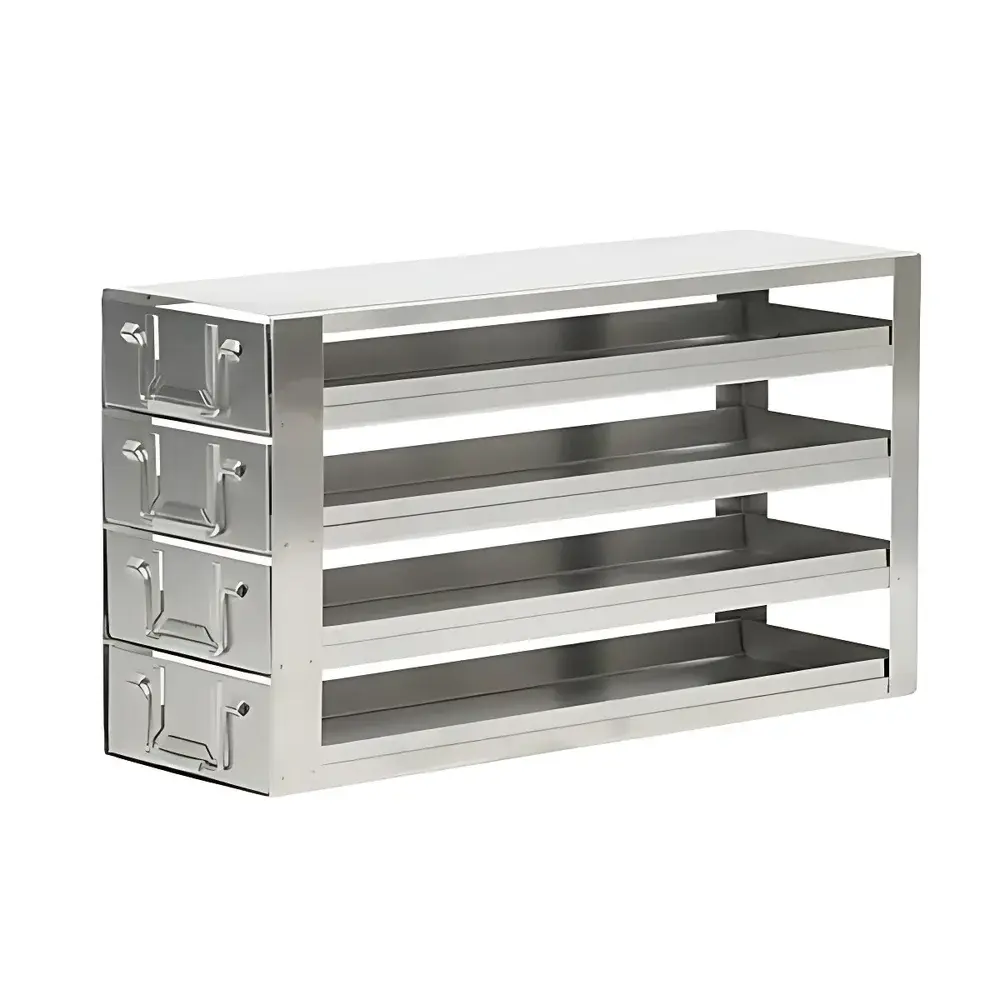
- Two independently accessible stainless-steel shelves (830 × 508 mm each), supporting scalable vessel configurations—from 100 mL flasks (up to 90 per shelf) to 2 L bottles (13 per shelf).
- High-efficiency, oil-free refrigeration system using imported R134a-free compressors with intelligent thermal load management to prevent auto-shutdown during prolonged low-temperature operation (down to 4 °C).
- Dual-mode control interface: standard LCD display with intuitive parameter navigation, or optional 4.3-inch 16-bit true-color resistive touchscreen supporting programmable multi-step protocols (up to 5 programs × 30 steps each, with time resolution to 1 minute).
- PID-based microprocessor temperature regulation with real-time compensation for ambient drift, enhanced by an external ambient temperature probe mounted on the front panel for feedforward correction.
- Brushless DC motor drive delivering stable rotational output across the full 10–300 rpm range, with bidirectional operation capability and ±1 rpm frequency accuracy verified under ISO 17025 traceable conditions.
- Integrated safety architecture including over-temperature audiovisual alarm, automatic power cutoff, self-diagnostic error reporting, and power-loss memory retention for all setpoints and runtime counters.
Sample Compatibility & Compliance
The ZQPL-500 accommodates standard laboratory glassware and plastic vessels—including Erlenmeyer flasks (100–2000 mL), baffled flasks, culture bags, and custom bioreactor sleeves—via configurable clamping fixtures. Its 26 mm and 50 mm orbit options allow optimization for oxygen transfer efficiency (kLa) in aerobic cultivations or low-shear suspension of sensitive cells. The interior chamber features electropolished stainless-steel walls and double-glazed tempered glass doors with UV germicidal lamps (254 nm), enabling sterility maintenance between runs. All electronic controls meet IEC 61000-6-3 EMC standards. When equipped with the optional Labotery DataLink software suite and enabled audit-trail logging, the system satisfies documentation requirements for GLP, GMP, and FDA 21 CFR Part 11 environments—including user authentication, electronic signatures, and immutable event logs.
Software & Data Management
The optional touchscreen controller provides native graphing functionality: real-time plotting of temperature and speed profiles, overlay of historical curves (retained for ≥12 months), and export-ready screenshots via USB 2.0 port. Data can be printed directly using an integrated thermal microprinter (optional) or transferred to external analysis platforms (e.g., MATLAB, GraphPad Prism) via CSV export. Labotery DataLink software—deployed on Windows-based lab PCs—enables remote Ethernet monitoring, centralized fleet management, and automated report generation compliant with ISO/IEC 17025 clause 7.7. All logged parameters include timestamps with millisecond precision, operator ID tags, and change-history tracking for full traceability.
Applications
This instrument serves as a core platform in academic research labs studying microbial growth dynamics, recombinant protein expression in E. coli or yeast, stem cell expansion under controlled hypoxia, and biodegradation kinetics of environmental pollutants. In industrial settings, it supports upstream process development for monoclonal antibody production, vaccine seed train amplification, and quality control testing of raw materials per USP <1043> and EP 2.6.27. Its wide thermal span (4–65 °C) also permits thermophilic enzyme screening, psychrophilic bacterial isolation, and accelerated stability studies aligned with ICH Q1A(R2).
FAQ
What is the maximum flask capacity per shelf?
Each 830 × 508 mm shelf holds up to 45 × 250 mL Erlenmeyer flasks or 12 × 1000 mL flasks using factory-installed universal clamps.
Does the unit support validation documentation (IQ/OQ/PQ)?
Yes—Labotery provides standardized qualification protocols and calibration certificates traceable to NIST standards; on-site OQ execution is available upon request.
Can the shaker operate continuously for >72 hours?
Yes—the brushless motor and reinforced mechanical drivetrain are rated for uninterrupted operation up to 10,000 hours MTBF under nominal load conditions.
Is CO₂ control available as an option?
No—this model is designed exclusively for air-equilibrated environments; CO₂ integration requires the separate Labotery ZQPL-CO₂ series.
How is temperature uniformity verified during installation?
A 9-point thermocouple mapping procedure (per ASTM E2251-17 Annex A1) is included in the commissioning checklist, with final report signed off by certified field engineers.