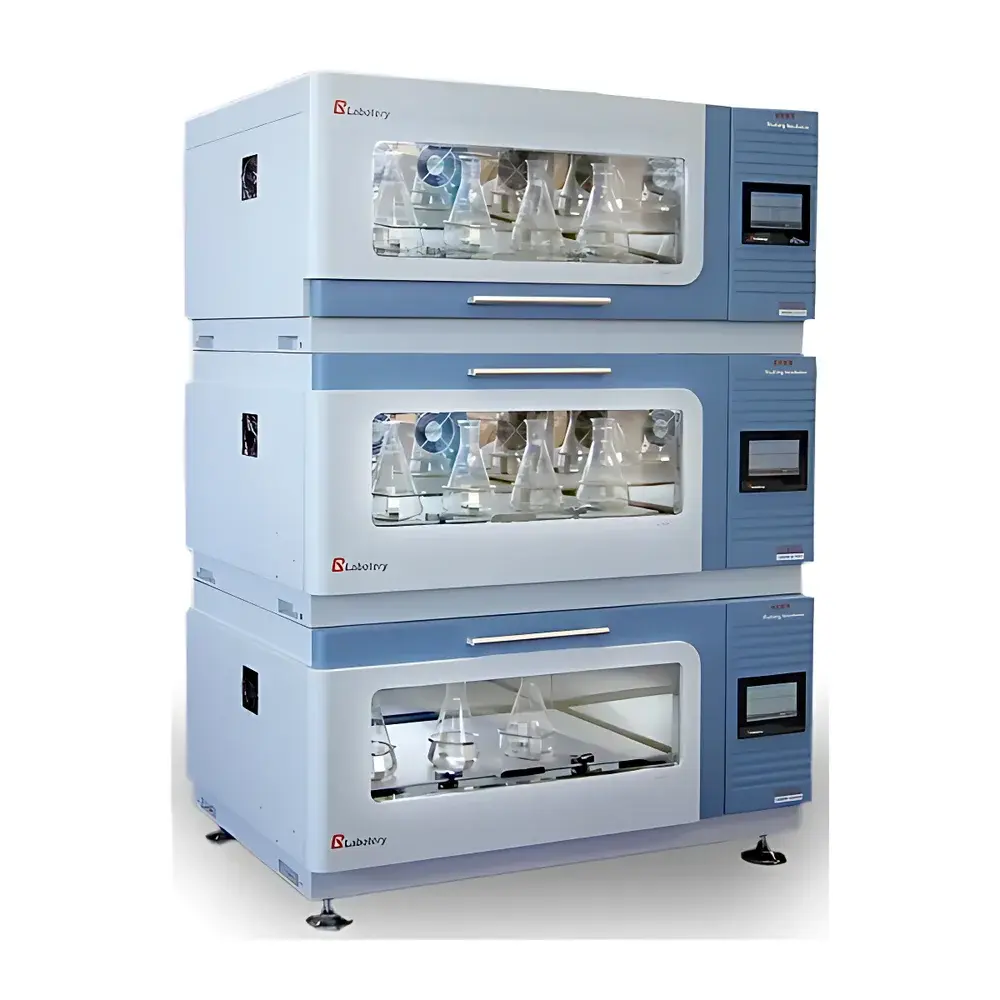
Labotery ZQPZ-228R CO₂ Incubator Shaker with Triple-Layer Stackable Configuration
| Brand | Labotery |
|---|---|
| Origin | Tianjin, China |
| Model | ZQPZ-228R |
| Shaker Type | Refrigerated/Heated Orbital Incubator Shaker |
| Timer Range | 0–999 h 59 min |
| Oscillation Frequency | 10–300 rpm (±1 rpm) |
| Orbit Diameter | Ø26 mm / 50 mm |
| Temperature Range | 4–65 °C (CO₂ mode: 4–60 °C) |
| Temperature Uniformity | ±0.5 °C at 37 °C |
| Temperature Stability | ±0.3 °C at 37 °C |
| Temperature Resolution | 0.1 °C |
| CO₂ Control Range | 0–20% |
| CO₂ Sensor | Imported NDIR (Non-Dispersive Infrared) |
| CO₂ Accuracy | ±0.1% |
| CO₂ Distribution Uniformity | ±0.1% |
| Shelf Dimensions | 930 × 530 mm |
| Single-Shelf Capacity | 100 mL × 60 / 250 mL × 45 / 500 mL × 28 / 1000 mL × 14 / 2000 mL × 15 / 3000 mL × 8 |
| Power Consumption (per shelf) | 1.5 kW |
| Input Voltage | AC 220 V ±10%, 50–60 Hz |
| External Dimensions (W×D×H) | 1450 × 920 × 600 mm |
| Display | 16-bit true-color touchscreen controller with real-time curve plotting, data logging (1-year retention), USB export, password lock, and audit-ready event logging |
Overview
The Labotery ZQPZ-228R is a precision-engineered, triple-layer stackable CO₂ incubator shaker designed for demanding cell culture, microbial fermentation, and bioprocess development applications requiring simultaneous control of temperature, humidity (indirectly via chamber sealing and ambient moisture retention), CO₂ concentration, and orbital agitation. It operates on the principle of forced convection thermal regulation combined with closed-loop NDIR (Non-Dispersive Infrared) CO₂ sensing and servo-controlled orbital motion—enabling stable, reproducible physiological conditions for aerobic suspension cultures. Unlike conventional shakers or standalone CO₂ incubators, the ZQPZ-228R integrates environmental control and mechanical stimulation within a single compact footprint, eliminating cross-system calibration drift and minimizing spatial contamination risk. Its refrigerated heating architecture—featuring an imported fluorine-free compressor and optimized heat-exchange ducting—ensures rapid thermal equilibration across the full 4–65 °C range, while maintaining ≤±0.3 °C stability at physiologically critical setpoints such as 37 °C.
Key Features
- Triple-layer modular stacking design: Each layer operates independently with dedicated PID temperature, CO₂, and speed control—enabling parallel experiments under distinct conditions without cross-interference.
- High-fidelity NDIR CO₂ sensor (imported): Delivers ±0.1% measurement accuracy and uniform distribution (±0.1%) across the chamber volume, compliant with ISO 13485-aligned calibration traceability protocols.
- True-color 16-bit touchscreen HMI: Displays real-time temperature, CO₂ %, RPM, timer status, alarm logs, and dual-axis (time vs. parameter) curves on a unified interface; supports screenshot capture and timestamped PDF export.
- Robust mechanical architecture: IP54-rated waterproof servo motor, sealed stainless-steel inner chamber with integrated drip barrier and bottom drainage port, and tempered double-glazed door with pressure-relief venting for O₂ exchange.
- Comprehensive safety and compliance systems: Door-open motion interlock, overtemperature cut-off with audible/visual alert, auto-recovery after power interruption, encrypted operator access levels, and GLP/GMP-ready audit trail (event type, timestamp, user ID, parameter delta).
- Expandable functionality: Optional remote monitoring via secure TLS-enabled mobile application; optional thermal printer module for FDA 21 CFR Part 11-compliant hardcopy output of validation reports.
Sample Compatibility & Compliance
The ZQPZ-228R accommodates standard Erlenmeyer flasks (100–3000 mL), baffled bottles, and multi-well plates on its 930 × 530 mm platform. Its CO₂ control system meets ASTM D618 and USP criteria for environmental monitoring instrumentation verification. The unit is CE-marked per Directive 2014/30/EU (EMC) and 2014/35/EU (LVD); firmware supports configurable data retention intervals aligned with ISO/IEC 17025 Clause 7.5.2 for raw data integrity. All temperature and CO₂ calibration points are user-accessible and field-verifiable using NIST-traceable reference standards.
Software & Data Management
Embedded firmware implements deterministic real-time scheduling for synchronized sampling (1 Hz default, configurable to 0.1 Hz). Logged parameters include chamber temperature, setpoint deviation, CO₂ concentration, actual RPM, door status, and error codes—all time-stamped with microsecond precision. Data is stored internally in encrypted SQLite3 format with cyclic overwrite protection and retained for ≥12 months. USB 2.0 port enables direct export of CSV or XML datasets; optional cloud sync (via Labotery Cloud Gateway v3.2) provides role-based access, version-controlled backups, and automated report generation for IQ/OQ/PQ documentation.
Applications
- Mammalian cell line expansion under 5% CO₂ and 37 °C with continuous orbital mixing (e.g., CHO, HEK293, hybridoma cultures).
- Microaerophilic bacterial cultivation (e.g., Helicobacter pylori, Campylobacter jejuni) requiring precise CO₂ modulation between 5–15%.
- Yeast and filamentous fungal fermentation studies where dissolved O₂ transfer correlates with orbital amplitude and frequency.
- Stability testing of biologics under accelerated temperature-CO₂ stress profiles (ICH Q5C).
- Teaching labs conducting comparative growth kinetics across multiple environmental variables in a space-constrained setting.
FAQ
Does the ZQPZ-228R support validation documentation for GxP environments?
Yes—its firmware includes configurable electronic signatures, immutable audit logs, and exportable calibration certificates compliant with FDA 21 CFR Part 11 Annex 11 requirements.
Can CO₂ and temperature be controlled independently per shelf?
Yes—each of the three shelves features fully isolated control loops with independent setpoint entry, enabling heterogeneous experimental designs.
What is the maximum flask size supported on a single shelf?
Up to thirty 3000 mL flasks may be accommodated using the Ø50 mm orbit configuration, subject to load balancing and airflow clearance constraints.
Is external humidity control available?
No—humidity is managed passively via sealed chamber design and ambient lab RH; active humidification requires third-party integration via optional port.
How is firmware updated?
Via authenticated USB stick upload; updates preserve all user configurations and historical logs without reset.
Related Products