
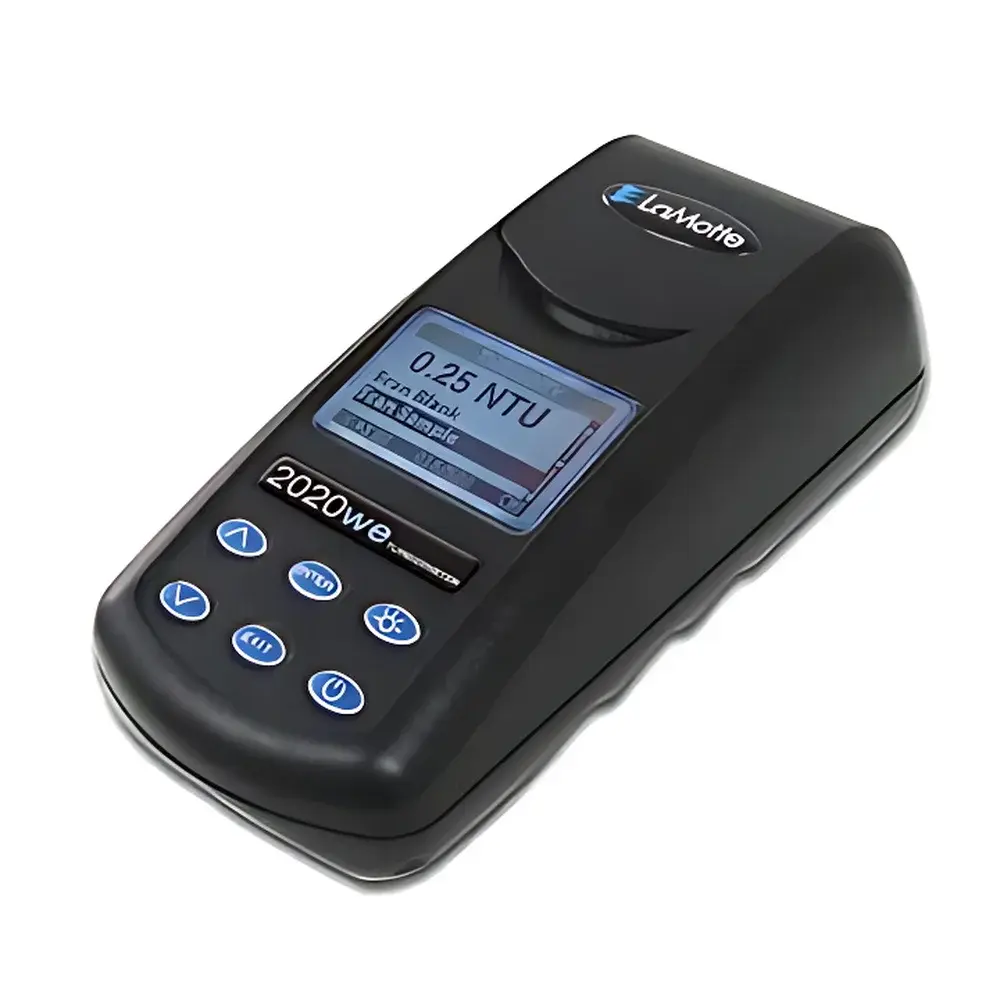
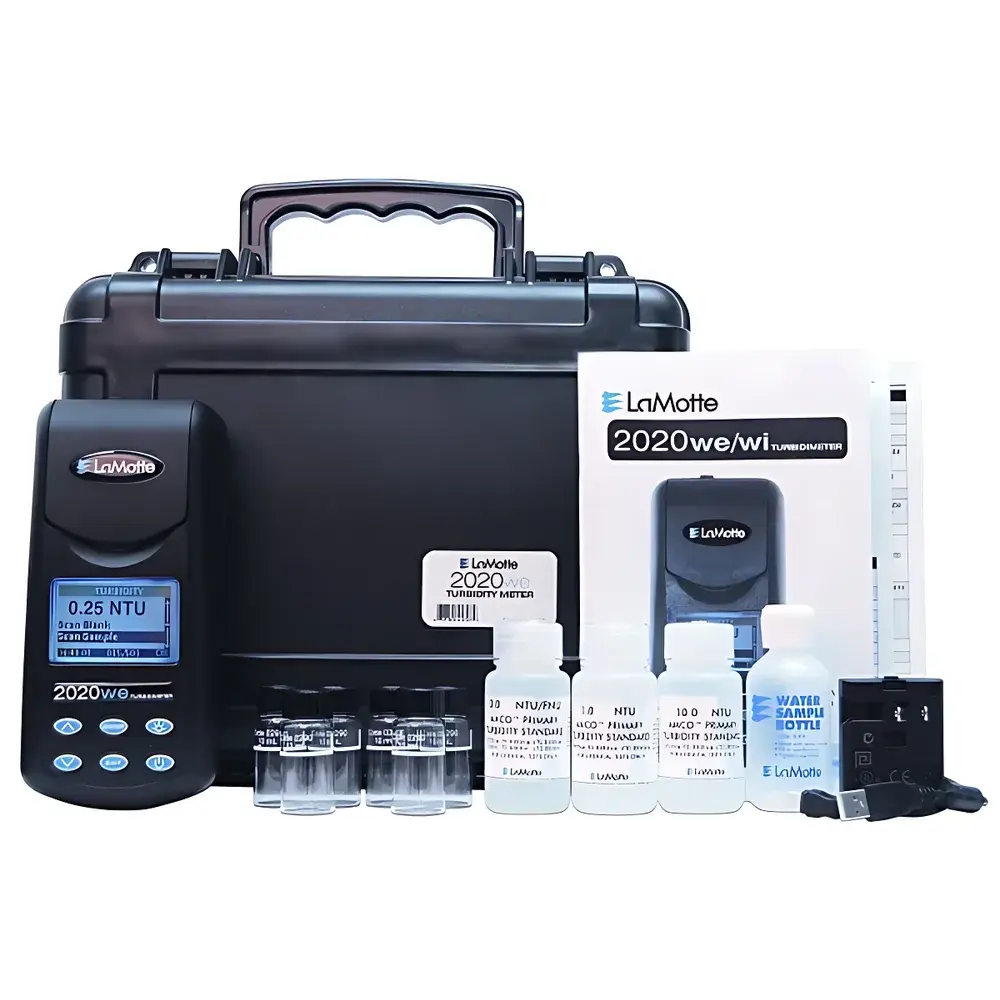
Lamotte 2020we Portable Turbidimeter
| Brand | Lamotte |
|---|---|
| Origin | USA |
| Model | 2020we |
| Instrument Type | Portable/Handheld Turbidimeter |
| Measurement Parameter | Turbidity |
| Compliance Standards | EPA Method 180.1 (tungsten lamp), ISO 7027 (860 nm LED) |
| Measurement Units | NTU, FNU, AU, ASBC, EBC |
| Range | 0–4000 NTU/FNU, 0–10,500 ASBC, 0–150 EBC |
| Resolution | 0.01 NTU/FNU (0–10.00), 0.1 NTU/FNU (10.00–10.99), 1 NTU/FNU (11.00–109.9), 1 NTU/FNU (110–4000) |
| Accuracy | ±0.05 NTU/FNU (0–2.5), ±2% (2.5–100), ±3% (>100) |
| Detection Limit | 0.05 NTU/FNU |
| Repeatability | ±0.02 NTU/FNU or ±1% |
| Light Source | Tungsten lamp (EPA mode), 860 nm LED (ISO mode) |
| Enclosure Rating | IP67 |
| Power | Rechargeable Li-ion battery |
| Interface | USB |
| Display | Backlit LCD |
| Language Support | 7 languages |
| Calibration | Automatic range selection, NIST-traceable standards compatible |
Overview
The Lamotte 2020we Portable Turbidimeter is a field-deployable, dual-standard turbidity measurement instrument engineered for precision, reliability, and regulatory compliance in environmental and water quality laboratories. It operates on the fundamental principle of nephelometry—measuring the intensity of light scattered at 90° from a collimated incident beam—as defined by both U.S. Environmental Protection Agency (EPA) Method 180.1 and International Organization for Standardization (ISO) 7027. The instrument features two independently selectable optical configurations: a tungsten-halogen lamp optimized for EPA-compliant measurements (broad-spectrum visible light, ~400–600 nm), and an 860 nm near-infrared LED compliant with ISO 7027 for reduced interference from color and absorbance in colored or highly organic samples. This dual-source architecture ensures method-specific traceability without hardware modification, supporting cross-jurisdictional data acceptance in municipal water utilities, wastewater treatment plants, and third-party environmental testing labs.
Key Features
- Dual optical path design with automatic source selection: tungsten lamp for EPA 180.1, 860 nm LED for ISO 7027—no manual lamp swapping required
- IP67-rated enclosure certified for dust-tight operation and immersion up to 1 m for 30 minutes, enabling robust use in field conditions including rain, splashing, or humid environments
- Rechargeable lithium-ion battery providing ≥12 hours of continuous operation per charge; USB-C port supports simultaneous charging and data transfer
- Backlit graphical LCD display with adjustable contrast, readable under direct sunlight and low-light conditions
- Automatic range switching across five decades (0.05–4000 NTU/FNU) eliminates user error in scale selection and optimizes signal-to-noise ratio at all concentrations
- Seven-language interface (English, Spanish, French, German, Portuguese, Chinese, Arabic) configurable via on-device menu—designed for multinational field teams and contract laboratories
- NIST-traceable calibration compatibility using primary standard formazin suspensions or AMCO-AE reference standards
Sample Compatibility & Compliance
The 2020we accepts standard 25 mm round glass vials (10 mL volume) and accommodates both clear and moderately colored aqueous samples—including raw surface water, filtered drinking water, effluent, stormwater runoff, and process streams in food/beverage production. Its ISO 7027 mode mitigates errors caused by sample coloration, making it suitable for applications where chromophore interference compromises EPA-mode readings. The instrument meets the performance criteria outlined in ASTM D6695 (Standard Practice for Turbidity Measurements), EPA 180.1 (for drinking water and wastewater), and ISO 7027-1:2016 (for routine monitoring and regulatory reporting). Data outputs are structured to support GLP/GMP audit trails when integrated with Lamotte’s optional LabManager software suite, and the firmware includes timestamped calibration logs with operator ID fields compliant with FDA 21 CFR Part 11 requirements for electronic records.
Software & Data Management
Data export is supported via USB mass-storage mode—no proprietary drivers required—enabling direct file transfer to Windows, macOS, or Linux systems. Measurement files are saved in CSV format with embedded metadata: date/time stamp, operator ID (if entered), calibration status, measurement mode (EPA/ISO), unit selected, and raw detector voltage values. Optional LabManager software provides advanced functionality including automated report generation (PDF/Excel), multi-instrument fleet management, calibration certificate templating aligned with ISO/IEC 17025, and secure user role assignment (admin/operator/auditor). All calibration events and measurement sessions are logged with immutable timestamps, satisfying internal QA protocols and external accreditation body requirements such as those imposed by state primacy agencies or ISO 17025-accredited laboratories.
Applications
- Field verification of drinking water turbidity at distribution points, wells, and storage tanks per EPA Total Coliform Rule and Long Term 2 Enhanced Surface Water Treatment Rule (LT2ESWTR)
- Wastewater treatment plant effluent monitoring for NPDES permit compliance (40 CFR Part 122)
- Stormwater quality assessment during construction site inspections and post-rainfall sampling events
- Process control in bottled water facilities, breweries, and dairy processing lines where turbidity serves as a proxy for particulate carryover
- Educational laboratory instruction in environmental science curricula, supporting hands-on method comparison between EPA and ISO protocols
- Emergency response deployments following natural disasters or infrastructure failures requiring rapid assessment of suspended solids in floodwaters or compromised reservoirs
FAQ
What turbidity units does the 2020we support, and how are they selected?
The instrument supports NTU (Nephelometric Turbidity Units), FNU (Formazin Nephelometric Units), AU (Absorption Units), ASBC (American Society of Brewing Chemists), and EBC (European Brewery Convention) units. Unit selection is performed via the main menu and is applied globally to all subsequent measurements until changed.
Is the 2020we suitable for measuring highly turbid industrial wastewater?
Yes—the extended range of 0–4000 NTU/FNU and auto-ranging capability enables reliable quantification of untreated or partially settled wastewater without dilution, provided sample homogeneity is maintained prior to analysis.
How often must the instrument be calibrated, and what standards are recommended?
Lamotte recommends daily verification with a primary standard (e.g., 20 NTU formazin or AMCO-AE suspension) before sample analysis. Full two-point calibration (zero and span) is required after battery replacement, firmware updates, or whenever accuracy verification fails.
Does the device store measurement history internally?
Yes—it retains up to 500 measurement records with full metadata (time, date, unit, mode, operator ID) in non-volatile memory, accessible via the review function or exported via USB.
Can the 2020we be used in saline or brackish water samples?
Yes—provided the sample vial is thoroughly rinsed with deionized water between measurements to prevent salt crystallization on optical surfaces, which could affect scatter geometry and baseline stability.
Related Products







