
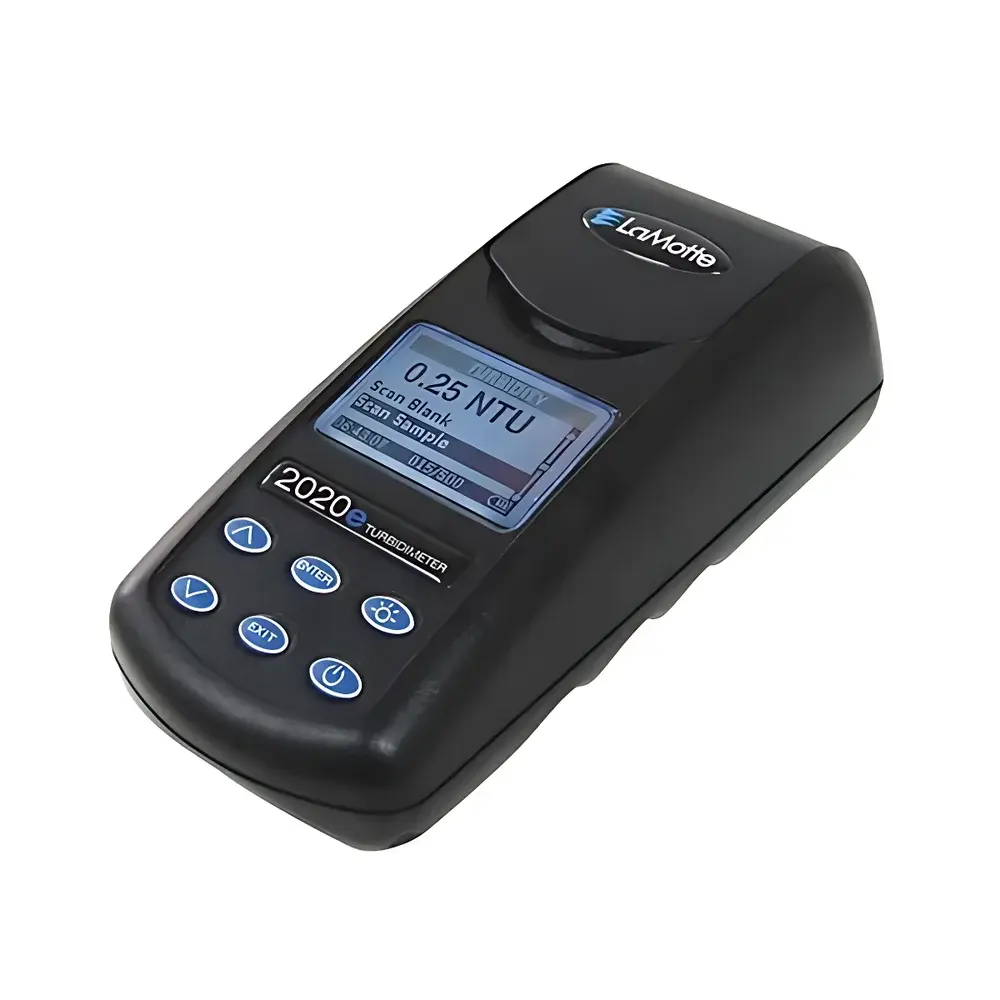
Lamotte 2020wi ISO-Compliant Benchtop Turbidimeter
| Origin | USA |
|---|---|
| Manufacturer Type | Authorized Distributor |
| Origin Category | Imported |
| Model | 2020wi |
| Price | USD 1,450 (FOB) |
| Product Type | Benchtop / Laboratory |
| Measurement Range | 0–4000 FNU |
| Resolution | 0.01 FNU (0.00–10.99), 0.1 FNU (11.00–109.9), 1 FNU (110–4000) |
| Operating Temperature | 0–50 °C |
| Accuracy | ±0.05 FNU (0–2.5 FNU), ±2% (2.5–100 FNU), ±3% (100–4000 FNU) |
| Detection Limit | 0.05 FNU |
| Repeatability | 0.02 FNU |
| Light Source | 860 nm LED (ISO 7027 compliant) |
| Signal Averaging Time | 0, 2, 5, or 10 s (user-selectable) |
| Data Storage | 4,000 points |
| Interface | USB and RS-232 |
| Display | Backlit LCD |
| Sample Volume | 10 mL |
| Cell Diameter | 25 mm |
| Enclosure Rating | IP67 |
| Dimensions (L×W×H) | 19.05 × 8.84 × 6.35 cm |
| Weight | 0.72 kg |
| Included Accessories | Calibration standards (0, 1, 10 FNU |
Overview
The Lamotte 2020wi is a high-precision benchtop turbidimeter engineered for compliance with ISO 7027:2016, the international standard governing optical measurement of turbidity in water and wastewater. Unlike EPA-compliant instruments that rely on tungsten-halogen lamps and broad-spectrum detection, the 2020wi employs a narrow-band 860 nm infrared LED light source—optimized to minimize interference from sample coloration, dissolved organic matter, and spectral absorbance. Its patented multi-detector optical chamber utilizes forward-scatter geometry with rigorous stray-light suppression, enabling stable, long-term performance across diverse matrix types. The instrument implements real-time signal averaging (configurable over 0, 2, 5, or 10 seconds), effectively dampening transient fluctuations caused by large suspended particles—critical for achieving high reproducibility in low-turbidity drinking water and high-turbidity process effluent applications. Designed for laboratory environments requiring traceable, auditable measurements, the 2020wi delivers metrological integrity aligned with GLP and ISO/IEC 17025 frameworks.
Key Features
- ISO 7027:2016-compliant 860 nm LED optical system with temperature-stabilized emission and calibrated photodetector array
- Multi-point signal averaging algorithm (0–10 s) to suppress noise from particle settling or agglomeration
- Triple-range resolution: 0.01 FNU (0.00–10.99), 0.1 FNU (11.00–109.9), and 1 FNU (110–4000) for optimized precision across full dynamic range
- IP67-rated enclosure with integrated sample chamber alignment ring ensuring repeatable vial positioning and eliminating path-length variability
- Backlit graphical LCD with intuitive menu navigation and real-time status indicators for battery, calibration, and measurement mode
- Onboard storage for up to 4,000 measurement records—including timestamp, operator ID, calibration ID, and raw signal values
- Configurable auto-shutdown (5, 10, or 30 minutes) and dual power options: 9 V alkaline battery or optional AC adapter
Sample Compatibility & Compliance
The 2020wi accepts standard 25 mm diameter round glass or plastic vials (10 mL volume), supporting both clean-water validation protocols and high-solids industrial samples. Its optical architecture minimizes color interference through near-infrared illumination, making it suitable for colored effluents, filtered surface waters, and membrane-treated potable supplies. The instrument meets ISO 7027 requirements for wavelength tolerance (±30 nm), detector angular acceptance (±1.5°), and linearity verification across 0–4000 FNU. It supports full audit-trail functionality when paired with SmartLink 2 software, generating time-stamped, user-locked records compliant with FDA 21 CFR Part 11 for electronic signatures and data integrity. Calibration verification is traceable to NIST-traceable formazin and AMCO-AE standards included in the kit.
Software & Data Management
SmartLink 2 software (Windows-compatible) enables bidirectional communication via USB or RS-232. Users can export datasets in CSV or Excel formats, generate calibration reports with uncertainty budgets, and configure instrument parameters remotely—including language selection (English, Spanish, French, Japanese, Italian, Portuguese), averaging time, auto-off delay, and unit display (FNU, FAU, ASBC, EBC). All stored measurements retain embedded metadata: date/time stamp, operator code, calibration lot number, and raw analog-to-digital converter (ADC) counts. Software-generated reports include ISO 7027 conformance statements and optional QC flagging for out-of-spec readings based on user-defined thresholds.
Applications
- Drinking water quality control per WHO Guidelines and national regulatory frameworks (e.g., EU Directive 98/83/EC)
- Wastewater treatment plant influent/effluent monitoring under ISO 10523 and EN 872
- Pharmaceutical water systems (PW, WFI) per USP and EP 2.2.2
- Food & beverage process water validation, including brewing (ASBC/EBC modes)
- Environmental field labs conducting ISO-certified surface water assessments
- Academic research requiring high-resolution turbidity kinetics or coagulation/flocculation studies
FAQ
What turbidity units does the 2020wi support?
FNU (Formazin Nephelometric Units), FAU (Formazin Attenuation Units), ASBC (American Society of Brewing Chemists), and EBC (European Brewery Convention).
Is the 2020wi suitable for regulatory reporting under ISO 7027?
Yes—the instrument’s 860 nm LED source, detector geometry, and calibration protocol are fully validated against ISO 7027:2016 Annex A and B requirements.
How is calibration traceability maintained?
Included primary standards (0, 1, and 10 FNU) are certified to NIST SRM 2134 and AMCO-AE reference materials, with documented uncertainty budgets provided in the certificate of analysis.
Can measurement data be exported for LIMS integration?
Yes—CSV exports include all required metadata fields (timestamp, operator, calibration ID, raw signal) and are compatible with major LIMS platforms via standardized import templates.
What is the minimum detectable turbidity level?
The detection limit is 0.05 FNU at the lowest range, verified using low-turbidity blanks and statistical analysis of baseline noise (3σ criterion).





