
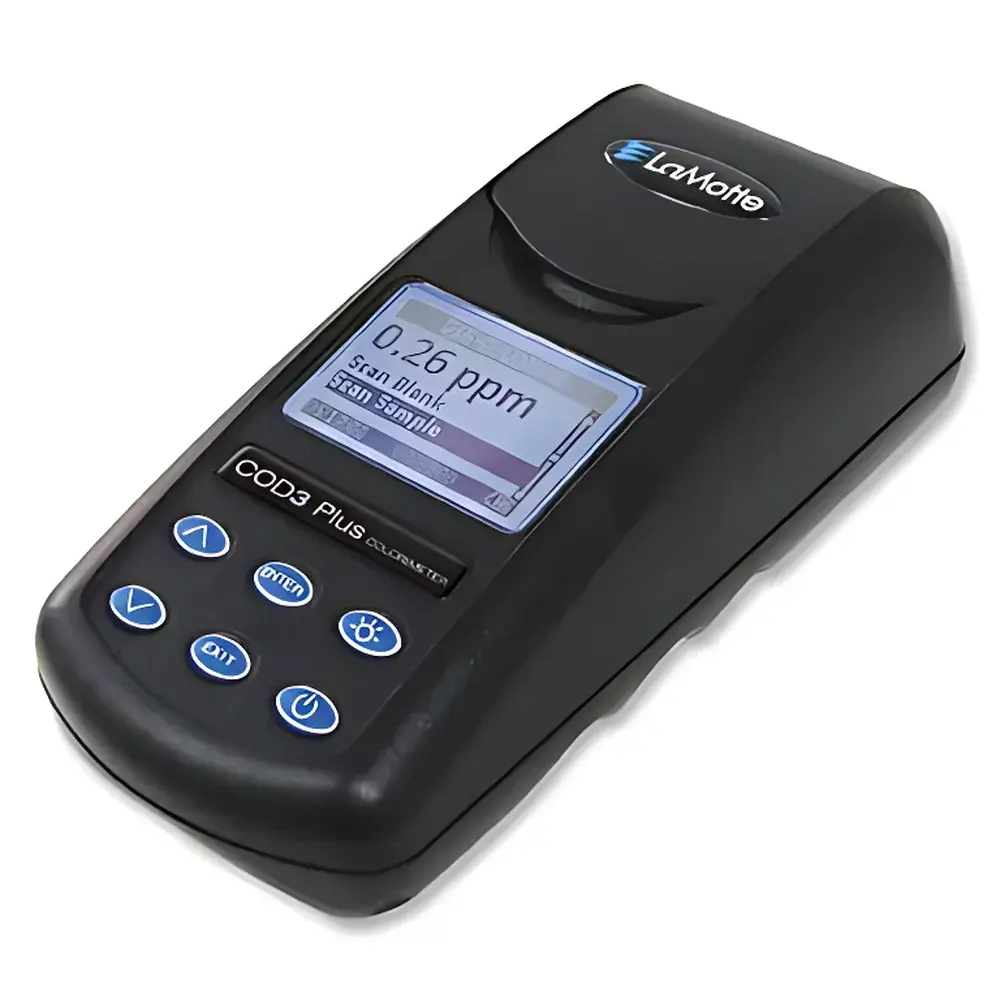
Lamotte COD3 PLUS Portable Chemical Oxygen Demand Analyzer
| Brand | Lamotte |
|---|---|
| Origin | USA |
| Model | COD3 PLUS |
| Instrument Type | Portable |
| Measurement Principle | UV-Vis Absorption Spectrophotometry (LED-based, dual-wavelength) |
| Wavelengths | 430 nm & 620 nm |
| Optical Range | 0–125% Transmittance (T) |
| Accuracy | ±2% Full Scale (FS) |
| Repeatability | ≤±5% |
| Detection Limit | 0.1 ppm |
| Measurement Time | 30 seconds |
| Batch Capacity | 1 sample per run |
| Light Source | High-stability LEDs with optical filters |
| Detector | Silicon photodiode |
| Display | 160 × 100 pixel backlit LCD (20 × 6 character graphical interface) |
| Sample Cells | 25 mm round cuvette, 10 mm square cell, 16 mm COD digestion vial |
| Power | Rechargeable Li-ion battery (500 tests per charge) or USB-powered operation |
| Data Storage | 500 timestamped measurement records with date/time stamp |
| Connectivity | USB interface for data export |
| Dimensions | 19.05 × 8.89 × 6.35 cm (7.5 × 3.5 × 2.5 in) |
| Weight | 453 g (16 oz) |
| Language Support | English, French, Spanish, Japanese, Italian, Portuguese, Chinese |
Overview
The Lamotte COD3 PLUS Portable Chemical Oxygen Demand Analyzer is a field-deployable, microprocessor-controlled spectrophotometer engineered for rapid, reliable quantification of chemical oxygen demand (COD) and over 30 additional water quality parameters in environmental, municipal, and industrial applications. Unlike traditional titrimetric or high-temperature digestion-only systems, the COD3 PLUS implements dual-wavelength LED-based absorption photometry—optimized at 430 nm and 620 nm—to deliver stable, drift-resistant measurements without reliance on halogen lamps or complex optical alignment. Its core architecture adheres to EPA-compliant methodology for COD determination when paired with certified digestion protocols (e.g., Method 410.4), while its optical design enables direct transmittance measurement across 0–125% T, supporting both low-absorbance trace analysis and high-concentration screening. The instrument operates on a fixed-pathlength principle using standardized 16 mm COD vials or interchangeable 10 mm square and 25 mm round cuvettes, ensuring compatibility with widely adopted reagent chemistries—including mercury-free and mercury-containing digestion kits—without recalibration.
Key Features
- Pre-programmed test library supporting 35+ EPA- and ISO-aligned water quality methods—including COD (low, standard, and high range), ammonia, phosphate, nitrate, copper, zinc, sulfate, turbidity, dissolved oxygen (Winkler), and cyanuric acid
- Automatic wavelength selection and dynamic zeroing via integrated microprocessor; no manual filter changes or manual baseline adjustment required
- Graphical 160 × 100 pixel backlit LCD with intuitive menu-driven navigation in seven languages (English, French, Spanish, Japanese, Italian, Portuguese, Chinese)
- User-configurable method storage: up to 25 custom calibration curves or reagent-specific protocols can be loaded via USB
- Onboard data logging with full timestamping (date + time); stores up to 500 measurement records with parameter ID, result, and operator tag
- Dual power options: long-life rechargeable Li-ion battery (rated for ≥500 measurements per charge) or continuous USB bus power for lab or vehicle use
- Ruggedized housing rated for field use; IP65-equivalent ingress protection against dust and water splashes
Sample Compatibility & Compliance
The COD3 PLUS accepts standard 16 mm COD digestion vials (for post-digestion analysis), 10 mm square cells (for low-volume or high-absorbance samples), and 25 mm round cuvettes (for legacy or multi-parameter workflows). All optical path geometries maintain consistent beam geometry and detector response, eliminating inter-cell variability. While the instrument itself does not perform digestion, it is fully compatible with Lamotte’s EPA-accepted digestion systems—including the 5-0102 COD Digestion Reactor—and supports both mercury-containing (e.g., 0075-SC, 0076-SC) and mercury-free (e.g., 0072-SC, 0073-SC) reagent kits. For regulatory reporting, COD results generated with validated digestion and measurement protocols comply with ASTM D1253, ISO 6060, and USEPA Method 410.4. Turbidity measurements (2–400 FTU) are referenced to Formazin standards but are not certified for direct EPA Method 180.1 compliance due to non-collimated detection geometry; users requiring regulatory-grade turbidity must employ dedicated nephelometers.
Software & Data Management
Data export is performed via USB 2.0 interface using Lamotte’s proprietary PC software (compatible with Windows 10/11), which enables batch download, CSV export, report generation with embedded metadata (operator ID, location tag, instrument serial number), and audit trail review. The onboard memory enforces GLP-compliant record integrity: each stored entry includes immutable timestamps, parameter name, measured value, unit, and method version identifier. While the COD3 PLUS does not implement FDA 21 CFR Part 11 electronic signature controls, its data structure supports integration into LIMS environments via standardized CSV schema. Firmware updates are delivered through secure USB-based package installation, preserving calibration coefficients and user-defined methods during upgrade cycles.
Applications
- Field-based wastewater effluent monitoring for municipal treatment plants conducting daily COD compliance checks
- Industrial pretreatment verification in food processing, pharmaceutical, and textile facilities prior to sewer discharge
- Stormwater runoff assessment at construction sites and highway drainage points under NPDES permit requirements
- Educational laboratories performing comparative COD methodology studies (e.g., dichromate vs. permanganate oxidation pathways)
- Drinking water source evaluation for organic loading trends in reservoirs and groundwater wells
- Emergency response screening during chemical spills or algal bloom events where rapid organic load estimation is critical
FAQ
Does the COD3 PLUS perform digestion internally?
No. The COD3 PLUS is a spectrophotometric analyzer only. Sample digestion must be conducted externally using a certified thermal digester (e.g., Lamotte 5-0102) prior to measurement.
Can I use third-party COD reagents with this instrument?
Yes—provided the reagent system produces a stable, linear absorbance response at either 430 nm or 620 nm and is calibrated against NIST-traceable COD standards. However, Lamotte-certified reagents (e.g., 0072-SC, 0073-SC) guarantee method validation and full technical support.
Is the turbidity measurement EPA-compliant?
The turbidity function provides rapid field screening (2–400 FTU) but uses absorbance-based detection rather than true nephelometry. It is not approved for regulatory reporting under EPA Method 180.1; dedicated turbidimeters meeting ISO 7027 are required for compliance submissions.
How is calibration verified between uses?
The instrument performs automatic dark-current compensation before each measurement. Users may verify photometric accuracy using Lamotte’s 100% T reference standard (Cat. No. 5-0101) and certified neutral density filters traceable to NIST.
What is the recommended maintenance schedule?
Optical surfaces should be cleaned weekly with lens-grade tissue and isopropyl alcohol. Battery health should be assessed quarterly; full discharge/recharge cycles are recommended every 90 days to maintain capacity. No routine lamp replacement is required—LEDs are rated for >50,000 hours of operation.
Related Products







