
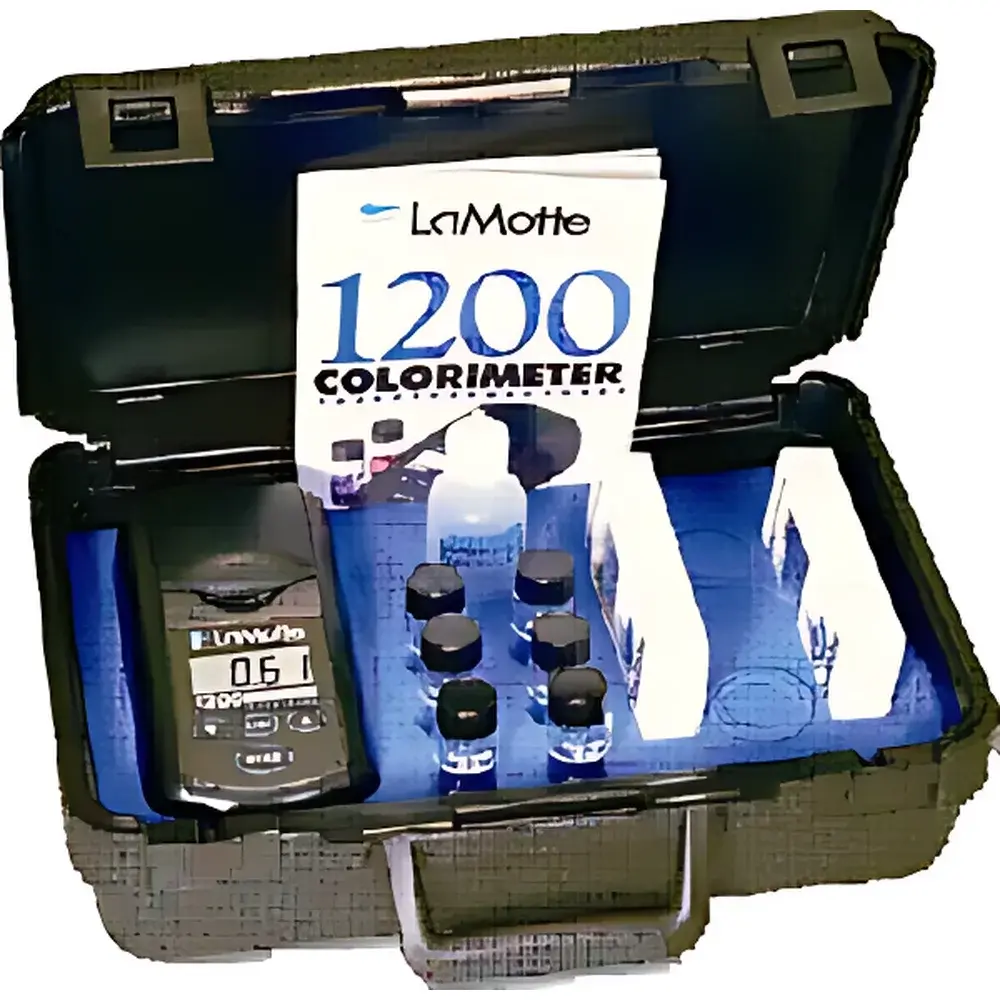
LaMotte DC1200-CL Residual Chlorine Analyzer
| Brand | LaMotte |
|---|---|
| Origin | USA |
| Model | DC1200-CL |
| Instrument Type | Portable |
| Measurement Principle | DPD Colorimetric Method (EPA-Compliant) |
| Measuring Parameter | Free Chlorine |
| Range | 0.00–4.00 mg/L |
| Accuracy | ±0.01 mg/L |
| Repeatability | ±0.02 mg/L |
| Resolution | 0.01 mg/L |
| LOD | 0.025 mg/L |
| Optical Precision | ±0.001 Absorbance Units |
| Response Time | 2 s |
| Light Source | LED |
| Detector | Silicon Photodiode |
| Wavelength | Single-Wavelength (530 nm typical for DPD) |
| Cuvette | 25 mm square, flat-bottom, capped |
| Display | 3.5-digit LCD |
| Power | 9 V alkaline battery or optional AC adapter (220 V / 50 Hz) |
| Dimensions | 8.5 × 16.2 × 6.7 cm |
| Weight | 312 g |
| Operating Temperature | 0–50 °C |
| Storage Temperature | −40 to +60 °C |
| Relative Humidity | 0–90 % RH (non-condensing) |
| Certifications | CE |
Overview
The LaMotte DC1200-CL Residual Chlorine Analyzer is a field-deployable, single-parameter photometric instrument engineered for rapid, precise quantification of free chlorine in drinking water, swimming pools, cooling towers, and wastewater effluents. It implements the U.S. Environmental Protection Agency (EPA)-recognized N,N-diethyl-p-phenylenediamine (DPD) colorimetric method—specifically aligned with EPA Method 334.0 and Standard Methods 4500-Cl G. The analyzer operates on a fixed-wavelength optical architecture centered at 530 nm, where oxidized DPD forms a stable pink-colored complex proportional to free chlorine concentration. Unlike multi-parameter platforms, the DC1200-CL eliminates cross-interference through dedicated optical path design and proprietary reagent chemistry, ensuring high specificity under variable matrix conditions (e.g., turbid or high-organic-content samples). Its microprocessor-controlled calibration algorithm compensates for inherent nonlinearity in the DPD reaction curve without requiring manual coefficient entry—enabling traceable, operator-independent results compliant with GLP documentation requirements.
Key Features
- True portable form factor (312 g) with IP67-rated housing for splash resistance—validated for continuous operation in humid, outdoor, or mobile laboratory environments.
- Zero-calibration workflow: Insert blank cuvette and press “Zero”—no numeric input required; automatic baseline subtraction performed in real time.
- Integrated flip-top cuvette cover blocks ambient light interference during measurement, critical for field accuracy per ISO 7027-1:2016 optical integrity guidelines.
- High-stability LED light source with <±0.001 absorbance unit optical precision ensures long-term repeatability across battery charge cycles.
- Two-second response time enables throughput of >20 samples/hour without thermal equilibration delays.
- 3.5-digit LCD displays concentration directly in mg/L with low-battery warning icon and auto-power-off after 5 minutes of inactivity.
- RS-232 serial interface supports direct data export to LIMS or Excel via optional cable (part #DC-COM1), enabling audit-ready record retention.
Sample Compatibility & Compliance
The DC1200-CL is validated for use with standard 25 mm square, flat-bottom, screw-cap cuvettes (included), accommodating both DPD tablet (Cat. #3670-01, 100 tests) and liquid reagent (Cat. #3670-01-LI, 140 tests) formats. Sample volume requirement is 10 mL; no filtration or dilution is necessary for clear water matrices. For turbid or colored samples, users may apply optional pre-filtration (0.45 µm membrane) per ASTM D1293 guidance. The instrument meets CE marking requirements for electromagnetic compatibility (EN 61326-1) and safety (EN 61010-1). Its measurement protocol satisfies U.S. Safe Drinking Water Act (SDWA) reporting thresholds and aligns with WHO Guidelines for Drinking-water Quality (4th ed.) for residual disinfectant monitoring.
Software & Data Management
While the DC1200-CL operates as a standalone instrument, its RS-232 output enables integration into regulated workflows. When connected to a PC running LaMotte’s optional LogLink software (v3.2+), users can generate timestamped reports containing sample ID, date/time, operator code, measured value, and calibration status—supporting 21 CFR Part 11-compliant electronic records when paired with institutional authentication protocols. All data are stored in CSV format for third-party statistical analysis (e.g., Shewhart control charts per ISO 9001:2015 Clause 8.5.1). Firmware updates are delivered via ASCII text file upload, preserving configuration integrity during revision control.
Applications
- Drinking water distribution system validation—routine verification of chlorine residual at entry points, storage tanks, and endpoint taps.
- Swimming pool and spa compliance monitoring—real-time adjustment of dosing systems to maintain 1–3 mg/L free chlorine per CDC Model Aquatic Health Code.
- Wastewater disinfection efficacy assessment—post-chlorination verification prior to discharge per NPDES permit limits.
- Pharmaceutical facility purified water loop surveillance—meeting USP and EU GMP Annex 1 requirements for microbial control indicators.
- Educational laboratories—teaching quantitative analytical chemistry principles including Beer-Lambert law application, method validation, and uncertainty propagation.
FAQ
Does the DC1200-CL measure total chlorine or only free chlorine?
It measures free chlorine exclusively using the DPD Method 1 protocol. Total chlorine requires DPD Method 3 (with glycine quenching), which is not supported by this model.
Can the instrument be used for chloramine detection?
No—chloramines require separate methodology (e.g., DPD Method 2 with iodide catalysis) and are outside the scope of DC1200-CL’s optical and reagent design.
Is the 9 V battery replaceable in the field?
Yes—the battery compartment is tool-free accessible; average runtime exceeds 2,000 measurements per set of alkaline cells.
How often must the instrument be calibrated?
Factory calibration is stable for 12 months under normal use; verification with NIST-traceable chlorine standard (e.g., LaMotte Cat. #3670-STD) is recommended before each daily shift.
What maintenance is required beyond routine cleaning?
Cuvette path optics should be wiped with lint-free tissue and isopropyl alcohol quarterly; no internal alignment or lamp replacement is needed during the instrument’s service life.
Related Products







