
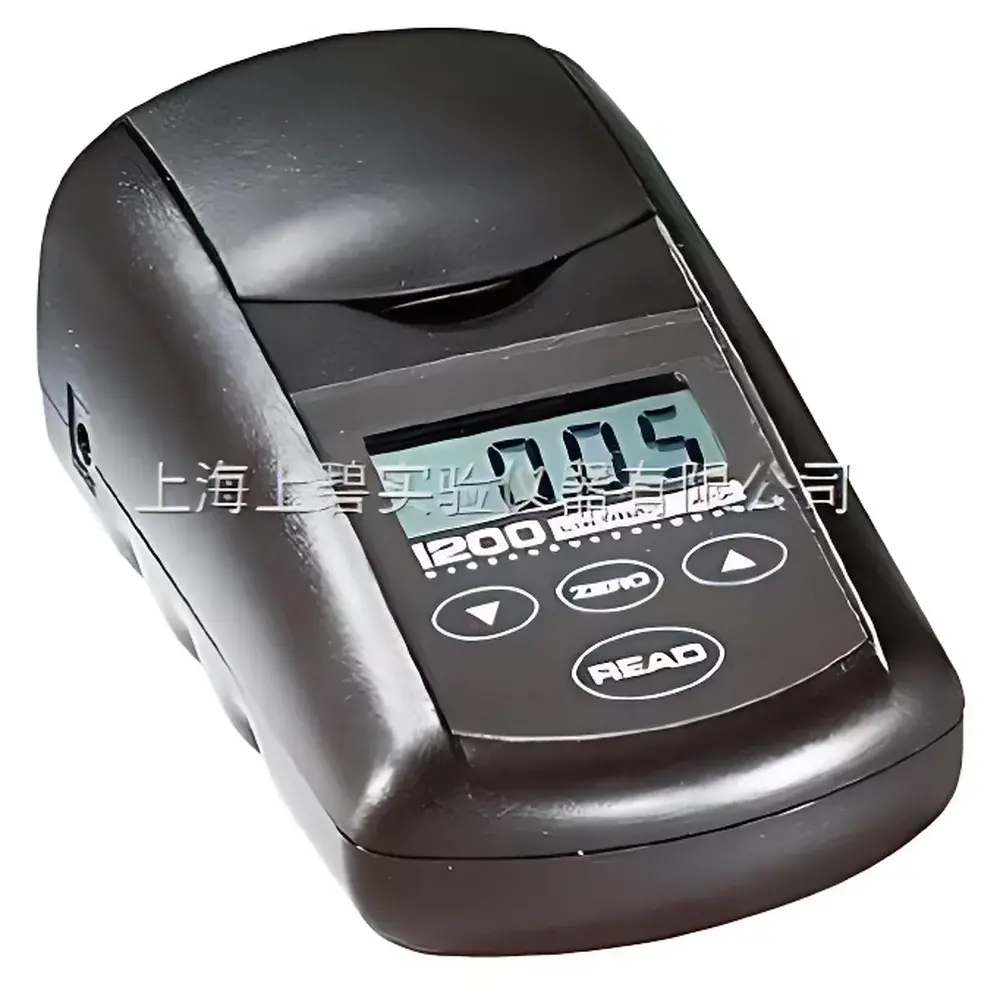
Lamotte DC1200-PLR Portable Colorimeter
| Origin | USA |
|---|---|
| Manufacturer Type | Authorized Distributor |
| Origin Category | Imported |
| Model | DC1200-PLR |
| Wavelength | 570 nm (Phosphate-specific) |
| Range | 0.00–6.00 mg/L PO₄-P |
| Resolution | 0.01 mg/L |
| Optical Accuracy | ±0.001 Absorbance Units |
| Response Time | 2 s |
| Light Source | LED |
| Detector | Silicon Photodiode |
| Cuvette Format | 25 mm round vials |
| Display | 3½-digit LCD with low-battery indicator |
| Enclosure | IP67-rated waterproof housing |
| Compliance | CE, EPA-compliant methods (e.g., EPA 365.3 for phosphate), RoHS |
| Power | 9 V alkaline battery or optional 220 V AC adapter (Model 1726-220) |
| Dimensions | 15 × 8 × 5.5 cm |
| Weight | 0.4 kg |
| Interface | RS232 (Cable Model 1772) |
| Standard Accessories | Sample vials, reagents, rugged carrying case |
Overview
The Lamotte DC1200-PLR Portable Colorimeter is a single-wavelength, direct-reading photometric instrument engineered for field-deployable quantification of orthophosphate (as PO₄-P) in water and wastewater samples. It operates on the principle of Beer-Lambert absorption spectroscopy at a fixed wavelength of 570 nm, optimized for the molybdenum blue reaction—standardized under U.S. Environmental Protection Agency Method 365.3 and equivalent ISO 6878 protocols. The device integrates a stable LED light source and a calibrated silicon photodiode detector to deliver repeatable absorbance measurements across its full analytical range (0.00–6.00 mg/L PO₄-P), with resolution to 0.01 mg/L and optical accuracy of ±0.001 absorbance units. Its microprocessor-controlled electronics support non-linear calibration curves, enabling accurate concentration readouts without manual curve-fitting or software interpolation. Designed explicitly for environmental monitoring, drinking water compliance, and wastewater treatment operations, the DC1200-PLR eliminates reliance on laboratory-based spectrophotometers while maintaining traceability to reference standards.
Key Features
- IP67-rated waterproof enclosure ensures reliable operation in rain, humidity, dust, and splashing conditions—validated for outdoor and industrial site use.
- Flip-top cuvette cover blocks stray light completely, eliminating ambient interference during measurement—a critical design element for high reproducibility in uncontrolled environments.
- One-button zeroing: Insert blank vial, press “Zero”—no numeric entry required; system auto-compensates for vial pathlength and background absorbance.
- Large 3½-digit LCD display with integrated low-battery warning provides clear visibility under variable lighting, including direct sunlight.
- Dual power options: Standard 9 V alkaline battery (typical life >2,000 measurements) or optional 220 V AC adapter (Model 1726-220) for extended benchtop use.
- RS232 serial interface (cable Model 1772 included) enables direct data export to LIMS, Excel, or custom QA/QC databases with timestamped records.
Sample Compatibility & Compliance
The DC1200-PLR is validated for aqueous samples meeting standard EPA sample preservation criteria (e.g., refrigeration at ≤4°C, acidification for metals analysis where co-measured). It accepts standard 25 mm round glass or plastic vials (supplied), with strict adherence to vial cleanliness and optical clarity per ASTM D5847. Phosphate measurement follows EPA Method 365.3 using ammonium molybdate–ascorbic acid reagents (Lamotte Catalog No. 3670-01 or equivalent), with detection limited by interferences from arsenate (>10×), silicate (>50 mg/L), and high turbidity (>5 NTU)—all documented in the operator manual per GLP requirements. Instrument performance verification is supported by NIST-traceable secondary standards (e.g., Lamotte 4140 DPD Chlorine Secondary Standards Kit adapted for phosphate validation via certified reference materials). The unit complies with CE marking directives (2014/30/EU EMC, 2011/65/EU RoHS) and supports audit-ready documentation for ISO/IEC 17025-accredited laboratories.
Software & Data Management
While the DC1200-PLR operates as a standalone instrument, its RS232 output delivers ASCII-formatted data packets containing measured concentration (mg/L), date/time stamp (if external clock sync enabled), and instrument ID. When connected to compliant laboratory informatics systems, this stream satisfies FDA 21 CFR Part 11 requirements for electronic records when paired with user authentication and audit trail logging. Lamotte does not provide proprietary PC software; however, the protocol is fully compatible with third-party serial terminal emulators (e.g., Tera Term, PuTTY) and LabVIEW-compatible drivers. Raw absorbance values are not exposed—only final concentration results—to maintain method integrity and reduce operator interpretation error. All calibration data, including zero and span points, are retained in non-volatile memory and can be recalled for GLP audit review.
Applications
- Drinking water utilities performing routine phosphate screening per State Revolving Fund (SRF) reporting requirements.
- Wastewater treatment plants conducting effluent monitoring for NPDES permit compliance (e.g., total phosphorus limits).
- Environmental consultants executing watershed nutrient loading assessments in lakes, rivers, and estuaries.
- Educational laboratories teaching colorimetric analysis principles with EPA-aligned methodology.
- Industrial pretreatment facilities verifying phosphate removal efficiency prior to municipal sewer discharge.
FAQ
Does the DC1200-PLR require annual factory recalibration?
No—calibration is performed in-field using Lamotte-certified reagents and blank vials. Annual verification against NIST-traceable standards is recommended but not mandatory under EPA guidance for field instruments.
Can the same instrument measure multiple analytes?
No—the DC1200-PLR is dedicated to phosphate at 570 nm. Other analytes (e.g., chlorine, nitrate, iron) require separate model variants (e.g., DC1200-CL, DC1200-NA) with matched wavelength optics and chemistry.
Is the RS232 interface compatible with modern Windows/macOS systems?
Yes—when used with a USB-to-serial adapter (FTDI chipset recommended) and standard terminal software, the interface functions without proprietary drivers.
What is the shelf life of the included phosphate reagents?
Unopened reagent kits retain stability for 24 months when stored at 15–25°C; opened vials must be refrigerated and used within 90 days per Lamotte Certificate of Analysis.
How is measurement uncertainty quantified for regulatory reporting?
Total uncertainty is derived from repeatability (±0.02 mg/L at 1.0 mg/L), reagent lot variability (±3% CV), and operator technique (±0.01 mg/L); combined standard uncertainty is reported as ±0.03 mg/L (k=2) in method validation summaries.




