
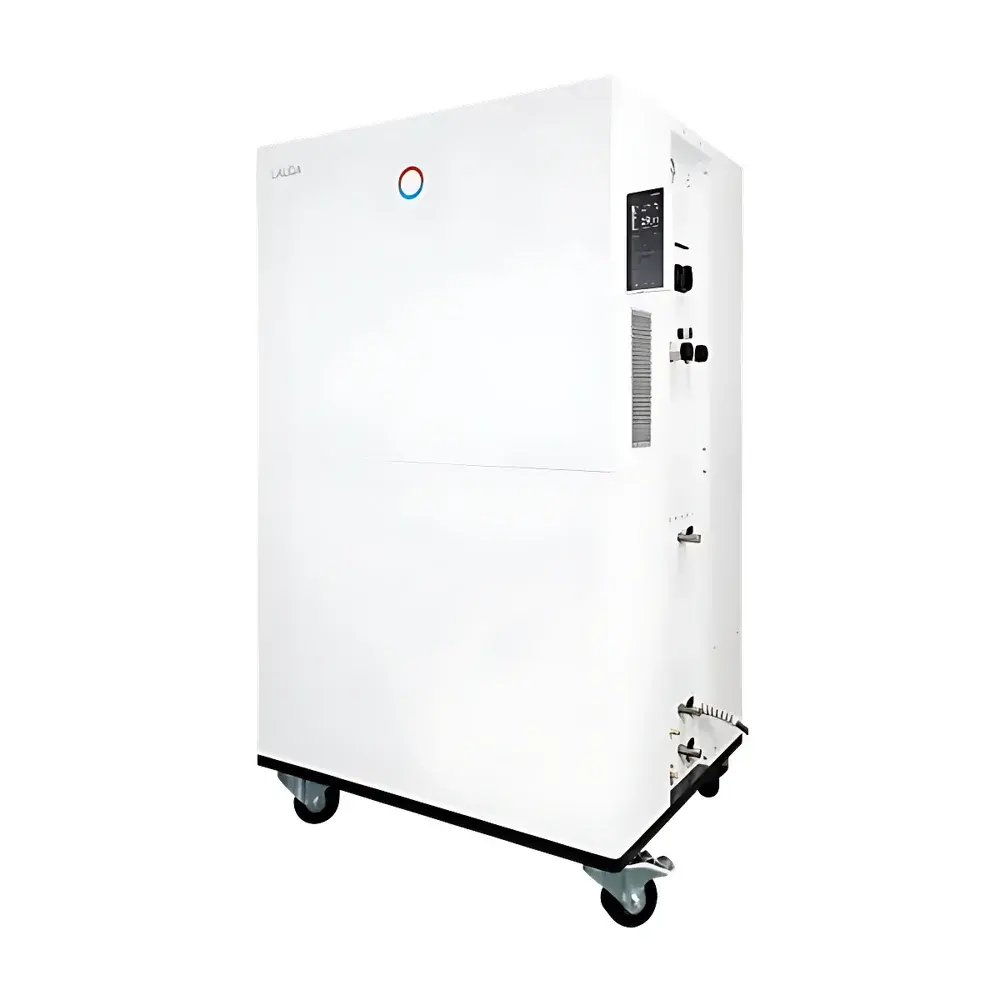
LAUDA Integral P Process Circulating Chiller
| Brand | LAUDA |
|---|---|
| Origin | Germany |
| Model | IN2050 PW |
| Temperature Range | −40 to +140 °C |
| Bath Volume | 36.3 L |
| Circulation Type | Internal & External |
| Temperature Control Mode | Refrigeration & Heating |
| Fluid Compatibility | Water/glycol mix (non-flammable, pressurized up to 4 bar) |
| Pump | High-performance LAUDA variable-speed pressure pump (8 output levels, pressure regulation) |
| Programmability | 150-step temperature/time program (5 independent programs) |
| Display | TFT touchscreen with multi-interface switching (curve view, parameter view) |
| Connectivity | Built-in web server (LAN access via PC/tablet/smartphone), Ethernet & USB ports included |
| Accessories Included | Pt100 sensor, fault contactor, vacuum-fill nozzle tube |
| Expansion | Two modular expansion slots |
| Dimensions (W×D×H) | 1100 × 895 × 1865 mm |
| Heating Power | 16 kW |
| Cooling Power (at 20 °C) | 20 kW |
| Max Flow Rate / Pump Pressure | 120 L/min / 6.0 bar |
Overview
The LAUDA Integral P Process Circulating Chiller (Model IN2050 PW) is an engineered thermal management system designed for demanding industrial process applications requiring precise, stable, and reproducible temperature control across an exceptionally wide operational range—from −40 °C to +140 °C. Unlike conventional open-bath circulators, the Integral P series operates under controlled overpressure (up to 4 bar), enabling the use of non-flammable water/ethylene glycol mixtures at elevated temperatures without boiling or vaporization. This pressurized expansion principle eliminates the need for silicone oil or other high-temperature synthetic fluids—reducing maintenance complexity, improving thermal safety, and ensuring compliance with workplace fluid-handling regulations. Its robust stainless-steel bath construction, integrated pressure-regulated bypass valve, and dual-mode refrigeration/heating architecture make it suitable for continuous-duty operation in pilot-scale reactors, jacketed vessels, calorimeters, and inline process monitoring systems.
Key Features
- Wide temperature span: −40 °C to +140 °C using pressurized aqueous glycol solution (no oil required)
- High-capacity circulation: 120 L/min max flow at 6.0 bar pump pressure, supporting large external loops with minimal pressure drop
- LAUDA variable-speed pressure pump with 8 discrete output stages and real-time pressure feedback control
- TFT color touchscreen interface with configurable display modes—including real-time temperature curve plotting, setpoint/status overview, and alarm history log
- Onboard programmable controller: 150-segment temperature/time profiles, organized into up to five independent programs for multi-stage processes
- Built-in web server enables remote monitoring and control over local area network (LAN); compatible with standard browsers on PCs, tablets, and smartphones
- Vacuum-assisted fill system with nozzle tube ensures bubble-free fluid charging and minimizes air entrapment in closed loops
- Two modular expansion slots support future integration of optional I/O modules (e.g., analog input for external sensor feedback, digital outputs for interlock signaling)
- Standard interfaces include Ethernet (RJ45), USB 2.0, Pt100 sensor input, and dry-contact fault relay for integration into plant SCADA or PLC environments
Sample Compatibility & Compliance
The Integral P IN2050 PW is validated for use with water/glycol mixtures (typically 30–50% v/v ethylene glycol), which remain thermally stable and non-volatile under pressurized conditions. It complies with DIN EN 61000-6-2 (immunity) and DIN EN 61000-6-4 (emission) for industrial electromagnetic compatibility. The unit meets CE marking requirements per Machinery Directive 2006/42/EC and Pressure Equipment Directive 2014/68/EU (PED Category II). Its sealed, low-vapor-pressure fluid handling design aligns with ISO 14001 environmental management principles and supports GLP-compliant documentation when paired with LAUDA.LIVE cloud-based service for firmware updates, diagnostic logs, and calibration traceability. No hazardous fluid classification applies due to the absence of hydrocarbon or silicone oils.
Software & Data Management
Internal firmware supports time-stamped event logging (including temperature deviations, pump status, pressure alarms, and power interruptions) with configurable retention periods. All operational data are accessible via the embedded HTTP server without third-party software installation. For regulated environments, optional LAUDA.LIVE subscription enables encrypted remote diagnostics, over-the-air firmware updates, and audit-trail generation compliant with FDA 21 CFR Part 11 requirements (when used with user-authenticated login and electronic signature protocols). Export formats include CSV and PDF reports; no proprietary binary formats are used. Configuration backups can be saved to USB storage or downloaded directly through the web interface.
Applications
- Temperature control of glass-lined or stainless-steel jacketed reactors in fine chemical synthesis
- Thermal conditioning of inline viscometers, FTIR flow cells, and UV/Vis spectrophotometric cuvettes
- Cooling/heating of calorimetric test rigs (e.g., reaction calorimeters, DSC reference units)
- Stabilization of laser sources, optical benches, and precision metrology equipment requiring sub-0.1 °C stability
- Process validation studies under ICH Q5C and USP guidelines for thermal stress testing of biologics
- Support of ASTM E2022-compliant thermal cycling tests for material aging and polymer degradation analysis
FAQ
What fluid types are approved for use in the Integral P series?
Only water/ethylene glycol (or propylene glycol) mixtures meeting LAUDA specification L-FLUID 200 are permitted. Silicone oils, mineral oils, or organic solvents are strictly prohibited due to compatibility and safety constraints.
Can the unit operate unattended for extended periods?
Yes—the system includes hardware-level watchdog timers, automatic restart after power failure, and configurable alarm thresholds with relay outputs for external shutdown sequencing.
Is external pressure regulation required for the process loop?
No. The integrated bypass valve and pressure-controlled pump maintain constant differential pressure across the external circuit; users only need to ensure mechanical integrity of their piping per PED Annex I requirements.
How is temperature uniformity verified across the bath volume?
LAUDA certifies axial and radial uniformity to ±0.3 °C at steady state (measured per DIN 12876-1 using nine-point Pt100 probe mapping), with dynamic stability of ±0.1 °C over 24-hour operation.
Does the device support Modbus TCP or Profibus DP communication?
Not natively—but the Ethernet port supports custom HTTP API integration; third-party gateways may be deployed to translate RESTful commands to fieldbus protocols as part of a larger automation architecture.
Related Products



