
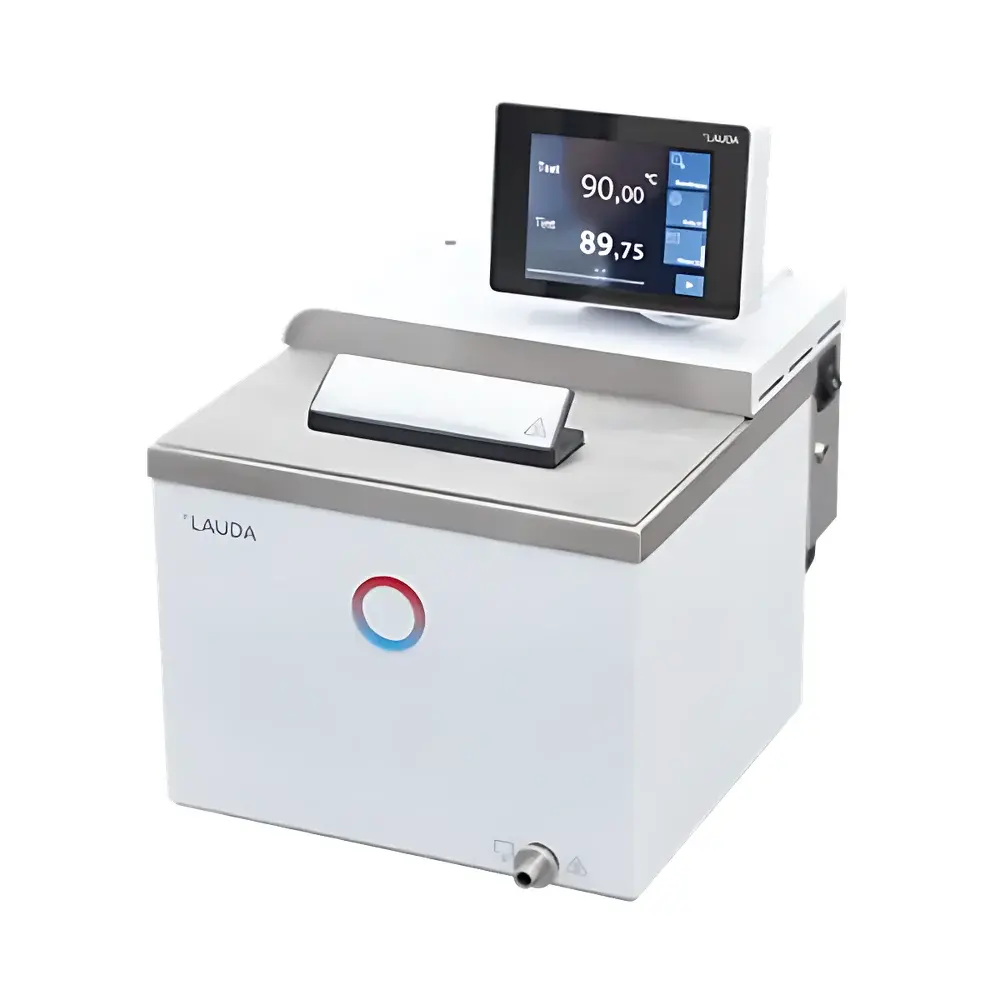
LAUDA PRO P10C Stainless Steel Bath Circulating Temperature Controller
| Brand | LAUDA |
|---|---|
| Origin | Germany |
| Model | P10C |
| Instrument Type | Circulating Temperature Bath |
| Circulation Mode | Internal & External |
| Temperature Control | Heating & Cooling |
| Bath Volume | 30 L |
| Temperature Range | 40–250 °C |
| Temperature Stability | ±0.01 K |
| Interface | Ethernet, USB, Pt100 |
| Pump | Integrated Vario Pump (8 adjustable power levels) |
| Bath Material | Insulated Stainless Steel with Carry Handles |
| Drain Valve | Front-mounted |
| Control Unit | Detachable OLED Basic Unit or Color Touchscreen Command Unit |
Overview
The LAUDA PRO P10C is a high-precision, stainless steel circulating temperature controller engineered for demanding laboratory and pilot-scale applications requiring stable, programmable thermal environments between 40 °C and 250 °C. Utilizing a dual-mode (heating/cooling) thermoregulation architecture with integrated refrigeration circuitry and high-efficiency resistive heating elements, the P10C maintains exceptional thermal homogeneity and dynamic response across its full operating range. Its core design principle centers on minimizing thermal lag and spatial gradient—achieving ±0.01 K stability under steady-state conditions—making it suitable for calorimetric studies, reaction kinetics monitoring, viscometry calibration, and material testing where thermal drift directly impacts measurement validity. The unit complies with IEC 61000-6-3 (EMC emission standards) and IEC 61010-1 (safety requirements for electrical equipment for measurement, control, and laboratory use), ensuring safe integration into regulated research and quality control environments.
Key Features
- Stainless steel bath vessel (30 L capacity), fully insulated with ergonomic lifting handles and front-mounted drain valve for rapid, spill-free fluid exchange
- Integrated Vario pump with eight discrete flow-rate settings (0.5–22 L/min), enabling precise adaptation to external loops with varying hydraulic resistance
- Detachable control interface: choice of OLED-based Basic Unit or full-color touchscreen Command Unit—both support remote mounting up to 2 m via shielded cable
- Dual communication architecture: standard Ethernet (TCP/IP, Modbus TCP) and USB 2.0 for direct PC connectivity; Pt100 input channel supports external sensor feedback for cascade or master-slave configurations
- Compact footprint (310 × 335 × 415 mm) with height-reduced profile when control unit is detached—optimized for benchtop integration beneath fume hoods or within modular lab cabinets
- Energy-efficient operation: peak power draw limited to 3.7 kW; intelligent load-matching algorithm minimizes compressor cycling and heater duty cycle during extended dwell periods
Sample Compatibility & Compliance
The P10C accommodates a broad spectrum of heat-transfer media—including water, silicone oils (e.g., DC200 series), and polyalkylene glycols—within its chemically resistant stainless steel bath and wetted components (SS316 pump head, EPDM seals). Bath compatibility extends to ISO 8573-1 Class 3 compressed air environments when used in conjunction with external dry-gas purging accessories. The system meets essential regulatory prerequisites for GLP-compliant laboratories: audit-trail-capable firmware (with timestamped parameter changes), password-protected configuration modes, and non-volatile memory retention of calibration offsets and operational logs. While not intrinsically rated for hazardous locations, optional ATEX-compatible variants (PRO Ex series) are available upon request for solvent-handling applications.
Software & Data Management
LAUDA’s proprietary WinPDA software (v5.2+) provides full remote supervision via Ethernet—enabling real-time graphing of bath temperature, external sensor readings, pump speed, and power consumption. Data export adheres to ASTM E1447-20 compliant CSV format with embedded metadata (operator ID, method name, UTC timestamps). For enterprise integration, the device supports OPC UA server functionality (IEC 62541), allowing seamless ingestion into LIMS or MES platforms. All firmware updates are digitally signed and validated prior to installation, satisfying FDA 21 CFR Part 11 requirements for electronic records and signatures when deployed with appropriate access controls and audit logging enabled.
Applications
- Calibration of temperature-sensitive analytical instruments (e.g., DSC, TGA, rheometers) against NIST-traceable reference standards
- Controlled-temperature synthesis in jacketed reactors (compatible with LAUDA’s RC series controllers via analog setpoint interface)
- Thermal aging studies per ISO 188 or ASTM D573 protocols for elastomers and polymer compounds
- Viscosity benchmarking using calibrated Ubbelohde or Cannon-Fenske capillaries at fixed shear rates
- Preconditioning of test specimens prior to mechanical testing (tensile, impact, creep) in accordance with ISO 291 ambient conditioning guidelines
- Stabilization of optical benches, interferometers, or laser diode mounts requiring sub-0.02 K thermal drift over 8-hour intervals
FAQ
What is the maximum recommended working temperature for silicone oil in the P10C bath?
For long-term stability and oxidation resistance, LAUDA recommends limiting silicone oil operation to ≤220 °C; continuous use above this threshold accelerates fluid degradation and may compromise seal longevity.
Can the P10C maintain temperature stability while circulating fluid through a 5-meter external loop with 12 mm ID tubing?
Yes—the Vario pump’s highest flow setting (22 L/min) delivers sufficient head pressure (up to 1.8 bar) to overcome typical pressure losses in such configurations; however, thermal inertia increases by ~15–20% versus open-bath operation, requiring minor PID retuning.
Is Pt100 calibration traceable to national standards included with the unit?
The factory-installed Pt100 sensor is supplied with a UKAS-accredited calibration certificate (ref. LAUDA-CAL-Pt100-XXXXX); user-performed recalibration requires a certified dry-block calibrator meeting ISO/IEC 17025 requirements.
Does the Ethernet interface support secure communication (e.g., TLS or SSH)?
The current firmware implements unencrypted Modbus TCP and HTTP-based status polling; encrypted protocols are planned for Q3 2025 firmware release (v5.4+), pending security validation per IEC 62443-4-2.
What maintenance intervals are specified for the refrigeration circuit?
Compressor oil and filter-drier replacement is required every 24 months under continuous operation; LAUDA’s service portal provides automated maintenance scheduling based on logged runtime hours and ambient humidity exposure data.



