
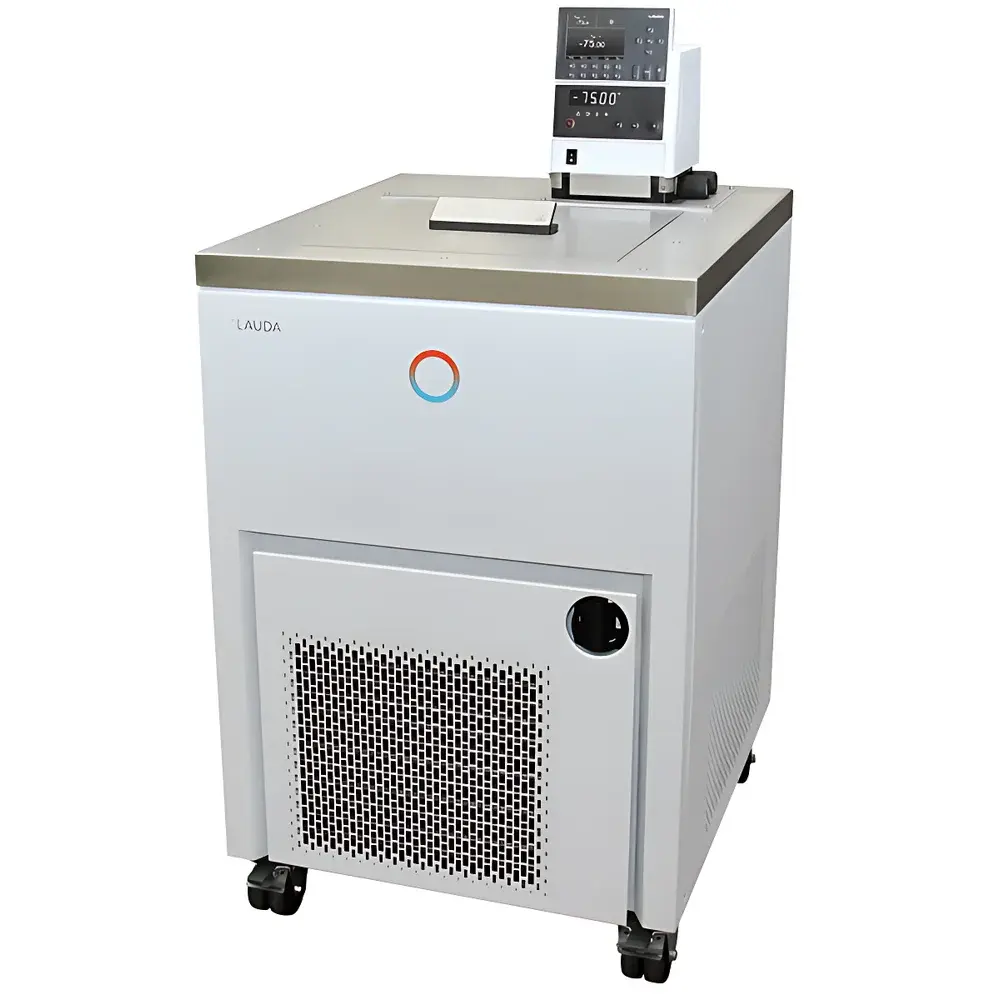
LAUDA Proline Kryomats RP4050C/W High-Performance Refrigerated Circulating Bath
| Brand | LAUDA |
|---|---|
| Origin | Germany |
| Model | RP4050C/W |
| Instrument Type | Refrigerated/Heating Circulating Bath |
| Bath Volume | 44 L |
| Temperature Range | −90 °C to +200 °C |
| Temperature Stability | ±1 K |
| Circulation Mode | External Circulation |
| Control Interface | Detachable High-Resolution LCD Controller with Programmable Display Functions |
| Pump Configuration | 4-Stage Adjustable Pressure Pump (Optimized for Internal/External Loops) |
| Integrated Features | Heated Bath Bridge Plate & Lid Heater (Condensation Suppression), Bypass Flow Regulator, Rear/Side Pump Ports |
| Programming Capacity | 150 Segments (Up to 5 Independent Programs) |
| Heating Power | 3.5 kW |
| Refrigeration Power (at 20 °C) | 5.0–6.0 kW |
| Max. Flow Rate / Pump Pressure | 19 L/min / 0.5 bar |
| Dimensions (W×D×H) | 600 × 700 × 1216 mm |
| Cooling Method | Air-Cooled or Water-Cooled Options Available |
Overview
The LAUDA Proline Kryomats RP4050C/W is a high-precision, dual-mode refrigerated/heating circulating bath engineered for demanding laboratory and industrial process applications requiring extreme thermal stability across an exceptionally wide operating range (−90 °C to +200 °C). Based on LAUDA’s proven Kryomats platform, this unit employs a cascade refrigeration system combined with high-efficiency electric heating elements to achieve rapid temperature ramping, precise setpoint maintenance, and long-term operational reliability. Its design adheres to fundamental thermodynamic principles governing heat transfer in closed-loop liquid circulation systems—utilizing forced convection via a multi-stage adjustable pressure pump to ensure uniform thermal distribution both within the integrated 44 L stainless-steel bath reservoir and throughout externally connected equipment (e.g., reactors, calorimeters, viscometers, or material test chambers). The system’s thermal stability of ±1 K is maintained under dynamic load conditions through adaptive PID control algorithms and real-time feedback from high-accuracy Pt100 sensors embedded in both the bath fluid and external loop return line.
Key Features
- Detachable high-resolution LCD controller with customizable display layout—enabling user-defined parameter visibility (e.g., bath temperature, external loop inlet/outlet, setpoint deviation, pump status) without navigation complexity
- Four-stage programmable pressure pump optimized for variable flow resistance in internal recirculation or external closed-loop configurations—ensuring consistent delivery pressure across viscosity- and length-dependent applications
- Integrated heated bath bridge plate and lid heater—actively preventing condensation formation during sub-ambient operation by maintaining surface temperatures above dew point, thereby eliminating moisture ingress into sensitive instrumentation interfaces
- Built-in bypass flow regulator and dual-position (rear/side) quick-connect pump ports—facilitating flexible integration with auxiliary equipment while minimizing dead volume and thermal lag
- Advanced programmable timer supporting up to 150 time–temperature segments distributed across five independent programs—ideal for simulating complex thermal profiles required in polymer curing, accelerated aging, or cryogenic material conditioning protocols
- Air-cooled and water-cooled variants available—allowing installation flexibility in environments with limited ventilation capacity or strict noise constraints
Sample Compatibility & Compliance
The RP4050C/W accommodates a broad spectrum of heat-transfer media—including water, water–glycol mixtures, silicone oils, and specialized low-temperature fluids—subject to compatibility verification per LAUDA’s Fluid Compatibility Guide (v.4.2). Its stainless-steel bath construction and chemically resistant wetted components meet DIN EN ISO 15223-1 requirements for medical device labeling and are compatible with GLP-compliant workflows when used with validated SOPs. While not intrinsically rated for hazardous area use, the unit complies with IEC 61010-1:2010 for electrical safety in laboratory equipment and conforms to CE marking directives (2014/30/EU EMC, 2014/35/EU LVD). Optional data logging modules support 21 CFR Part 11–compliant audit trails when paired with LAUDA’s Proline Software Suite.
Software & Data Management
The RP4050C/W supports remote operation via LAUDA’s Proline Command interface (RS232/RS485, Ethernet optional), enabling integration into centralized lab automation platforms. The native firmware includes non-volatile memory for program retention during power interruption and supports Modbus RTU/TCP protocol for SCADA-level interoperability. When configured with LAUDA’s Proline LabControl software (Windows-based), users gain access to real-time graphing, automated report generation (PDF/CSV), alarm event logging with timestamped metadata, and password-protected parameter lockdown—meeting essential criteria for ISO/IEC 17025-accredited testing laboratories. All temperature and flow data are timestamped with millisecond resolution and exportable for traceability in regulatory submissions.
Applications
- Material science: Thermal cycling of composites, elastomers, and phase-change materials under controlled shear-free conditions
- Pharmaceutical development: Dissolution testing at physiologically relevant temperatures; stability studies per ICH Q1A(R2)
- Chemical process engineering: Jacket temperature control for glass reactors (e.g., D.I.E.H.M. systems) and pilot-scale synthesis units
- Calibration laboratories: Reference temperature source for thermometer and sensor validation per ASTM E74 and ISO 17025 Annex A.3
- Electronics testing: Environmental stress screening of PCB assemblies and semiconductor packages across extended cold-to-hot transitions
- Automotive R&D: Coolant simulation for battery thermal management system validation
FAQ
What heat transfer fluids are recommended for operation below −40 °C?
For sustained operation below −40 °C, LAUDA recommends certified low-viscosity synthetic hydrocarbon or fluorinated fluids (e.g., Therminol LT, Shell S2 PAG 10) — always consult the Fluid Compatibility Matrix prior to selection.
Can the RP4050C/W be operated in a fully unattended mode for overnight thermal cycling?
Yes — its programmable controller, non-volatile memory, and integrated safety cutoffs (overtemperature, low-level, dry-run protection) enable validated unattended operation when deployed with appropriate environmental monitoring.
Is external cooling water required for the water-cooled variant?
Yes — the water-cooled configuration requires a continuous supply of deionized water at 10–25 °C and 3–6 bar pressure, with flow rate ≥2.5 L/min, as specified in the Installation Manual Section 4.2.
How does the heated lid prevent condensation without compromising thermal efficiency?
The lid heater operates independently at a precisely regulated temperature (~5–10 K above ambient dew point), creating a thermal barrier that suppresses moisture nucleation while contributing negligibly (<0.5%) to total system energy demand.
Does LAUDA provide IQ/OQ documentation for GMP-regulated environments?
Yes — factory-verified Installation Qualification (IQ) and Operational Qualification (OQ) templates are available upon request and may be executed onsite by LAUDA-certified field engineers.



