
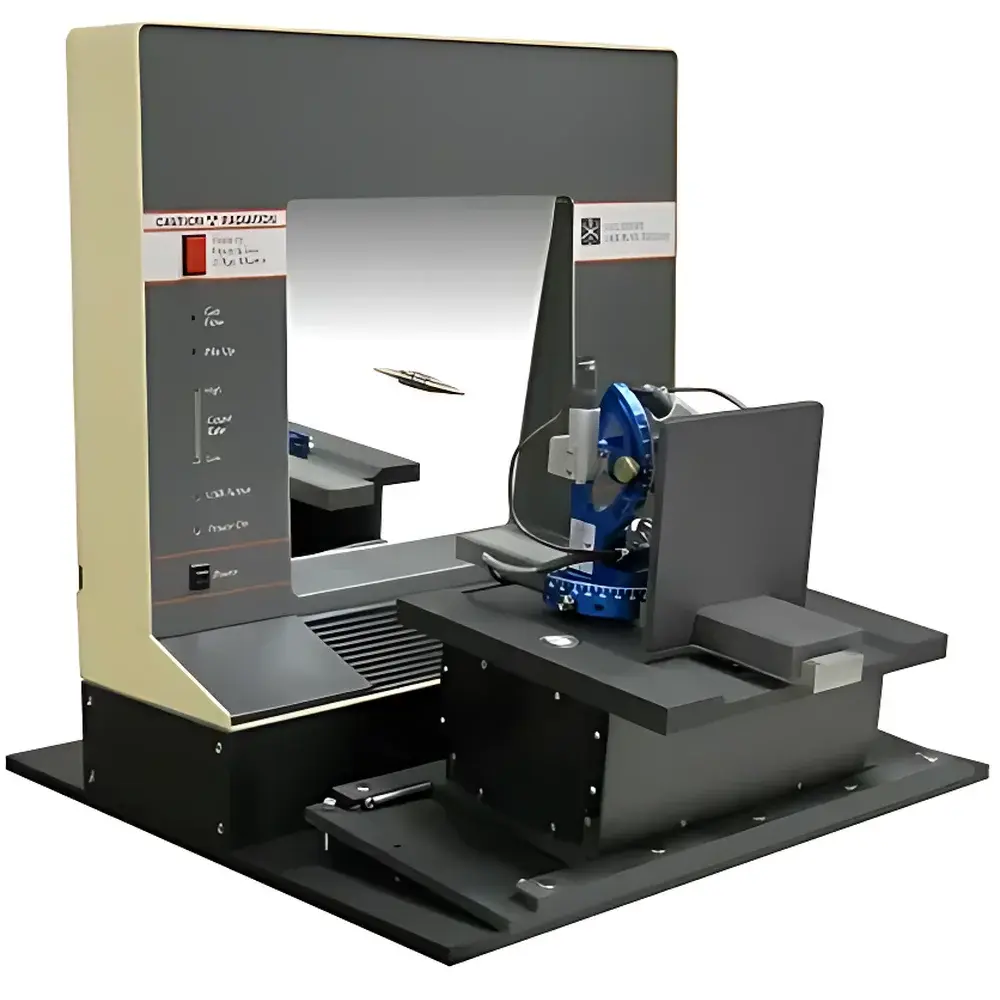
Laue Crystal Diffractometer LC-06
| Origin | USA |
|---|---|
| Manufacturer Type | Distributor |
| Origin Category | Imported |
| Model | LC-06 |
| Price Range | USD 28,000 – 70,000 |
| Instrument Type | Single-Crystal X-ray Diffractometer |
| Angular Resolution | < 0.05° |
| Effective Detection Area | 30 cm × 30 cm |
| Data Acquisition Time | Seconds per Laue Pattern |
| Gas Replacement Interval | Every 6 months |
| Coolant Replacement Interval | Annually |
| Sample Rotation Capability | Yes |
Overview
The Laue Crystal Diffractometer LC-06 is a high-precision single-crystal X-ray diffractometer engineered for rapid, non-destructive structural characterization of crystalline materials. Based on the Laue diffraction method, it utilizes polychromatic (white) X-ray radiation incident on a stationary single crystal to generate a geometrically rich diffraction pattern governed by the Bragg condition: nλ = 2d sinθ. Unlike monochromatic rotating-crystal or powder diffraction techniques, the LC-06 captures full three-dimensional reciprocal lattice information in a single exposure—enabling real-time determination of crystal orientation (in both reflection and transmission geometries), lattice symmetry, mosaicity, domain structure, and macroscopic strain distribution. Its design prioritizes laboratory efficiency and metrological robustness, making it particularly suited for quality control in semiconductor wafer manufacturing, aerospace alloy certification, and academic crystallography labs requiring fast feedback on crystal integrity without sample reorientation or scanning.
Key Features
- Large-format detection area (30 cm × 30 cm) accommodates extended Laue patterns from bulk crystals, rods, and plates—supporting comprehensive symmetry analysis and multi-domain mapping.
- Angular sensitivity better than 0.05° enables precise indexing of low-symmetry space groups and accurate identification of twinning or phase coexistence.
- Real-time acquisition and on-the-fly pattern analysis: complete Laue image capture, automatic spot centroiding, and orientation matrix calculation within seconds—integrated with dedicated PC-based control software.
- Sample rotation stage synchronized with detector motion ensures optimal pattern symmetry and minimizes extinction effects during orientation refinement.
- Low-maintenance thermal and gas management system: sealed X-ray tube requires only biannual gas replenishment and annual coolant replacement—reducing operational downtime and total cost of ownership.
- Modular optical path with interchangeable beam collimation and filtering options supports adaptation to diverse crystal sizes, absorption coefficients, and radiation safety requirements.
Sample Compatibility & Compliance
The LC-06 accepts standard single-crystal specimens ranging from 0.5 mm to 50 mm in dimension—including wafers, boules, turbine blade sections, and epitaxial thin films mounted on goniometer stages. It complies with IEC 61000-6-3 (EMC emission standards) and meets ANSI N43.3 radiation safety guidelines for cabinet-type X-ray systems. All operational parameters—including tube voltage, current, and exposure duration—are software-locked to pre-validated ranges aligned with ISO 17025 calibration traceability requirements. The system supports GLP-compliant audit trails for instrument configuration changes and user access logs—fully compatible with FDA 21 CFR Part 11 electronic record and signature validation frameworks when deployed in regulated environments.
Software & Data Management
Control and analysis are executed via LaueView™ v4.x—a Windows-based application featuring intuitive graphical workflow navigation, automated spot detection using adaptive thresholding and Hough transform algorithms, and least-squares refinement of orientation matrices against reference crystal databases (e.g., ICSD, Bilbao Crystallographic Server). Raw TIFF and HDF5 data formats are natively supported; metadata embedding includes timestamp, sample ID, beam parameters, and environmental sensor readings (temperature, humidity). Export options include CIF-compatible orientation reports, vector field maps of residual strain, and batch-processed CSV tables suitable for statistical process control (SPC) integration. Software updates are delivered via secure HTTPS with SHA-256 signature verification.
Applications
- Determination of crystallographic orientation in silicon, sapphire, GaN, and SiC substrates for microelectronics fabrication.
- Residual stress mapping in nickel-based superalloys used in jet engine components—quantified via lattice parameter shifts derived from Laue spot displacement analysis.
- Assessment of crystallinity and defect density in laser-grown single crystals (e.g., Nd:YAG, Ti:sapphire) prior to optical polishing.
- In-process verification of crystal homogeneity during Czochralski or Bridgman growth—detecting sub-grain boundaries, dislocation clusters, and thermal strain gradients.
- Educational use in advanced materials science curricula for teaching reciprocal space geometry, point group symmetry, and kinematic diffraction theory.
FAQ
What type of X-ray source does the LC-06 employ?
It uses a sealed-tube, high-brilliance tungsten-anode X-ray generator operating at up to 50 kV and 1 mA, optimized for broadband Laue spectrum output between 0.2 nm and 0.8 nm.
Can the LC-06 perform quantitative strain analysis?
Yes—through sub-pixel centroid fitting of Laue spots and comparison with ideal lattice predictions, it calculates relative lattice distortions with repeatability better than ±2 × 10⁻⁴ Δd/d.
Is remote operation supported?
Yes—via encrypted VNC session over LAN/WAN, with role-based access controls and session logging enabled by default.
Does the system require external water cooling?
No—the integrated thermoelectric cooler and low-power tube design eliminate the need for external chillers or plumbing.
How is calibration maintained across long-term use?
A built-in reference crystal (silicon or quartz) allows daily quick-check alignment; full NIST-traceable calibration is recommended annually and performed by certified field service engineers.



