
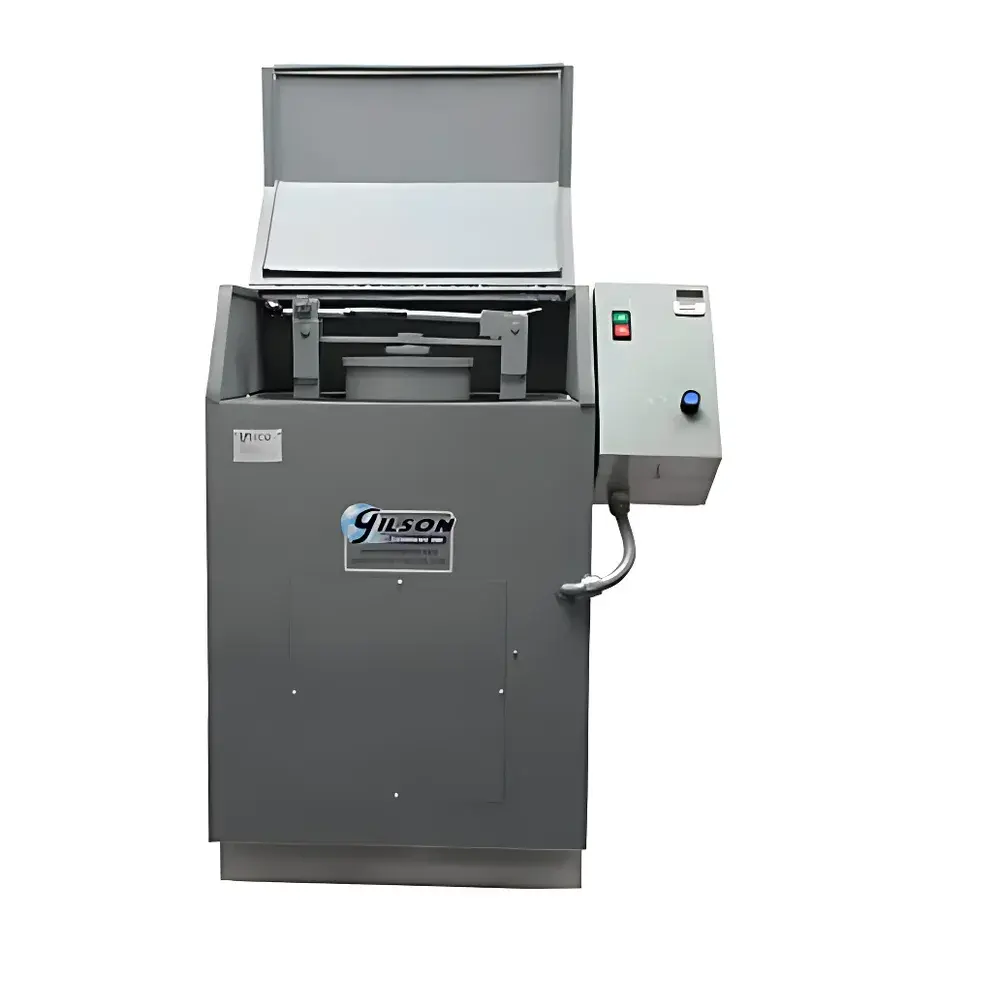
LC-115 Ring and Puck Mill
| Origin | USA |
|---|---|
| Manufacturer Type | Authorized Distributor |
| Origin Category | Imported |
| Model | LC-115 |
| Pricing | Upon Request |
Overview
The LC-115 Ring and Puck Mill is a precision-engineered laboratory comminution device designed for consistent, reproducible size reduction of hard, brittle materials—including rocks, ores, minerals, soils, ceramics, and geological specimens—prior to elemental or mineralogical analysis. Operating on the principle of constrained eccentric oscillation, the mill subjects samples to controlled compressive loading, impact, and shear forces within a sealed grinding chamber. A 203 mm (8 in) diameter stainless steel bowl houses a rotating eccentric drive shaft that imparts precise horizontal orbital motion to a chromium steel ring-and-puck assembly. This kinematic configuration ensures uniform energy transfer across the sample bed, minimizing preferential fracture and thermal degradation while achieving final particle sizes ranging from 1500 µm down to 38 µm (U.S. Standard Sieve Series No. 100 to No. 400). The system is optimized for batch processing under either dry or wet conditions, with maximum feed particle size limited to 12.7 mm (0.5 in) to ensure mechanical integrity and throughput consistency.
Key Features
- Robust 1 HP (746 W) three-phase induction motor, rated for 208/220/400 V, 50/60 Hz operation; single-phase variants available upon specification
- Eccentric cam-driven oscillation mechanism delivering repeatable 900 rpm (750 rpm at 50 Hz) rotational speed with fixed amplitude displacement
- Integrated digital timer (0–100 minutes) with automatic reset function, supporting GLP-compliant test documentation and inter-run repeatability
- Interlocked safety guard enclosure with polycarbonate viewing window, fully enclosing the grinding chamber during operation
- Cam-actuated bowl locking system ensuring zero lateral movement during high-force comminution cycles
- Acoustically insulated steel cabinet with vibration-damping mounts, reducing operational noise to ≤72 dBA at 1 m distance
- Ergonomically angled control panel with tactile start/stop switches, emergency stop button (IEC 60204-1 compliant), and status indicators
Sample Compatibility & Compliance
The LC-115 accommodates both dry and wet grinding protocols, enabling preparation of samples for X-ray fluorescence (XRF), inductively coupled plasma (ICP-OES/MS), atomic absorption spectroscopy (AAS), and sieve analysis. Its chromium steel grinding set (250 mL capacity) is suitable for general-purpose mineralogical and geochemical applications. Optional accessories include the LCA-240 chromium steel replacement set (same 250 mL volume) and the LCA-242 tungsten carbide set (100 mL capacity), engineered for highly abrasive or contamination-sensitive matrices requiring ultra-low wear and minimal metallic leaching. All grinding components comply with ASTM D2234 (standard practice for collection of gross samples of coal), ISO 18283 (solid mineral fuels — manual sampling), and USP (particle size distribution testing). The unit meets CE machinery directive requirements (2006/42/EC) and carries UL/cUL listing for North American electrical safety compliance.
Software & Data Management
While the LC-115 operates as a standalone electromechanical instrument without embedded firmware or network connectivity, its digital timer supports audit-ready run logging when paired with external laboratory information management systems (LIMS). Time-stamped operation records—including duration, start/stop timestamps, and operator ID—can be manually entered into electronic lab notebooks (ELN) compliant with FDA 21 CFR Part 11 when used in regulated environments. The absence of proprietary software eliminates compatibility constraints and facilitates integration into existing QA/QC workflows governed by ISO/IEC 17025 or GMP Annex 11 frameworks. Calibration verification is performed via periodic tachometer validation of rotational speed and timer accuracy traceable to NIST standards.
Applications
- Geochemical exploration: preparation of drill core and chip samples for multi-element analysis
- Cement and clinker homogenization prior to XRD and LOI determination
- Coal and coke sizing for proximate and ultimate analysis per ASTM D3172–D3176
- Environmental soil screening for heavy metal extraction and TCLP testing
- Mineral processing R&D: grindability index estimation and liberation studies
- Academic research in rock mechanics and comminution physics
FAQ
What is the maximum feed size the LC-115 can accept?
The recommended maximum feed particle dimension is 12.7 mm (0.5 in) to prevent jamming and ensure uniform stress distribution across the grinding interface.
Can the LC-115 process wet samples?
Yes—wet grinding is supported using compatible solvents or aqueous slurries; however, the LCA-242 tungsten carbide kit is strongly advised for corrosive or high-moisture content samples.
Is the LC-115 suitable for regulatory-compliant laboratories?
Yes—the mechanical design, timer functionality, and safety interlocks align with GLP and ISO/IEC 17025 requirements when operated within documented SOPs and maintained per manufacturer-recommended intervals.
How often should the grinding components be replaced?
Chromium steel sets typically require replacement after 500–800 grinding cycles depending on material abrasivity; tungsten carbide sets extend service life by ≥3× under equivalent conditions.
Does the unit support variable speed control?
No—the LC-115 operates at a fixed eccentric drive speed (900 rpm / 750 rpm) to maintain mechanical stability and reproducibility; speed variation is not supported nor recommended for analytical consistency.




