
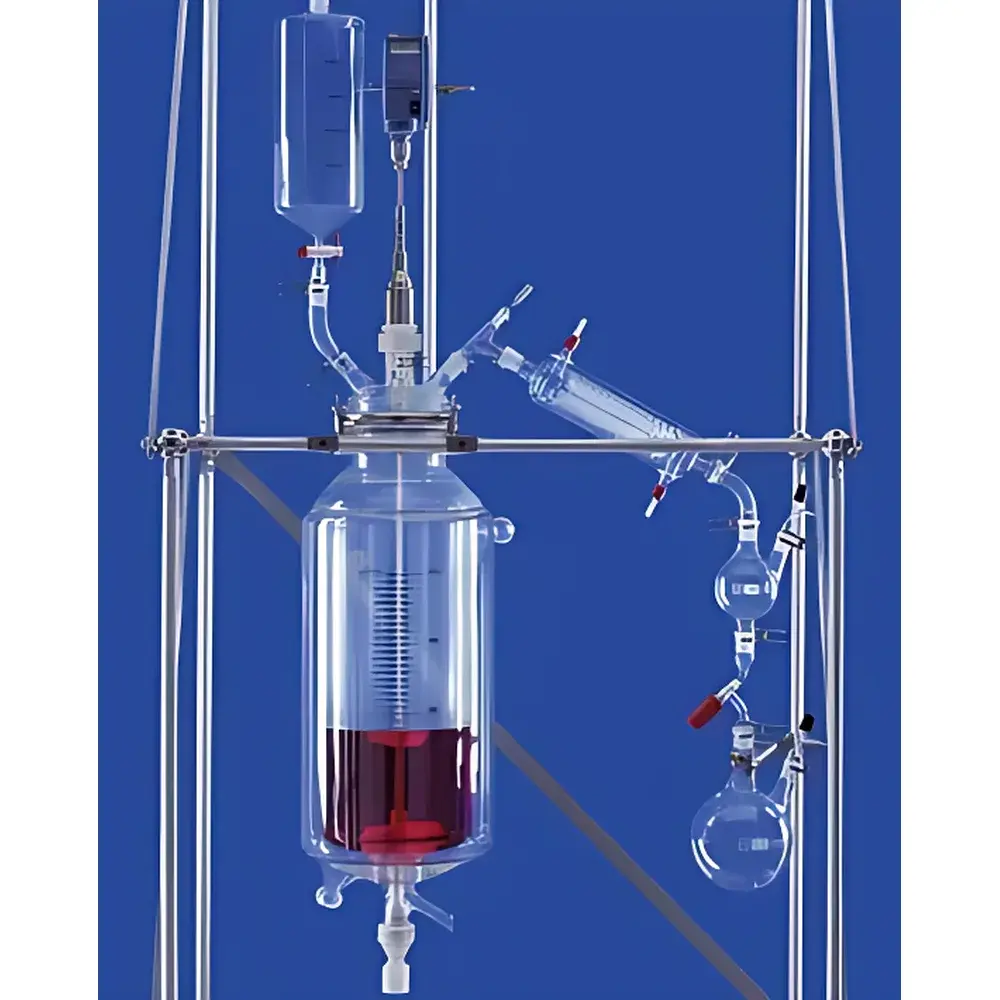
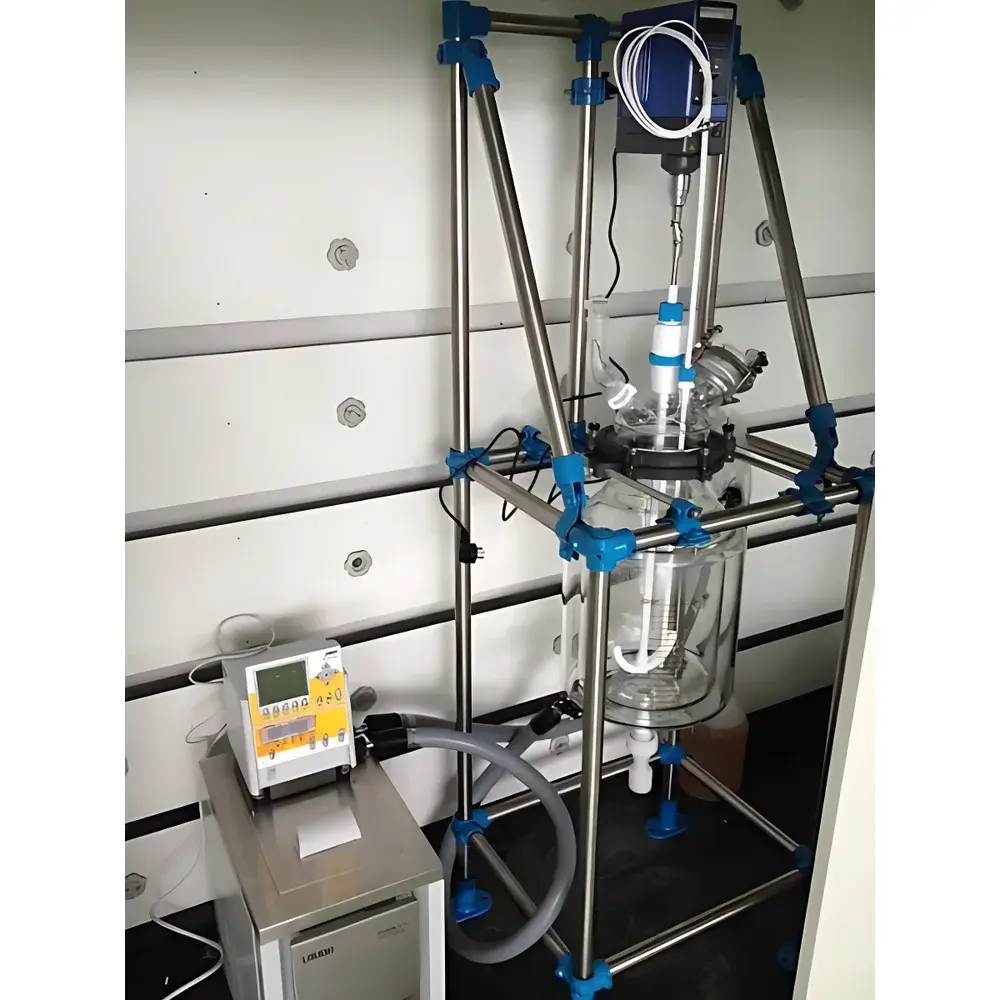
LENZ Kilogram-Scale Glass Reactor (DURAN® Borosilicate Glass, Jacketed)
| Brand | LENZ |
|---|---|
| Origin | Germany |
| Model Range | 10 L – 30 L |
| Vessel Material | DURAN® borosilicate glass (ISO 3585 compliant) |
| Jacket Type | Double-wall, circulating fluid jacket (GL or KF outlet options) |
| Operating Pressure | Low-pressure (≤ 0.5 bar gauge) |
| Working Volume | Medium-scale (10–30 L nominal) |
| Sealing System | Chemically resistant PTFE gaskets with quick-release clamps |
| Bottom Valve | PTFE plug valve, zero-dead-volume design |
| Stirrer Shaft Seal | Standard PTFE-sealed mechanical seal (vacuum-rated to 5 mbar abs) |
| Stirrer Options | Anchor, propeller, and dual-layer impellers (all PTFE-coated or fully PTFE) |
| Temperature Monitoring | PTFE-sheathed Pt100 probe port integrated in lid |
| Lid Ports | 4–5 standardized NS29/32 or NS45/50 ground-glass joints |
| Support Frame | Modular stainless steel (AISI 304), tool-free assembly/disassembly |
| Condenser Compatibility | Straight, Liebig, or Dimroth types (PTFE-valved inlet/outlet, multiple lengths) |
| Accessories | PTFE-tipped addition funnels (various capacities), separatory condenser modules, distillation adapters, custom reaction flasks (100 mL – 30 L), evaporation/receiving vessels |
Overview
The LENZ Kilogram-Scale Glass Reactor is a precision-engineered, jacketed laboratory reactor system designed for controlled chemical synthesis, process development, and scalable reaction optimization under low-pressure conditions. Constructed entirely from high-purity DURAN® borosilicate glass (compliant with ISO 3585 and DIN EN 1744), the reactor provides exceptional thermal shock resistance (ΔT ≤ 120 °C), chemical inertness toward aggressive reagents (including concentrated acids, alkalis, and halogenated solvents), and optical clarity for real-time visual monitoring of reaction progress, phase separation, or crystallization events. Its double-wall jacket enables precise temperature control via external circulation of heating/cooling media (e.g., LAUDA thermostats), supporting operational ranges from –20 °C to +200 °C depending on fluid choice and pressure rating. The system operates within low-pressure regimes (up to 0.5 bar gauge), making it suitable for reflux, solvent removal, hydrogenation (with appropriate gas handling), and moisture-sensitive reactions when paired with vacuum-compatible accessories.
Key Features
- DURAN® glass construction ensures long-term dimensional stability, minimal extractables, and compliance with GLP/GMP-relevant material traceability standards.
- Modular lid configuration with 4–5 standardized NS-ground glass joints (NS29/32 or NS45/50) allows flexible integration of temperature probes, condensers, addition funnels, gas inlets, and sampling ports.
- Zero-dead-volume PTFE bottom valve enables quantitative discharge without product retention—critical for stoichiometric reactions and catalyst recovery.
- PTFE-sealed mechanical stirrer assembly rated for continuous operation under vacuum down to 5 mbar absolute, compatible with anchor, propeller, and dual-layer impeller geometries for optimized mixing across viscosity ranges (1–10,000 mPa·s).
- Stainless steel support frame (AISI 304) features rapid-release clamping mechanisms and height-adjustable mounting points for seamless alignment with condensers, dry ice traps, or fractional distillation setups.
- Jacket outlet options include both GL-thread and KF-flange interfaces, enabling direct coupling to industrial-grade circulation units or modular lab-scale chillers.
Sample Compatibility & Compliance
The reactor accommodates heterogeneous, multiphase, and exothermic reactions involving organic, inorganic, and organometallic systems. Its DURAN® glass body meets ASTM E438 Type I, Class A requirements for laboratory glassware, while PTFE components conform to USP Class VI biocompatibility specifications. All wetted surfaces are non-metallic and leachate-free—essential for pharmaceutical intermediate synthesis and catalyst screening where metal contamination must be avoided. The system supports documentation workflows aligned with FDA 21 CFR Part 11 when used with validated data logging software (e.g., LAUDA Alpha software with audit trail enabled). Pressure relief is achieved via calibrated rupture discs (optional add-on), satisfying basic PED 2014/68/EU Category I requirements for low-pressure equipment.
Software & Data Management
While the reactor itself is hardware-only, it is fully interoperable with third-party process monitoring platforms. When coupled with LAUDA Proline or Thermostat circulators, users access real-time temperature profiling, ramp/soak programming, and event-triggered data export (CSV/Excel) via RS485 or Ethernet. Optional Pt100 probe integration enables closed-loop feedback control of jacket temperature within ±0.2 °C accuracy. All digital records maintain timestamped metadata, supporting ALCOA+ principles (Attributable, Legible, Contemporaneous, Original, Accurate) required for regulatory submissions.
Applications
- Process chemistry scale-up from milligram to kilogram batches in API synthesis.
- Development of polymerization protocols (e.g., polycondensation, ring-opening) requiring precise thermal history control.
- Hydrogenation and catalytic reduction studies using palladium-on-carbon or Raney nickel under inert/vacuum atmospheres.
- Solvent-free or low-solvent reactions benefiting from visual endpoint detection (e.g., enolate formation, imine condensation).
- Educational demonstrations of thermodynamics, kinetics, and mass transfer phenomena in undergraduate and graduate laboratories.
- Custom distillation and extraction workflows using interchangeable condenser modules (reflux, fractional, Dean-Stark).
FAQ
What temperature range is supported with the jacketed system?
With glycol/water mixtures, operation from –20 °C to +120 °C is typical; silicone oil extends the upper limit to +200 °C at reduced pressure.
Can the reactor be used under full vacuum?
Yes—the PTFE shaft seal and ground-glass joints are rated for sustained operation at 5 mbar absolute; optional vacuum-tight lid variants available for sub-mbar applications.
Is customization available for non-standard port configurations or vessel geometry?
LENZ offers OEM engineering services for bespoke lid layouts, specialized stirrer geometries, and custom flask shapes (e.g., spherical-bottom, pear-shaped) with lead times of 8–12 weeks.
How is cleaning and maintenance performed?
All glass components are autoclavable (121 °C, 2 bar); PTFE parts withstand repeated solvent washing and mild alkaline soak—no disassembly beyond standard clamp removal is required.
Does the system comply with electrical safety directives?
The reactor is a passive apparatus; compliance responsibility lies with connected peripherals (e.g., stirrer motors, circulators), which must carry CE, UL, or UKCA marking per applicable regional directives.



