
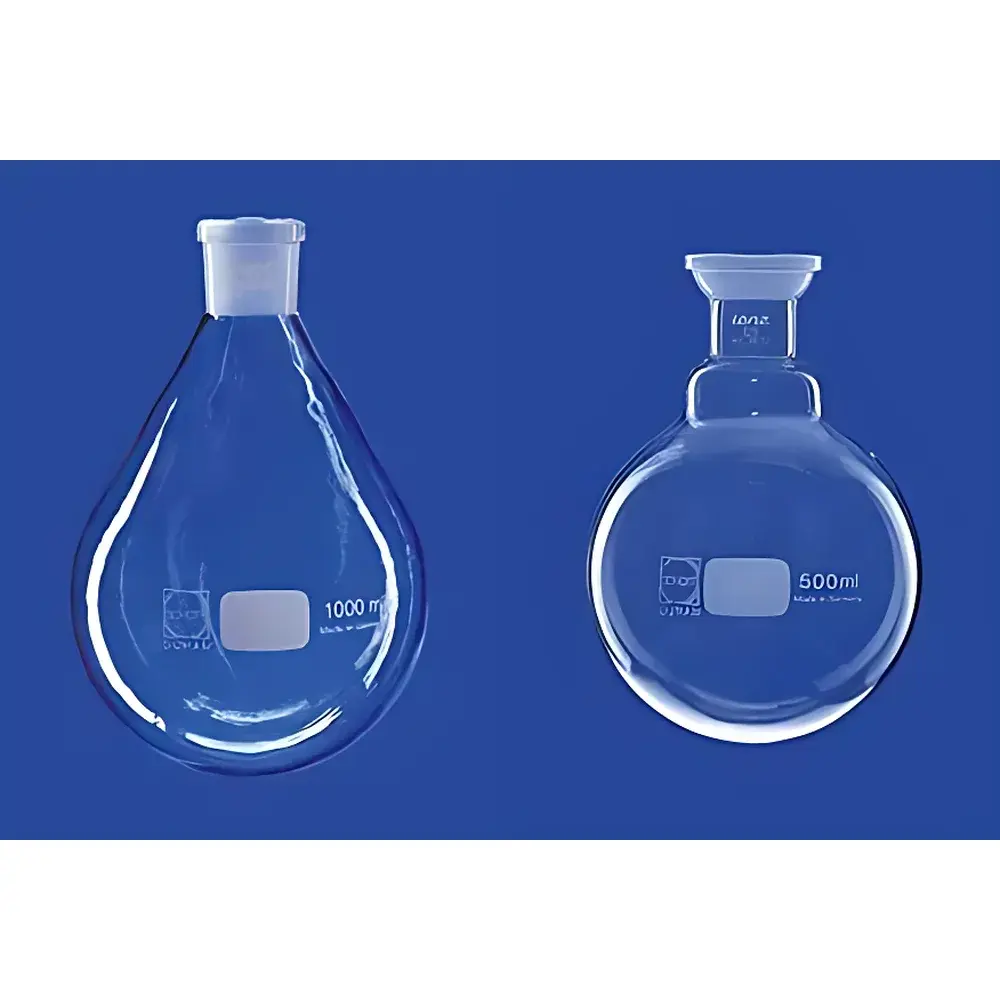
LENZ Rotational Evaporator Pear-Shaped Flask & Receiving Flask Set
| Brand | Lenz |
|---|---|
| Origin | Germany |
| Material | DURAN® Borosilicate Glass (Schott AG) |
| Standard Taper | 29/32 (also available in 14/23 and S 35) |
| Volumes | Flask Options — 5 mL to 3000 mL |
| Coating | Transparent Polyurethane (PUR) Safety Coating |
| Compliance | ASTM E438 Type I, Class A |
| Minimum Graduation | 0.01 mL |
| Accuracy | ±0.1% (v/v) at 20 °C |
| Application Temperature Range | –70 °C to +500 °C (short-term), –20 °C to +300 °C (continuous) |
Overview
The Lenz Rotational Evaporator Pear-Shaped Flask & Receiving Flask Set is a precision-engineered glassware system designed for reliable solvent removal, concentration, and gentle distillation under reduced pressure in research, QC, and pilot-scale synthesis laboratories. Constructed exclusively from Schott DURAN® borosilicate 3.3 glass, each component meets stringent international standards for thermal shock resistance (ΔT ≥ 160 °C), chemical inertness (resistant to concentrated acids, alkalis, and organic solvents), and dimensional stability. The pear-shaped geometry optimizes surface-to-volume ratio and film formation during rotation, enhancing evaporation efficiency while minimizing bumping and foaming. All flasks feature ground-glass joints conforming to ISO 2979 (29/32 taper), ensuring leak-tight, reproducible coupling with rotary evaporator chucks, condensers, and vacuum manifolds.
Key Features
- Manufactured in Germany using Schott DURAN® borosilicate 3.3 glass—certified to ISO 3585 and ASTM E438 Type I, Class A specifications
- Integrated transparent polyurethane (PUR) safety coating applied via dip-coating process: prevents fragmentation dispersion upon mechanical impact, blocks UV degradation, and reduces surface scratching during routine handling
- Pear-shaped evaporation flasks available in seven volumetric grades (5–3000 mL) with standardized 29/32 or 14/23 conical joints; receiving flasks offered in five capacities (100–2000 mL) with S 35 standard taper
- Calibration traceable to national metrology institutes (e.g., PTB Germany); volume markings etched—not printed—for long-term legibility and solvent resistance
- Thermal stability up to 500 °C for short-term sterilization (dry heat) and compatibility with cryogenic cooling down to –70 °C
- No internal stress points or annealing defects—verified by polariscope inspection per DIN 12207
Sample Compatibility & Compliance
These flasks are compatible with all major rotary evaporator platforms (e.g., Buchi, IKA, Heidolph, Yamato) and support GLP/GMP-compliant workflows. The DURAN® glass composition ensures non-leaching performance with pharmaceutical intermediates, high-purity solvents (e.g., THF, DMF, ethyl acetate), and aqueous buffers across pH 0–14. PUR coating complies with EU Directive 2002/72/EC for food-contact materials and passes USP Class VI biological reactivity testing. Calibration conforms to ISO 1042 for volumetric glassware and supports audit readiness for FDA 21 CFR Part 11–aligned electronic lab notebooks when paired with validated weighing or titration protocols.
Software & Data Management
While the flasks themselves are passive components, their metrological integrity directly supports digital data integrity in regulated environments. Each batch is supplied with a Certificate of Conformance (CoC) including lot number, manufacturing date, calibration temperature (20 °C), and reference to DIN EN ISO 1042. For labs implementing electronic quality management systems (eQMS), the CoC may be integrated into LIMS or ELN metadata fields to maintain full traceability from raw material (Schott melt batch ID) through final inspection. No embedded electronics or firmware—designed for interoperability, not obsolescence.
Applications
- Solvent recovery and sample concentration in natural product isolation, peptide synthesis, and polymer purification
- Low-temperature distillation of thermolabile compounds (e.g., essential oils, cannabinoids, vitamins)
- High-throughput evaporation workflows requiring interchangeable flask sets across parallel evaporators
- GMP-compliant API intermediate processing where glassware certification and coating integrity are documented in equipment qualification (IQ/OQ)
- Teaching laboratories requiring durable, safety-coated glassware resistant to student handling and autoclave cycles
FAQ
Are these flasks suitable for use with aggressive solvents such as hydrofluoric acid or molten alkali metals?
No. While DURAN® glass resists most common laboratory chemicals, it is not resistant to HF, hot concentrated phosphoric acid, or alkali metal melts. Consult Schott’s Chemical Resistance Guide (Ref. CRG-2023) before exposure.
Can the PUR coating be removed or reapplied after damage?
The PUR layer is permanently bonded and not field-repairable. Damaged coatings compromise containment integrity; replacement is required per ISO 15195 calibration interval recommendations.
Do you provide NIST-traceable calibration certificates?
Standard CoCs include metrological verification per ISO 1042. NIST-traceable calibration (with uncertainty budget) is available upon request as a value-added service.
What is the maximum recommended rotational speed for the 3000 mL pear-shaped flask?
Maximum safe rotation depends on bath temperature, vacuum level, and solvent viscosity. For DURAN® 3000 mL flasks, typical operational limits are ≤120 rpm at 40 °C and ≤60 mbar absolute pressure—refer to your evaporator manufacturer’s mechanical load specifications.
Is the PUR coating compliant with USP for plastic components in pharmaceutical packaging?
The coating satisfies USP Class VI requirements for cytotoxicity, systemic injection, and intracutaneous reactivity—but is not intended as primary packaging. It serves solely as a containment safeguard for laboratory glassware.



