
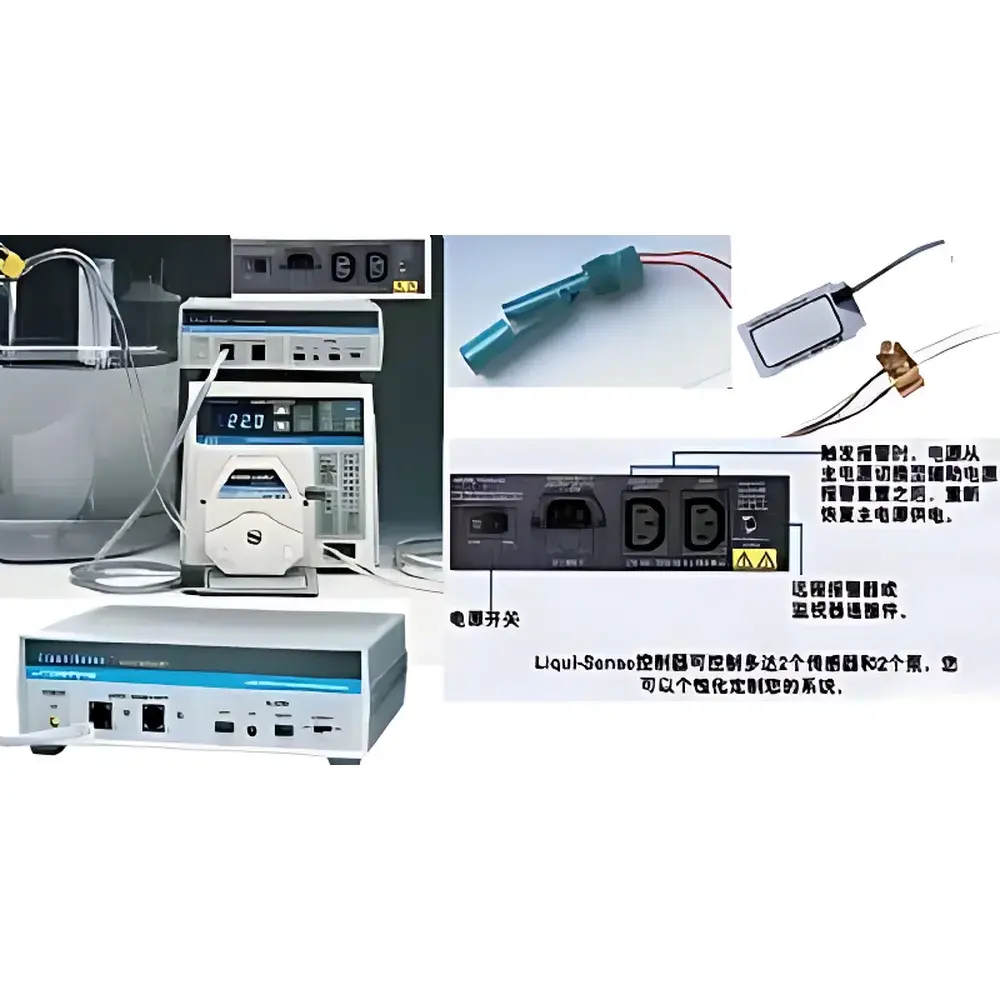
Liqui-Sense Model 77096-05 Peristaltic Pump Monitoring System
| Origin | USA |
|---|---|
| Manufacturer Type | Authorized Distributor |
| Origin Category | Imported |
| Model | 77096-05 |
| Pricing | Available Upon Request |
Overview
The Liqui-Sense Model 77096-05 Peristaltic Pump Monitoring System is an industrial-grade, fail-safe control platform engineered for continuous, unattended fluid transfer operations in regulated laboratory, pharmaceutical, bioprocessing, and environmental monitoring environments. Designed around a deterministic relay-based architecture, the system implements real-time, condition-driven pump logic—detecting critical process deviations (e.g., overfill, leakage, air entrainment) and executing predefined safety responses without operator intervention. Its core functionality relies on discrete sensor input interpretation via configurable thresholds, enabling deterministic state transitions between primary and backup peristaltic pumps. Unlike software-dependent controllers, the 77096-05 operates on hardwired logic with zero firmware dependencies—ensuring compliance with IEC 61508 SIL-1 functional safety principles for critical fluid-handling applications where deterministic response time and immunity to software corruption are non-negotiable.
Key Features
- Dual-pump control capability: Simultaneously manages two independent peristaltic pumps with automatic failover—primary pump deactivation and secondary pump activation upon sensor-triggered alarm condition.
- Three-sensor input support: Accepts up to two process sensors (e.g., level, leak, or bubble detection) plus one dedicated external alarm output channel (30 VDC, 1 A max).
- Independent sensor sensitivity adjustment: Each connected sensor features calibrated potentiometer-based threshold tuning—enabling precise adaptation to fluid conductivity, surface tension, or optical path characteristics.
- Fail-safe manual reset: Power-loss recovery protocol prevents unintended reactivation after brownout or reboot; requires deliberate physical reset to resume operation.
- RJ12 modular sensor interface: Standardized plug-and-play connectivity for all compatible Liqui-Sense transducers (level switches, fluid detection strips, infrared bubble sensors).
- IEC 320-F mains inlet: Supports universal 180–230 VAC, 50/60 Hz operation with integrated 6.3 A relay output rated for direct pump motor switching.
- Configurable alarm signaling: Third relay output interfaces with strobes, sirens, PLC inputs, or remote annunciators—assignable to distinct fault conditions (e.g., “tank full” vs. “line leak”).
Sample Compatibility & Compliance
The system is agnostic to peristaltic pump brand or drive mechanism, provided the pump accepts standard AC line-voltage switching via its internal relay or external contactor. Sensor compatibility spans aqueous, organic, and mildly corrosive fluids—validated for use with polypropylene (PP), nylon, and fluoropolymer wetted materials per ASTM D543. Level switches (models 07187-28/30) feature 1/2 NPT male mounting and operate reliably across pH 2–12. Fluid detection strips (77095-00) detect sub-milliliter liquid volumes (< 0.8 mL) via conductive bridging; bubble sensors (77095-50) employ 850 nm infrared transmission through transparent tubing (max ID: 13 mm), meeting ISO 8596 optical alignment tolerances. The controller complies with EN 61326-1 (EMC for laboratory equipment) and carries CE marking for EU market deployment. It supports GLP/GMP audit trails when integrated with external data loggers compliant with FDA 21 CFR Part 11.
Software & Data Management
The 77096-05 is a hardware-only control unit with no embedded operating system, firmware, or network interface—eliminating cybersecurity attack surfaces and validation overhead associated with software-based controllers. All operational logic resides in discrete logic ICs and electromechanical relays. Event logging requires external integration: optional accessory 08330-20 (telephone/pager dialer) enables automated voice/SMS alerts via PSTN, while analog voltage outputs (via optional signal conditioner modules) feed into SCADA or LIMS systems. For regulatory environments, time-stamped relay status changes may be captured using third-party digital I/O acquisition hardware compliant with IEEE 1588 precision time protocol.
Applications
- Continuous media feeding in bioreactors and chemostats, with automatic shutdown upon overflow or tubing rupture.
- Waste collection systems in clinical analyzers and IVD instruments—preventing spillage during container saturation.
- Reagent delivery in automated ELISA or PCR workstations, where air-in-line detection prevents assay failure due to incomplete aspiration.
- Environmental water quality stations: monitoring sump levels and detecting leaks in rainwater harvesting or wastewater sampling lines.
- GMP-compliant buffer preparation suites, where dual-pump redundancy ensures uninterrupted transfer during scheduled maintenance windows.
FAQ
Can the 77096-05 monitor pumps powered by variable-frequency drives (VFDs)?
Yes—provided the VFD includes a dry-contact run-enable input, the 77096-05’s relay outputs can directly control start/stop sequencing without interfacing with VFD communication protocols.
Is calibration required before deployment?
No field calibration is needed; however, sensor sensitivity must be manually adjusted using onboard trim pots to match application-specific fluid properties and mounting geometry.
Does the system support Modbus or Ethernet communication?
No—it is intentionally designed as a standalone, protocol-free hardware controller to ensure deterministic response and eliminate software validation requirements.
What is the maximum allowable cable length between the controller and a fluid detection strip?
When using model 77095-04 (4.5 m shielded cable), signal integrity is maintained up to 4.5 meters; longer runs require twisted-pair shielding and local signal conditioning per IEC 61000-4-5 surge immunity guidelines.
Can the system trigger a shutdown based on multiple simultaneous sensor inputs?
Yes—the logic architecture supports AND/OR-configurable interlocks; for example, pump stop can be triggered only when both high-level and leak-detection signals are active.



