
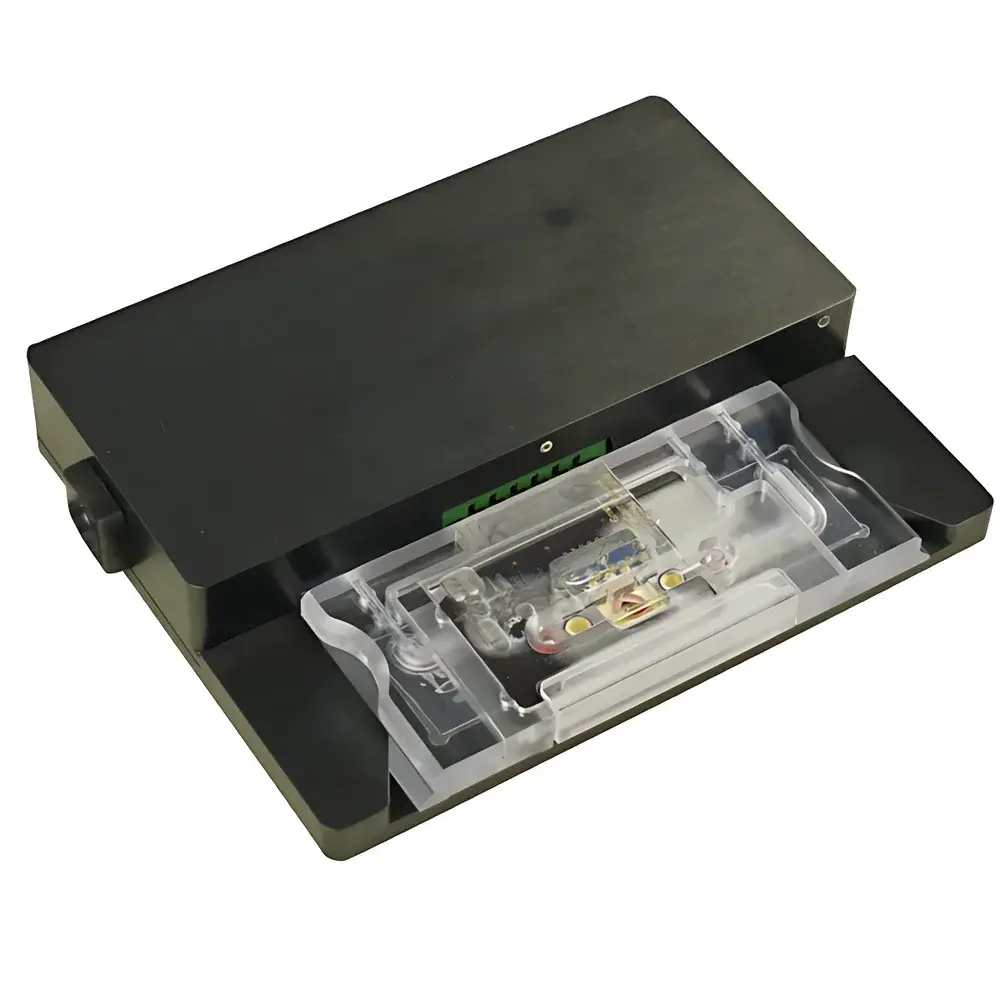
MCS MEA2100-Beta Screen Microelectrode Array System for Pancreatic Beta-Cell Electrophysiology
| Brand | Multi Channel Systems |
|---|---|
| Origin | Germany |
| Manufacturer Type | Original Equipment Manufacturer (OEM) |
| Product Category | Imported Instrument |
| Model | MEA2100-Beta Screen |
| Instrument Type | Single-Well Format |
| Application Scope | In Vitro Studies |
| Compliance | CE-marked, ISO 13485–certified manufacturing environment |
| Software Platform | MC_Rack v4.8+ with Beta-Screen Add-on Module |
| Data Acquisition | 60 kHz per channel, 16-bit resolution, real-time spike sorting and burst analysis |
Overview
The MCS MEA2100-Beta Screen is a purpose-engineered microelectrode array (MEA) system optimized for high-fidelity, non-invasive electrophysiological monitoring of pancreatic beta-cell networks in vitro. Built upon the industry-standard MEA2100 platform from Multi Channel Systems (Reutlingen, Germany), this configuration integrates hardware, signal conditioning, and application-specific software to resolve glucose-dependent electrical oscillations—such as slow-wave membrane potential fluctuations, action potential bursts, and synchronized network activity—in intact islets of Langerhans. Unlike intracellular or patch-clamp techniques, the MEA2100-Beta Screen employs extracellular field potential recording across a planar 60-electrode array (59 active + 1 reference), enabling simultaneous, long-term functional assessment of primary rodent/human islets or stem-cell-derived beta-cell clusters without physical penetration or acute dissociation. Its design adheres to principles of physiological relevance: recordings are performed under controlled CO2/humidity conditions inside standard incubators (37 °C, 5% CO2), supporting both acute (72 hr) experimental paradigms while preserving native cell–cell coupling and paracrine signaling.
Key Features
- Single-well MEA chip format (MEA2100-60iR) compatible with standard 35-mm Petri dishes and perfusion chambers
- Dedicated Beta-Screen acquisition and analysis module within MC_Rack software, pre-configured for burst detection, inter-burst interval (IBI) mapping, and glucose-response latency quantification
- Low-noise analog front-end with programmable gain (×100–×1000), 0.1–5000 Hz bandpass filtering, and real-time digital spike sorting using template-matching algorithms
- Modular architecture supports integration with external perfusion systems (e.g., ALA Scientific VC-6), temperature controllers, and metabolic monitors (e.g., Seahorse XF analyzers)
- CE-marked hardware and ISO 13485–compliant manufacturing documentation suitable for preclinical research environments operating under GLP-aligned workflows
Sample Compatibility & Compliance
The system accommodates intact pancreatic islets (20–150 µm diameter), pseudoislet aggregates, and monolayer cultures derived from human iPSCs or rodent primary isolates. Electrode geometry (30 µm diameter, TiN-coated, 200 µm pitch) ensures optimal signal-to-noise ratio for extracellular potentials generated by beta-cell clusters. All MEA chips are sterilized via ethylene oxide and certified endotoxin-free (≤0.03 EU/mL). The MEA2100-Beta Screen complies with IEC 61000-6-3 (EMC emissions) and IEC 61000-6-2 (immunity), and its software architecture supports audit trail generation and user access control—features aligned with FDA 21 CFR Part 11 readiness for regulated screening applications.
Software & Data Management
MC_Rack v4.8+ provides intuitive experiment setup, live visualization of multi-channel raster plots and peri-stimulus time histograms (PSTH), and batch processing of burst parameters (duration, frequency, amplitude). Raw data are stored in HDF5 format with embedded metadata (stimulus protocol, temperature, gas composition), ensuring FAIR (Findable, Accessible, Interoperable, Reusable) compliance. Export options include MATLAB (.mat), Python-compatible NumPy arrays, and CSV timelines for downstream statistical modeling (e.g., R-based mixed-effects regression of glucose dose–response curves). Optional cloud synchronization enables secure cross-lab collaboration and version-controlled analysis pipelines.
Applications
- Characterization of glucose-stimulated insulin secretion (GSIS) dynamics via electrophysiological correlates (e.g., burst frequency vs. insulin ELISA)
- Pharmacological profiling of sulfonylureas, GLP-1 receptor agonists, KATP channel modulators, and novel ion channel targets
- Functional validation of gene-edited beta-cells (e.g., KCNJ11, ABCC8, HNF1A mutants) in disease modeling
- Toxicity screening of drug candidates on islet network synchrony and excitability thresholds
- Longitudinal studies of beta-cell dedifferentiation or senescence under chronic hyperglycemia or lipotoxicity
FAQ
Is the MEA2100-Beta Screen compatible with human donor islets?
Yes—validated for use with human islets isolated under IRB-approved protocols; electrode sensitivity accommodates lower-amplitude signals typical of human tissue.
Can recordings be performed inside a standard CO2 incubator?
Yes—the system includes an incubator-compatible headstage and shielded cabling rated for continuous operation at 37 °C and 95% RH.
Does the software support automated detection of glucose-induced bursting onset?
Yes—Beta-Screen includes a configurable latency detector that identifies first burst initiation post-glucose challenge with sub-second precision.
Are MEA chips reusable?
No—each MEA2100-60iR chip is single-use to ensure sterility, signal fidelity, and avoidance of cross-sample contamination.
What level of technical support is provided for assay development?
Multi Channel Systems offers application-specific consulting, protocol optimization workshops, and remote troubleshooting via secure screen-sharing sessions with certified electrophysiology engineers.





