
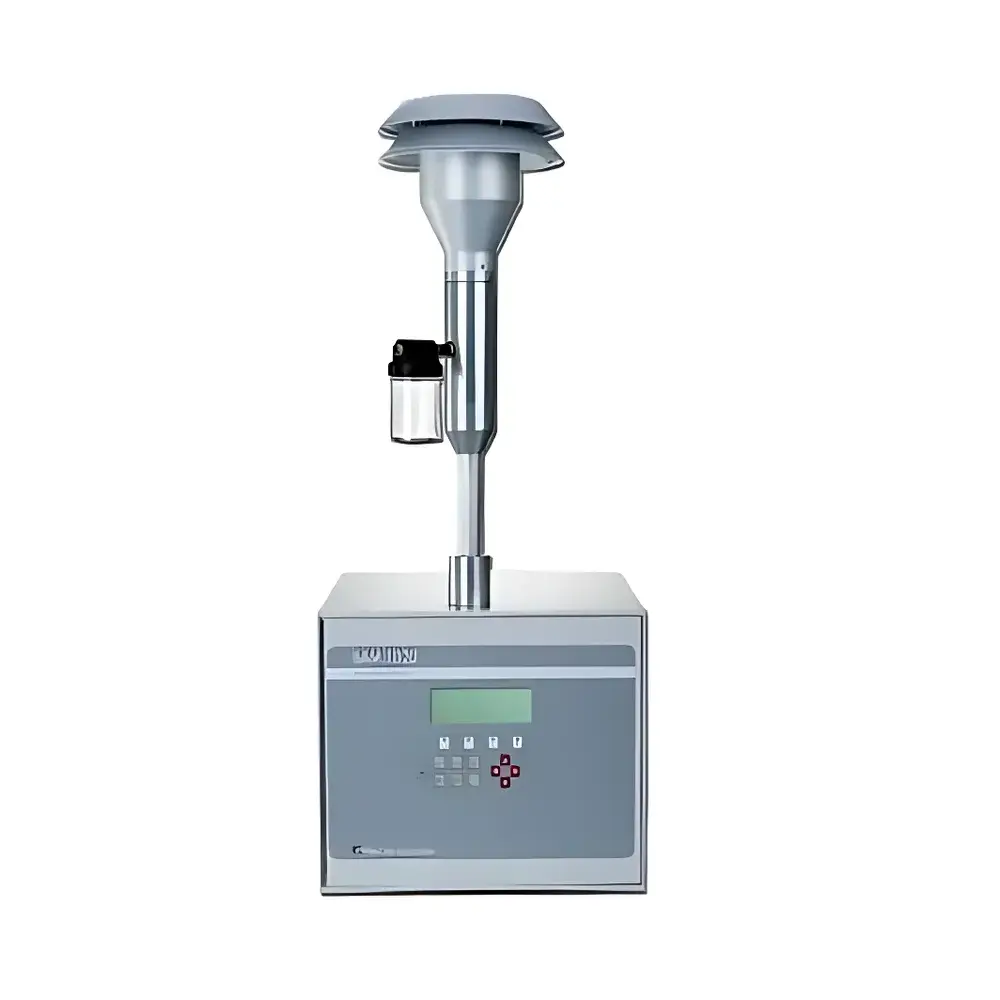
Met One BAM-1020 Beta Attenuation Particulate Monitor
| Origin | USA |
|---|---|
| Manufacturer Type | Authorized Distributor |
| Origin Category | Imported |
| Model | BAM-1020 |
| Pricing | Upon Request |
Overview
The Met One BAM-1020 Beta Attenuation Particulate Monitor is a regulatory-grade, continuous ambient air monitoring instrument engineered for precise, long-term measurement of atmospheric particulate mass concentration. It operates on the well-established beta-ray attenuation principle: a calibrated 14C radioactive source emits beta particles (electrons) through a moving glass fiber filter tape; particle-laden air is drawn across the tape surface at a controlled flow rate, depositing particulate matter (PM) onto the tape. The detector measures the intensity of transmitted beta radiation before and after sample collection. The attenuation—proportional to the accumulated mass—is converted into mass concentration (µg/m³) using the Beer–Lambert law and instrument-specific calibration factors. This method provides traceable, gravimetrically referenced quantification without reliance on optical assumptions or environmental compensation algorithms. Certified by the U.S. Environmental Protection Agency (EPA) under EQPM-0798-122 for PM10 equivalency, the BAM-1020 meets stringent performance criteria defined in 40 CFR Part 53 for Federal Reference Methods (FRM) and Federal Equivalent Methods (FEM). Its design supports unattended operation across diverse climatic zones—from −30 °C to +60 °C—and complies with international regulatory frameworks including ISO/IEC 17025-aligned quality management (ISO 9001), California Air Resources Board (CARB) requirements, and EU CE and TÜV safety directives.
Key Features
- Regulatory-compliant beta attenuation measurement with 14C source (60 µCi) and solid-state beta detector for high signal-to-noise ratio and long-term stability
- Automated, programmable sampling cycles (default 1-hour) with integrated zero and span drift correction—zero checks performed pre- and post-sampling; span verification via motorized reference membrane insertion
- Modular inlet configuration supporting PM10, PM2.5 (SCC or WINS impactor-based), and Total Suspended Particulates (TSP) monitoring with field-swappable cut-point assemblies
- Onboard microprocessor-controlled data acquisition system with 200-day internal storage (1-hour resolution), real-time status diagnostics, and automatic flagging of anomalies—including power loss, flow deviation, temperature/humidity excursions, and calibration failures
- Low-maintenance architecture: self-cleaning filter tape transport mechanism (PN460130, 21 m length), user-adjustable flow rate (0–20 SLM), and minimal consumables
- RS-232 serial interface for remote data retrieval and integration with SCADA or central EMS platforms; supports up to six auxiliary analog/digital sensor inputs (e.g., NOx, SO2, O3, meteorological parameters)
Sample Compatibility & Compliance
The BAM-1020 is validated for ambient air matrices compliant with EPA, ISO 12103-1, and EN 12341 standards. Its glass fiber filter tape (ash-free, low blank, high collection efficiency >99.9% for PM2.5) ensures compatibility with subsequent laboratory analysis (e.g., ion chromatography, ICP-MS) when required for speciation. Instrument-level compliance includes EPA EQPM certification for PM10, CARB Executive Order G-113-1, NRC general license authorization for 14C use, and TÜV-certified electromagnetic compatibility (EMC) and electrical safety (IEC 61000-6-2/6-3). All firmware and calibration protocols adhere to GLP/GMP principles, with full audit trail capability for calibration events, maintenance logs, and data integrity flags—enabling readiness for 21 CFR Part 11-compliant environments when paired with validated software.
Software & Data Management
Data acquisition and configuration are managed via Met One’s certified desktop applications: MicroMet Plus (for legacy deployment) and AirPlus (for modern networked operations). Both support automated report generation (hourly/daily/weekly summaries), configurable alarm thresholds (e.g., ±X% deviation from running mean, exceedance of WHO/EU limit values), and export in CSV, XML, or EPA-compatible AQS format. Raw beta count data, flow telemetry, temperature/humidity readings, and diagnostic flags are time-stamped with UTC synchronization and stored with immutable metadata. Remote firmware updates and parameter reconfiguration are supported over secure serial or Ethernet (with optional adapter), and all data exports include embedded provenance tags for chain-of-custody documentation.
Applications
- Ambient air quality monitoring networks operated by national and municipal environmental agencies
- Compliance verification for industrial emission control zones and near-source fence-line monitoring
- Long-term trend analysis in urban, rural, and background stations per EEA and WHO Air Quality Guidelines
- Research-grade exposure assessment studies requiring gravimetric traceability and low detection limits (0.1 µg/m³ resolution)
- Calibration reference for optical scattering instruments (e.g., nephelometers, TEOMs) in co-location studies
- Emergency response deployments during wildfire smoke events or dust storm episodes, leveraging its robustness under high-humidity and wide-temperature conditions
FAQ
Is the BAM-1020 suitable for PM2.5 monitoring under U.S. EPA FRM requirements?
Yes—the instrument achieves FRM-equivalent performance for PM2.5 when equipped with an EPA-approved PM2.5 inlet (e.g., WINS or SCC impactor) and operated in 24-hour averaging mode, delivering ±2% accuracy relative to gravimetric reference.
How frequently must the 14C source be replaced?
The 14C source has a half-life of 5,730 years; no replacement is required during the instrument’s operational lifetime. Source activity remains stable within specification over decades.
Does the BAM-1020 support remote diagnostics and firmware updates?
Yes—via RS-232 or optional Ethernet gateway, enabling secure remote access for health monitoring, configuration changes, and firmware upgrades without on-site intervention.
What is the maximum allowable relative humidity for continuous operation?
Up to 90% RH at temperatures between 0 °C and 60 °C, provided condensation is prevented via standard enclosure heating or desiccant management.
Can raw beta count data be exported for independent algorithmic processing?
Yes—full-resolution beta transmission counts (pre- and post-sampling), flow rate, temperature, and pressure telemetry are accessible via serial protocol and included in all standard data exports.
Related Products







