

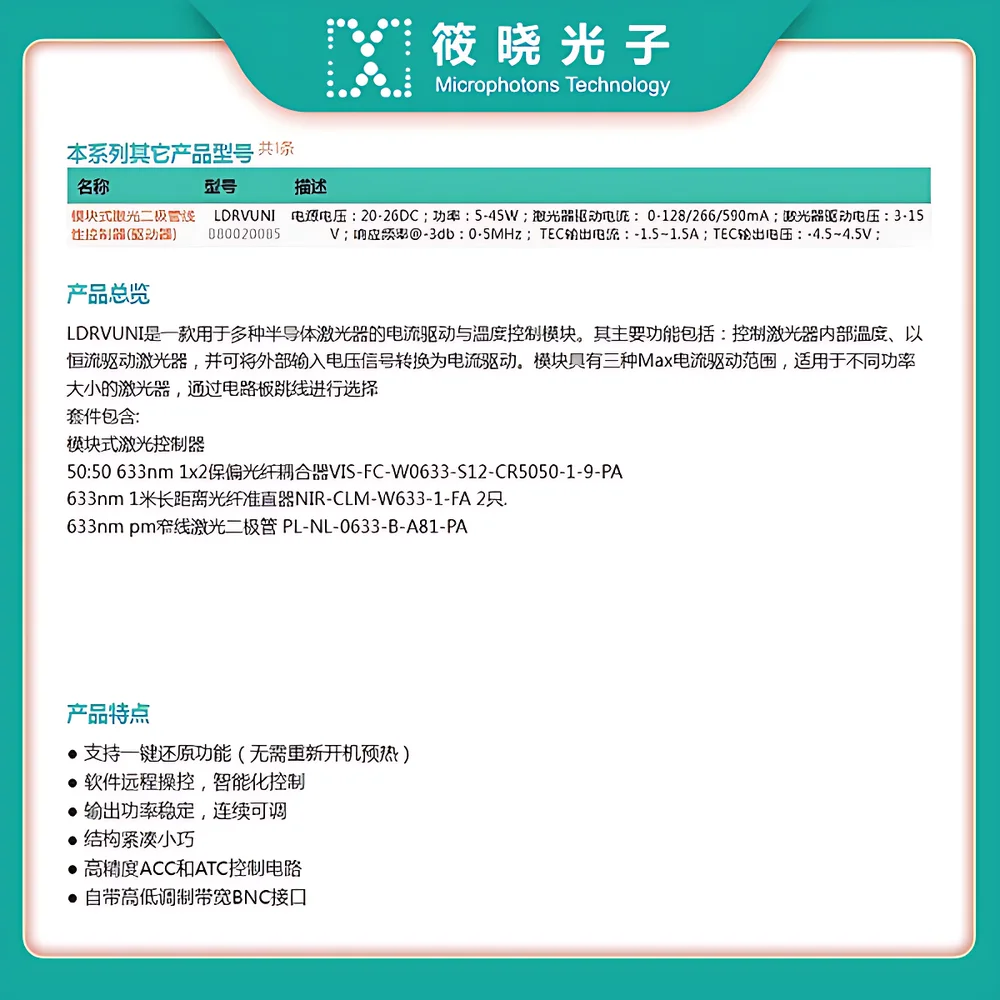
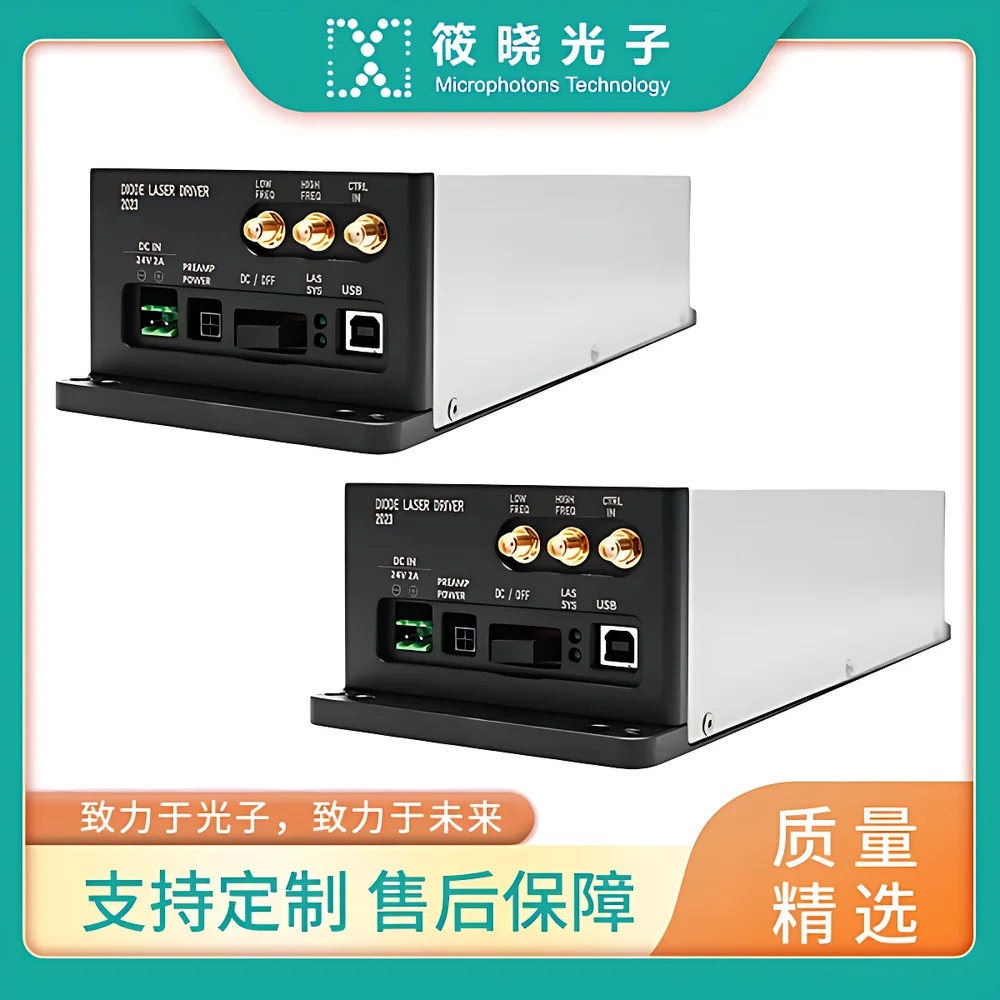
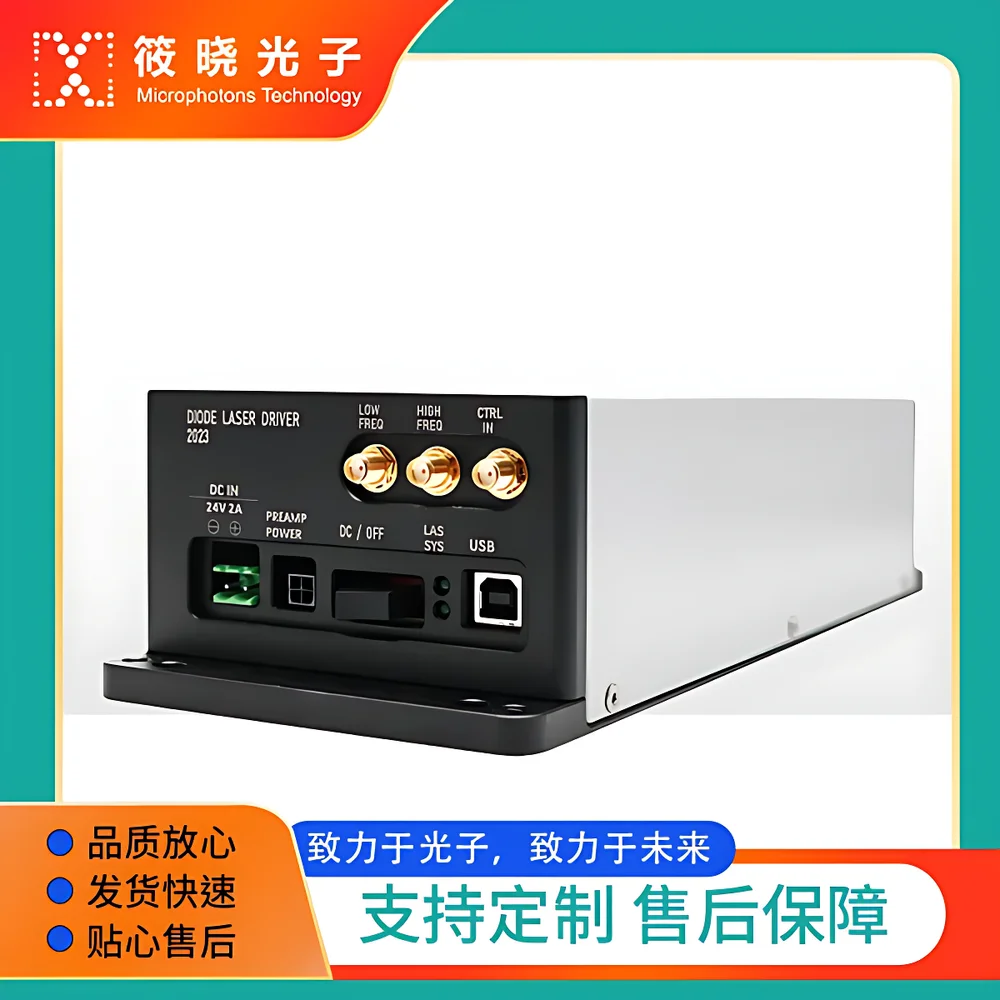
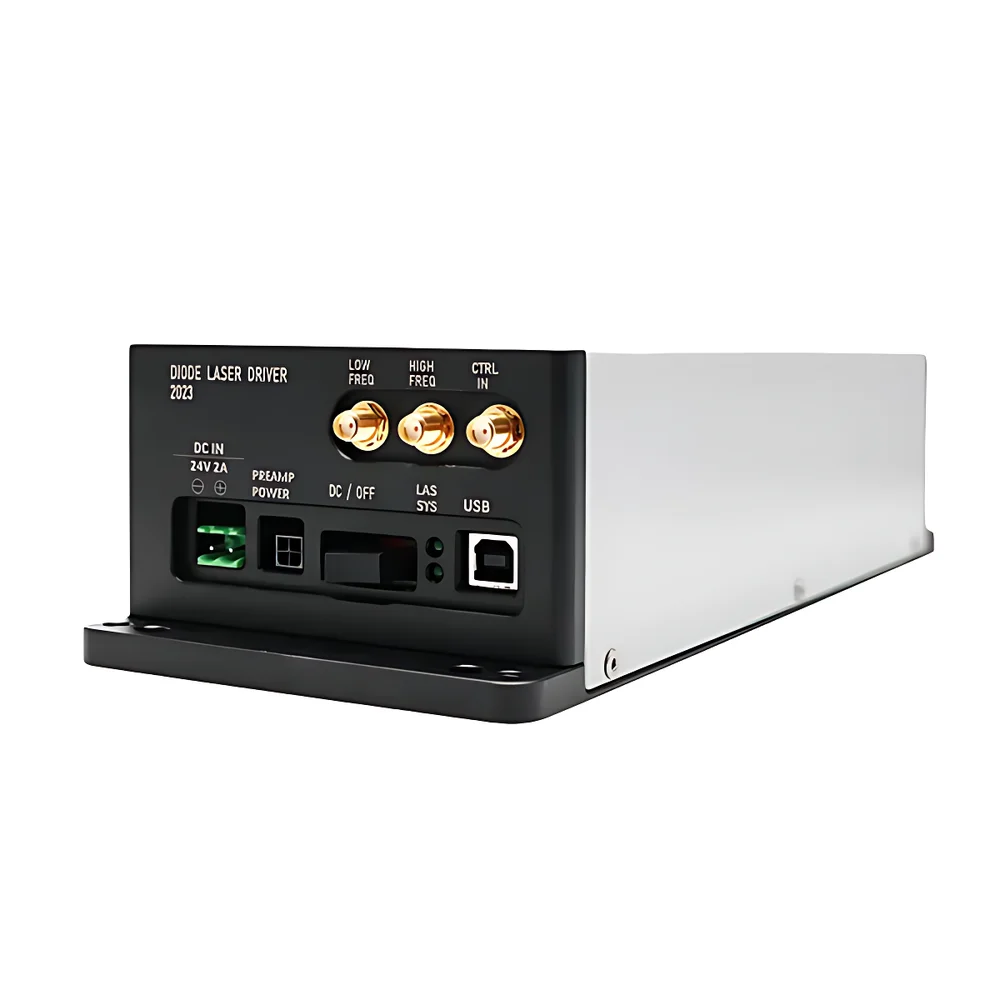
Microphotons LDC-250-M-633 Narrow-Linewidth 633 nm Laser Source Module

| Brand | Microphotons |
|---|---|
| Origin | Shanghai, China |
| Manufacturer Type | OEM Manufacturer |
| Region of Origin | Domestic (China) |
| Model | LDC-250-M-633 |
| Pricing | Upon Request |
Ask about pricing, availability and specifications.
Overview
The Microphotons LDC-250-M-633 is a compact, thermoelectrically cooled (TEC), continuous-wave (CW) narrow-linewidth laser source module operating at a precisely stabilized wavelength of 633 nm. Engineered for high-stability optical metrology, interferometry, holography, and quantum optics applications, this module integrates a distributed feedback (DFB) or external cavity diode laser (ECDL) architecture—depending on configuration—to achieve sub-MHz spectral linewidth and long-term wavelength stability (< ±1 pm over 8 hours). The 633 nm output aligns with the HeNe laser standard reference line, enabling direct compatibility with legacy alignment systems, calibration artifacts, and ISO/IEC 17025-accredited optical test benches. Its monolithic mechanical design minimizes thermal drift and acoustic sensitivity, while the integrated TEC control ensures active temperature stabilization within ±0.02 °C of setpoint—critical for maintaining mode-hop-free operation under ambient fluctuations.
Key Features
- Stabilized 633 nm output with typical linewidth 300 m coherence length
- Integrated dual-stage TEC control with user-configurable PID parameters via DIP switches (SW14–SW16) on the driver board—enabling fine-tuning of thermal response dynamics for specific laser diode characteristics
- Three selectable current ranges (128 mA, 266 mA, 590 mA) configured via hardware jumpers (P4/P9); jumper positions must be matched to ensure correct model identification by host software and prevent current misallocation
- On-board ILIM (SW15) and VLIM (SW16) DIP switches allow safe capping of TEC drive current and voltage—configured per manufacturer-specified limits of the internal laser diode’s TEC element to prevent thermal runaway or cold condensation
- Low-noise analog current modulation input (0–5 V) and TTL-compatible enable/disable interface for synchronized pulsed operation in time-resolved experiments
- Rugged aluminum housing with SMA905 fiber-coupled output (optional FC/PC or PM-fiber variants available), designed for integration into OEM instruments and automated optical platforms
Sample Compatibility & Compliance
The LDC-250-M-633 is compatible with standard single-mode silica fibers (SMF-28, core Ø 8.2 µm @ 633 nm) and polarization-maintaining (PM) fiber variants when ordered with appropriate collimation optics. It meets IEC 60825-1:2014 Class 3R laser safety requirements when operated within specified optical power limits (≤ 5 mW free-space output). All electrical interfaces comply with CE EMC Directive 2014/30/EU and RoHS 2011/65/EU. While not certified to FDA 21 CFR Part 11, the module supports traceable calibration workflows when used with NIST-traceable power meters and wavemeters—making it suitable for GLP-compliant R&D environments where instrument qualification (IQ/OQ/PQ) documentation is maintained internally.
Software & Data Management
The module operates via RS232 or USB-to-serial interface using ASCII command protocol (e.g., “SET TEMP 25.0”, “READ POWER”). No proprietary GUI is required; integration is supported through Python (pySerial), LabVIEW VIs, or MATLAB Instrument Control Toolbox. Firmware includes non-volatile storage for user-defined default setpoints (temperature, current, modulation gain). Audit trails are generated only at system level—i.e., when hosted within validated laboratory information management systems (LIMS) or electronic lab notebooks (ELN). For GxP-regulated use, users must implement procedural controls for jumper/DIP-switch configuration changes—including version-controlled change logs and dual-operator verification per SOP-INST-017.
Applications
- High-resolution laser Doppler velocimetry (LDV) and particle image velocimetry (PIV) in fluid dynamics labs
- Calibration of spectrometers, wavemeters, and Fabry–Pérot interferometers against the 633 nm iodine-stabilized reference
- Atomic physics experiments involving rubidium D2-line sideband cooling or calcium ion trapping where 633 nm serves as repumping or detection light
- Optical coherence tomography (OCT) system development requiring long-coherence illumination sources
- Gravitational wave detector prototype alignment and beam characterization in university cleanroom facilities
FAQ
What happens if the P4 and P9 jumpers are set to mismatched positions?
Mismatched jumper positions cause the firmware to misidentify the maximum drive current capability, leading to incorrect scaling of digital-to-analog converter (DAC) outputs—potentially resulting in uncontrolled current overshoot and irreversible damage to the laser diode junction.
Can SW14 (PID tuning) be adjusted during laser operation?
No. All DIP switch modifications—including SW14—must be performed with the module fully powered down. Live adjustment may induce transient thermal shock and destabilize lasing threshold conditions.
Is the 633 nm output polarization-maintained by default?
No. The standard version delivers unpolarized output through multimode fiber coupling. PM-fiber versions require explicit ordering and include stress-applying parts (SAP) aligned to the slow axis; extinction ratio exceeds 20 dB after proper alignment.
Does the module support analog modulation above 100 kHz?
The analog modulation bandwidth is DC–80 kHz (−3 dB) due to driver-stage bandwidth limitations. For RF modulation (>1 MHz), an external electro-optic modulator (EOM) is recommended in series with the output beam.
How often should the TEC PID parameters be re-optimized?
Re-tuning is required only after mechanical re-mounting, ambient temperature zone changes exceeding ±5 °C, or replacement of the laser diode submount. Routine operation under stable lab conditions does not necessitate periodic PID recalibration.
More from Microphotons
View all Microphotons products → Microphotons ABL-005IR-GE InGaAs Linear Sensor SWIR Camera (QVGA Resolution, GigE Vision Interface)
- Difrotec D7 Series Ultra-High-Precision Laser Interferometer (λ/1000)
- Microphotons TPX-D25.4-f10-t12.7 Mounted Aspheric Plano-Convex THz Lens for High-Spatial-Resolution Imaging
- Microphotons ASE-0980-10 Broadband Amplified Spontaneous Emission Light Source at 980 nm (10 mW Output)


