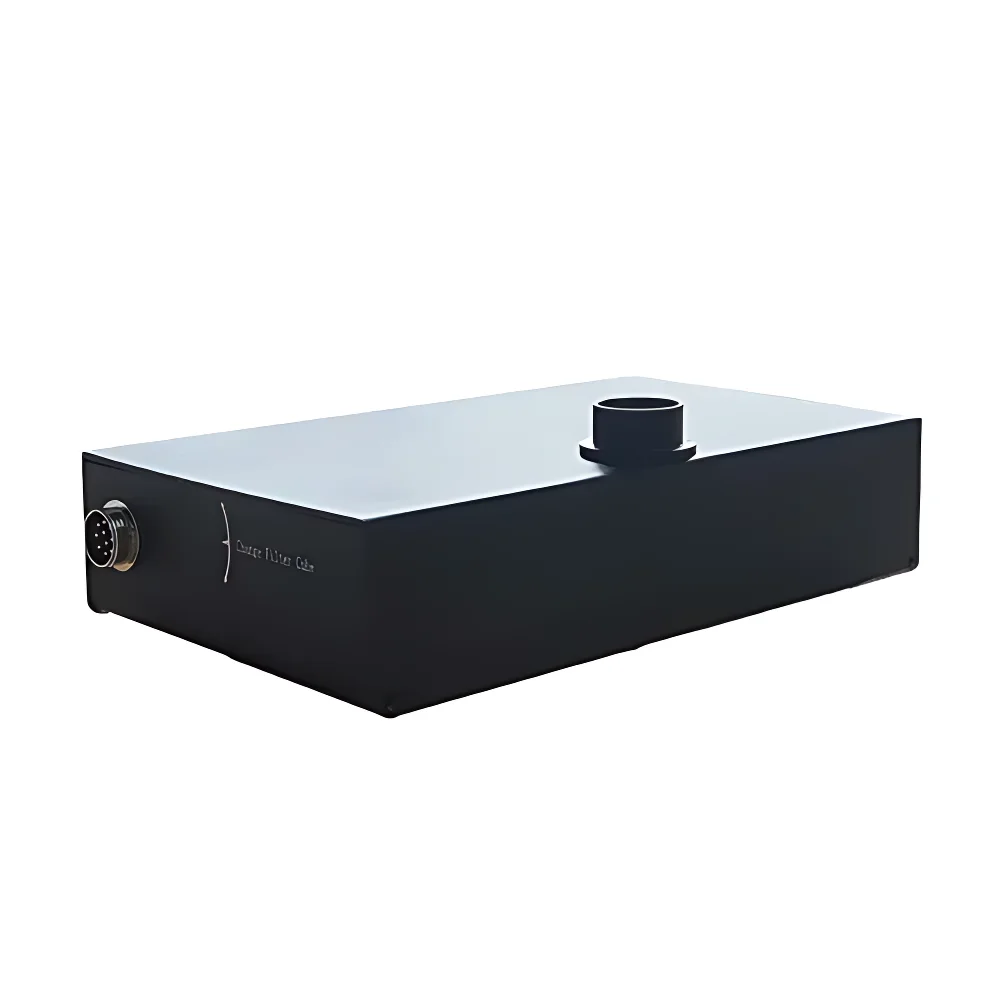
MingHui FL5-LED-DIMH Five-Position Motorized Inverted Fluorescence Attachment

| Brand | MingHui |
|---|---|
| Origin | Guangdong, China |
| Manufacturer Type | Direct Manufacturer |
| Product Category | Domestic |
| Model | FL5-LED-DIMH |
| Light Source Type | High-Power LED (UV/Blue/Green) |
| Illumination Mode | Internal (Epi-Illumination) |
| Standard Filter Sets | UBG (UV-Longpass, Blue-Bandpass, Green-Longpass) |
| LED Power | 18 W |
| LED Lifetime | ≥30,000 h |
| Control Interface | Integrated 1.8" Color Display Power Box with Channel Identification & Brightness Memory |
| Compatibility | Olympus Inverted Microscopes |
| Filter Switching | Motorized, Encoded, Position-Recognized |
| Max Simultaneous Channels | 4 Fluorescence + 1 Brightfield |
| Excitation/Barrier Specifications | UEX 365/30 nm / DM 405 nm / EM 425 nm LP |
Ask about pricing, availability and specifications.
Overview
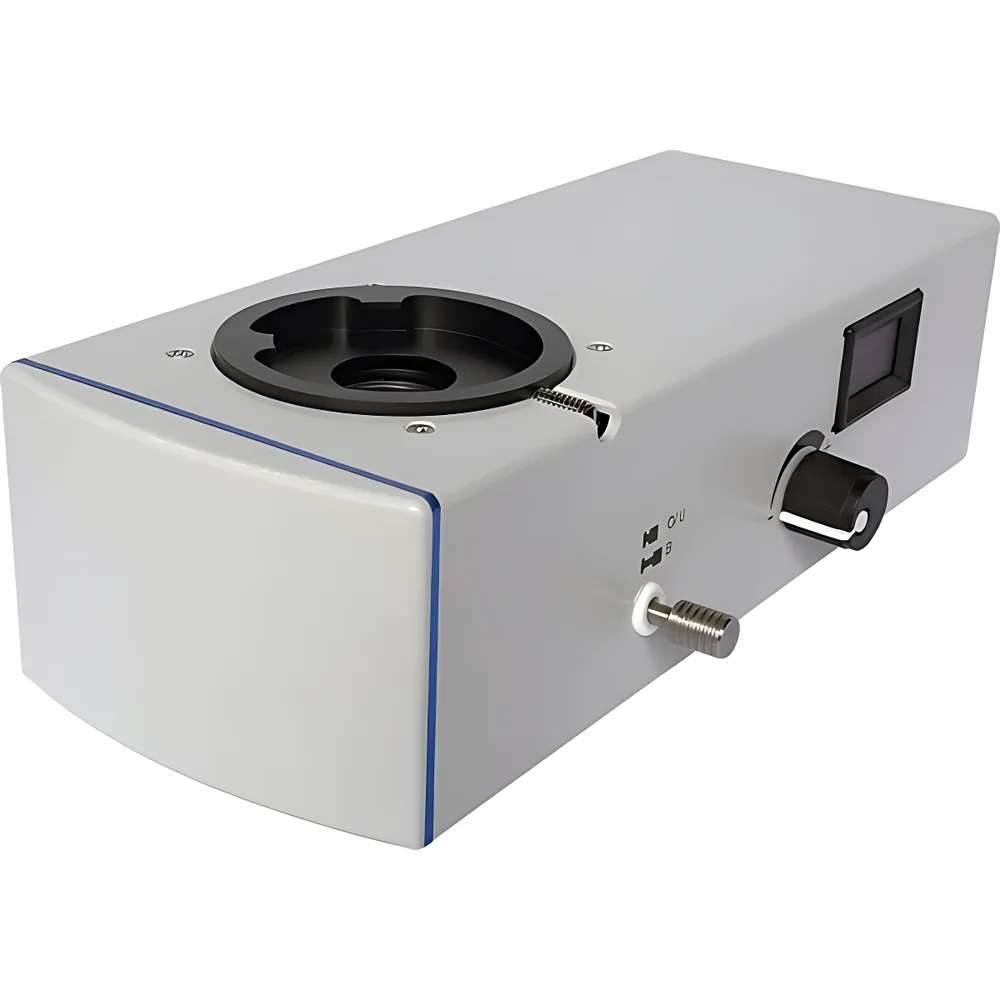
The MingHui FL5-LED-DIMH is a five-position motorized fluorescence attachment engineered for inverted optical microscopes—specifically optimized for compatibility with Olympus inverted platforms. It implements epi-fluorescence illumination architecture, where excitation light is directed through the objective lens onto the specimen and emitted fluorescence is collected along the same optical path. This configuration ensures high signal-to-noise ratio and minimal background interference in live-cell imaging, fixed-tissue analysis, and multi-label co-localization studies. Unlike traditional mercury or xenon arc lamps, the FL5-LED-DIMH integrates three independently addressable, high-radiance LED modules (UV, blue, and green), each spectrally matched to standardized fluorophore excitation profiles. The system eliminates warm-up delays, thermal drift, and ozone generation—critical advantages for time-lapse microscopy and GLP-compliant routine QC workflows.
Key Features
- Motorized five-position filter turret with encoded position recognition: enables precise, repeatable switching between up to four fluorescence channels and one brightfield mode without manual realignment.
- Three factory-calibrated LED sources (365 nm UV, 470 nm blue, 530 nm green), each rated at 18 W output power and >30,000-hour operational lifetime—reducing total cost of ownership and minimizing instrument downtime.
- Dedicated 1.8-inch color display power box with digital brightness readout: supports continuous intensity adjustment per channel and retains individual brightness settings across power cycles.
- Optimized bandpass and longpass filter sets: UBG configuration includes UEX (365/30 nm ex, 425 nm LP em), BAEX (470/30 nm ex, 535/35 nm em), and GEX (530/30 nm ex, 575 nm LP em), ensuring minimal spectral crosstalk and high emission collection efficiency.
- Modular, tool-free filter cube replacement: all cubes are pre-aligned and mechanically keyed—no alignment screws or calibration routines required upon installation.
- Native integration with Olympus inverted microscope optical paths: maintains parfocality, Köhler illumination geometry, and infinity-corrected beam alignment without auxiliary optics or adapters.
Sample Compatibility & Compliance
The FL5-LED-DIMH supports standard 35 mm glass-bottom dishes, chambered coverslips, and multi-well plates commonly used in cell culture and developmental biology applications. Its internal epi-illumination design minimizes phototoxicity during prolonged observation—particularly beneficial for GFP/RFP/YFP-expressing lines and calcium-sensitive dyes (e.g., Fluo-4, Fura-2). All optical components comply with ISO 10110 surface quality standards; LED drivers meet IEC 61000-3-2 harmonic emission limits. While not certified for clinical diagnostics under FDA 510(k) or CE-IVD, the system conforms to general laboratory equipment safety requirements (IEC 61010-1) and supports audit-ready documentation for GLP and ISO/IEC 17025 environments when paired with timestamped image metadata and electronic logbook integration.
Software & Data Management
The FL5-LED-DIMH operates as a hardware-controlled peripheral—requiring no proprietary acquisition software. It interfaces seamlessly with third-party microscopy platforms including Olympus cellSens, Nikon NIS-Elements, and open-source tools such as Micro-Manager and Fiji/ImageJ via TTL trigger signals and RS-232 serial commands. The power box logs channel selection history, cumulative LED runtime, and brightness setpoints—exportable as CSV for preventive maintenance scheduling. For regulated environments, optional firmware upgrade enables 21 CFR Part 11–compliant audit trails when integrated with validated LIMS or ELN systems, including user authentication, electronic signatures, and immutable event logging.
Applications
- Live-cell dynamics: monitoring mitochondrial membrane potential (TMRM), lysosomal pH (LysoTracker), or nuclear translocation (NF-κB-GFP) with minimal photobleaching.
- Immunofluorescence screening: simultaneous detection of DAPI (nuclei), FITC (primary antibody), and TRITC (secondary antibody) using sequential channel acquisition.
- Stem cell differentiation assays: quantitative assessment of marker expression (e.g., Sox2, Oct4, Nestin) across heterogeneous populations.
- Neuronal network activity: calcium imaging in primary cortical cultures using GCaMP6s and dual-color ratiometric analysis.
- Microbial biofilm characterization: spatial mapping of extracellular polymeric substances (EPS) with ConA-Alexa Fluor 488 and SYTOX Orange staining.
FAQ
Is the FL5-LED-DIMH compatible with non-Olympus inverted microscopes?
Yes—mechanical and optical interface dimensions follow JIS B 7141 and DIN 6868-57 standards; custom adapter plates are available for Nikon Eclipse Ti, Zeiss Axio Observer, and Leica DMi8 platforms.
Can additional filter sets be added beyond the standard UBG configuration?
Yes—the turret accepts any 25 mm diameter, 11 mm thick filter cube conforming to ANSI Z80.10; custom cubes (e.g., Cy5, mCherry, CF™ dyes) can be ordered with OEM-grade dichroics and emission filters.
Does the system support analog or digital intensity modulation?
Intensity is controlled digitally via PWM-driven constant-current drivers; analog 0–5 V input is available on request for external DAQ synchronization.
What is the maximum permissible working distance for objective lenses?
The attachment maintains full functionality with objectives having ≥2 mm working distance—including 20×/0.40 NA, 40×/0.60 NA, and 60×/0.70 NA dry and water-dipping lenses.
Is firmware update capability included?
Yes—USB-C service port enables field-upgradable firmware supporting new channel protocols, enhanced thermal management algorithms, and expanded RS-232 command sets.