
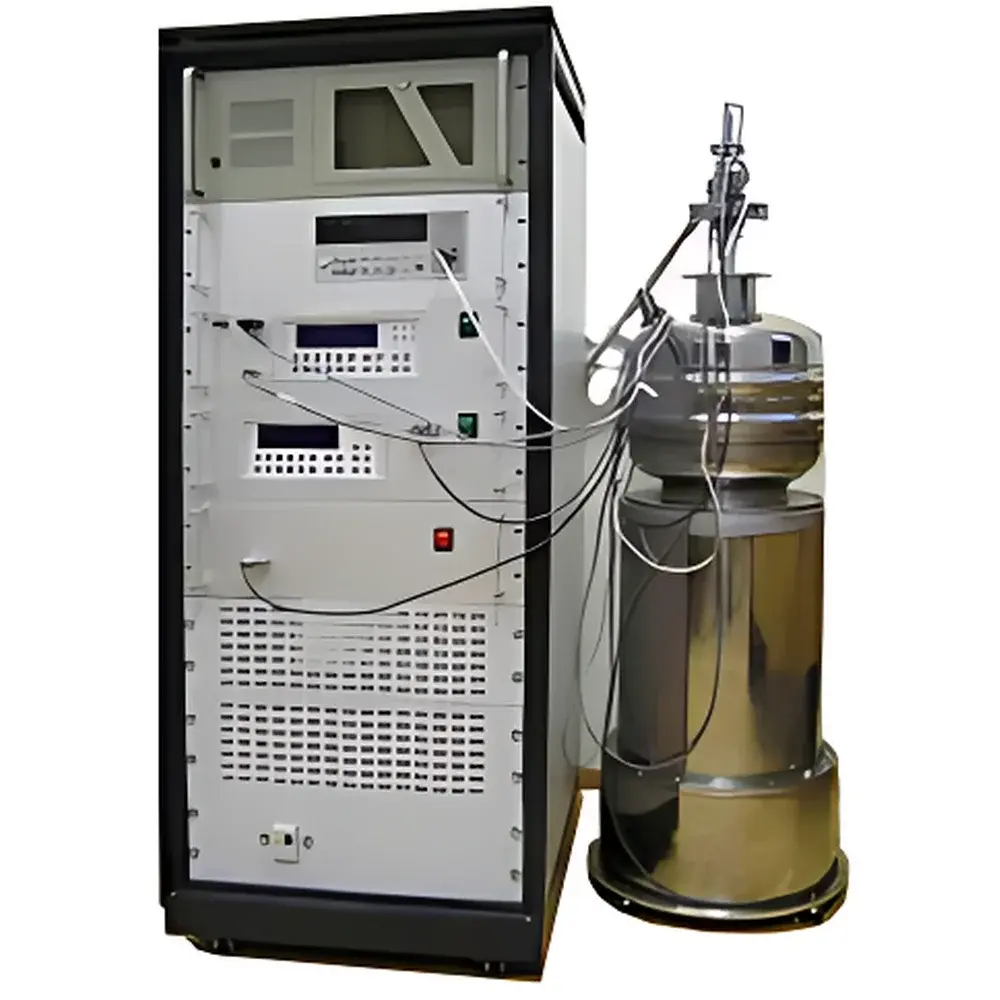
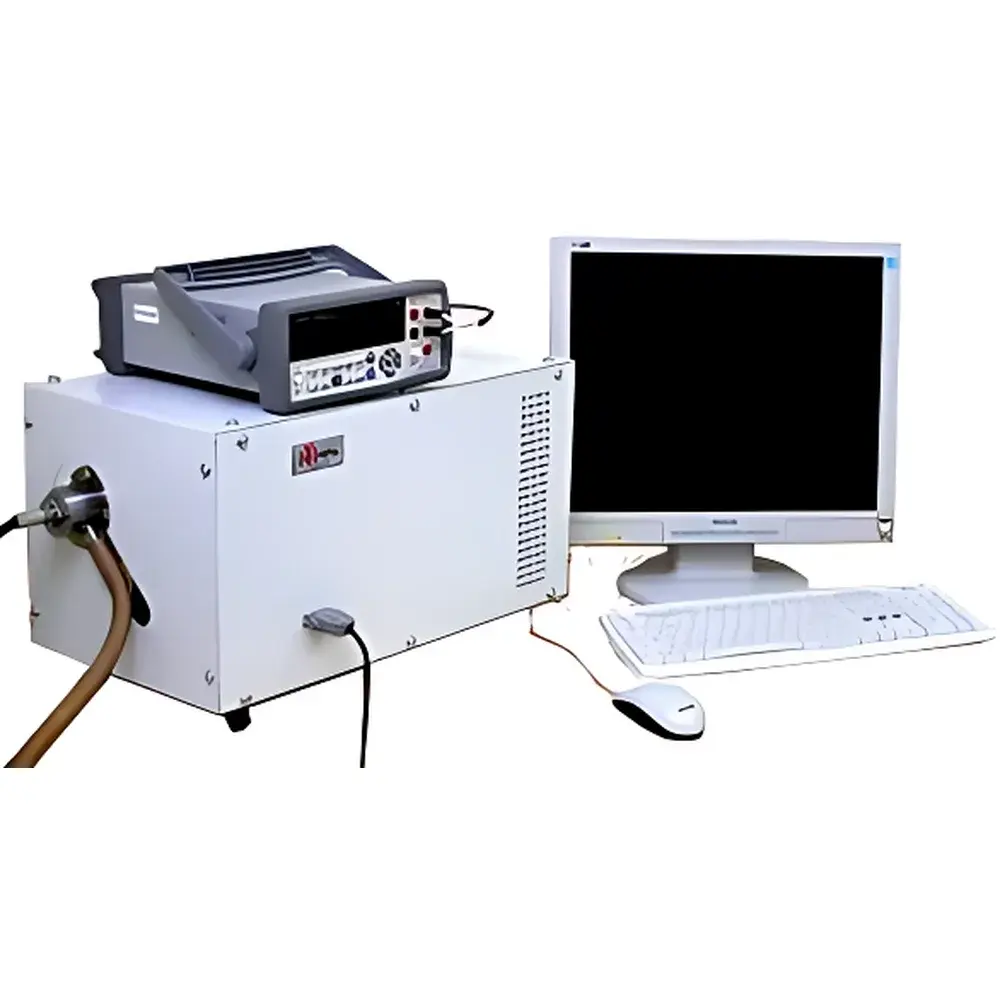
MMS Magnetocaloric Effect Direct Measurement System
| Origin | Russia |
|---|---|
| Manufacturer Type | Distributor |
| Origin Category | Imported |
| Model | MMS |
| Pricing | Upon Request |
| Cooling Medium | Liquid Nitrogen |
| Operating Temperature Range | 110–365 K |
| Magnetocaloric Temperature Change Range | ≥0.1 K |
| Temperature Stability During Measurement | ±0.05 K |
| Magnetic Field Range | 0.02–1.8 T |
| Magnetic Field Ramp Rate | 0.05–6 T/s |
Overview
The MMS Magnetocaloric Effect Direct Measurement System is a precision-engineered, cryogenically cooled instrumentation platform designed for quantitative, in-situ characterization of the magnetocaloric effect (MCE) in bulk and powdered magnetic materials. Based on the adiabatic temperature change (ΔTad) measurement principle, the system directly captures the transient thermal response of a sample subjected to controlled, rapid magnetic field variations under well-defined thermal boundary conditions. Unlike indirect estimation methods relying on magnetization integration (e.g., Maxwell relation-derived ΔTad), the MMS employs high-resolution thermometry integrated within a calibrated measuring insert to record real-time temperature evolution with sub-10 mK temporal resolution. This direct methodology ensures traceable, experimentally grounded MCE data essential for validating theoretical models, benchmarking candidate refrigerants for magnetic cooling cycles, and supporting ISO/IEC 17025-compliant material qualification protocols.
Key Features
- Cryostat-integrated architecture featuring a liquid nitrogen–cooled shank-end cryostat enabling stable operation across 110–365 K without helium dependency
- Computer-controlled permanent magnet array based on a Halbach-like configuration, delivering homogeneous, tunable magnetic fields from 0.02 T to 1.8 T with programmable ramp profiles
- Dual-stage thermal isolation between sample chamber and environment, minimizing parasitic heat exchange during adiabatic transients
- High-stability platinum resistance thermometer (PRT) embedded in the measuring insert, calibrated traceably to NIST standards, with <±0.05 K thermal drift over 30-minute measurement windows
- Field-ramp rate controllability from 0.05 T/s (quasi-static) to 6 T/s (dynamic regime), facilitating comparative analysis of relaxation kinetics and hysteresis losses
- Modular design supports interchangeable sample holders for disk, pellet, ribbon, and powder geometries — accommodating both single-crystal and polycrystalline specimens up to 10 mm diameter × 3 mm thickness
Sample Compatibility & Compliance
The MMS accommodates solid-state magnetic materials including intermetallic compounds (e.g., Gd-Si-Ge, La-Fe-Si), manganese-arsenides (MnAs-based), Heusler alloys, and rare-earth-free candidates such as FeRh and Ni-Mn-In systems. Sample mass range: 10–500 mg. All thermal and magnetic subsystems are engineered to meet mechanical and electromagnetic safety requirements per IEC 61000-6-4 (EMC emission) and IEC 61000-6-2 (immunity). Data acquisition workflows support audit-ready documentation aligned with GLP and GMP environments; raw time-series datasets include embedded metadata (timestamp, field setpoint, PID parameters, ambient pressure, LN₂ level) required for FDA 21 CFR Part 11–compliant electronic records when deployed with validated LabVIEW software configurations.
Software & Data Management
Control, acquisition, and post-processing are fully implemented via a customized LabVIEW-based application running on Windows OS. The software provides synchronized triggering of field pulses, thermal sampling (up to 1 kHz), and real-time visualization of ΔTad(t), dT/dt, and field history. Export formats include CSV (ASCII), HDF5 (for hierarchical metadata-rich storage), and MATLAB .mat files. Batch processing tools enable automated calculation of peak ΔTad, full-width-at-half-maximum (FWHM) of thermal transients, and field-dependent entropy change (ΔSM) via numerical differentiation. Software validation documentation (IQ/OQ protocols) and source code version control logs are supplied upon request for regulated laboratory deployment.
Applications
- Development and screening of active magnetic regenerator (AMR) materials for near-room-temperature magnetic refrigeration
- Quantification of intrinsic MCE magnitude, hysteresis losses, and thermal lag in first- and second-order phase transition materials
- Correlation studies between microstructure (grain size, phase purity, defect density) and adiabatic temperature response
- Calibration reference for indirect MCE estimation techniques (e.g., magnetization-derived ΔSM validation)
- Education and advanced training in solid-state thermodynamics and magneto-thermal coupling phenomena
FAQ
What cooling medium does the MMS require?
Liquid nitrogen only — no liquid helium or closed-cycle cryocooler integration is needed.
Can the system operate below 110 K?
No — the base temperature limit is defined by the LN₂ bath stability and thermal anchoring design; extension to lower temperatures requires third-party cryostat retrofitting.
Is the magnetic field homogeneity specified?
Yes — field uniformity is ±1.2% over a 5 mm Ø × 2 mm axial volume at 1.5 T, verified by Hall probe mapping.
Does the system support AC magnetic field cycling?
No — it is optimized for DC field sweeps and step-field protocols; sinusoidal or pulsed AC fields are outside its design scope.
Are calibration certificates included with shipment?
Yes — NIST-traceable PRT calibration certificate and magnetic field mapping report are provided with each unit.



