
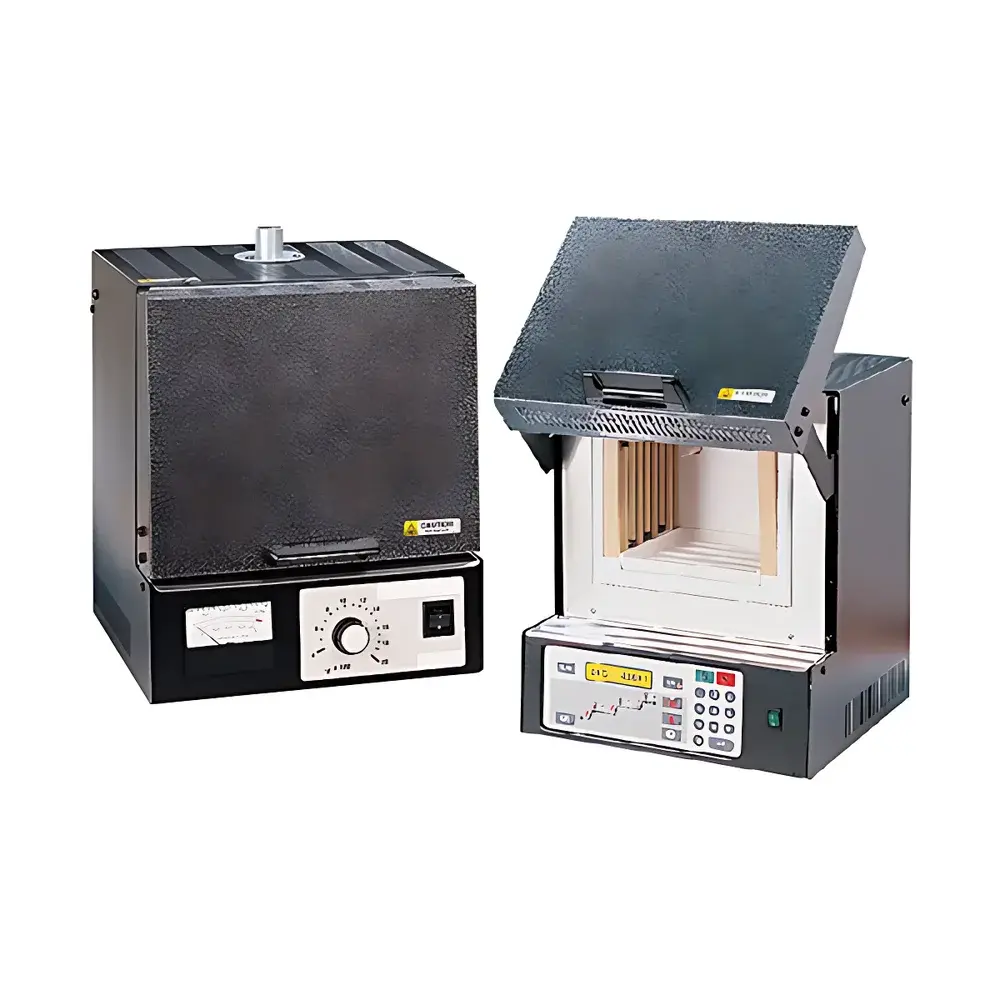
Neytech 3-550 Programmable Muffle Furnace
| Origin | USA |
|---|---|
| Manufacturer Type | Authorized Distributor |
| Origin Category | Imported |
| Model | 3-550 |
| Instrument Type | Box-Type Muffle Furnace |
| Max Temperature | 1050 °C |
| Temperature Control Accuracy | ±1 °C (at setpoint stability) |
| Max Power | 5600 W |
| Ramp-to-Max-Temp Time | 25 min |
| Heating Method | Embedded Resistance Heaters |
| Internal Chamber Dimensions | 15.2 × 15.2 × 22.9 cm (L×W×H) |
| Chamber Volume | 5.3 L |
| Voltage/Frequency | 200–250 V, 50/60 Hz |
| Temperature Range | 50–1100 °C |
| Temp Uniformity | ±8 °C (at 1000 °C, steady-state) |
| Ramp Rate | 0.1–40 °C/min |
| Cooling Profile | Natural convection-based |
| Safety | Interlocked vertical-lift door with automatic power cutoff |
Overview
The Neytech 3-550 is a programmable, high-reliability box-type muffle furnace engineered for precision thermal processing in research laboratories, quality control environments, and materials development facilities. Designed and manufactured under strict U.S.-based engineering standards, the 3-550 employs a robust composite chamber construction—distinct from traditional ceramic fiber or firebrick linings—to deliver rapid thermal response, enhanced structural integrity, and extended service life. Its heating system integrates embedded resistance elements surrounded by refractory brick insulation, minimizing thermal stress on heating components and enabling repeatable performance across thousands of thermal cycles. The furnace operates on a true muffle principle: the sample chamber is fully isolated from combustion gases and heating elements, ensuring contaminant-free, oxidation-controlled atmospheres essential for ashing, calcination, sintering, and pre-firing of advanced ceramics, metallurgical powders, and electronic substrates.
Key Features
- Vertical-lift door architecture directs radiant heat upward and away from the operator, reducing exposure risk and improving ergonomics during sample loading/unloading.
- Integrated safety interlock system cuts power immediately upon door opening—compliant with IEC 61010-1 and UL 61010B-1 requirements for laboratory electrical equipment.
- Three-stage PID temperature programming with nine user-definable profiles; includes hold, ramp, and soak segments per stage, plus a dedicated “constant-temperature” mode (Program 0).
- Seven-day delayed start function enables unattended operation scheduling aligned with facility maintenance windows or shift rotations.
- Modular chamber design maximizes internal volume (5.3 L) while minimizing external footprint—ideal for space-constrained lab benches.
- Optional ceramic hearth plate (sold separately) protects bottom-mounted heaters from mechanical impact and chemical residue accumulation during repeated high-temperature use.
- Front-panel digital interface with intuitive navigation and real-time display of setpoint, actual temperature, elapsed time, and active program status.
Sample Compatibility & Compliance
The 3-550 accommodates standard crucibles (alumina, platinum, silicon carbide), ceramic setters, and metal trays up to 14.5 cm × 14.5 cm in base dimension. Its uniform temperature distribution (±8 °C at 1000 °C) meets ASTM E1142 and ISO 9001 thermal validation prerequisites for routine process qualification. The furnace supports GLP/GMP-aligned workflows through traceable parameter logging (when paired with optional data acquisition modules) and conforms to key regulatory expectations including FDA 21 CFR Part 11 readiness when integrated with compliant software platforms. It is routinely deployed in applications requiring adherence to ASTM C117, ISO 1171 (ash content), and USP heavy metals testing protocols.
Software & Data Management
While the 3-550 operates as a standalone instrument with local front-panel control, it features an RS-485 serial port (Modbus RTU protocol) for integration into centralized lab automation systems. Optional PC-based software enables remote monitoring, real-time graphing, alarm configuration, and export of timestamped temperature logs in CSV format—supporting audit-ready documentation for ISO/IEC 17025-accredited laboratories. All program parameters—including ramp rates, dwell times, and termination conditions—are stored non-volatile memory with battery-backed retention, eliminating data loss during brief power interruptions.
Applications
- Controlled-oxidation sintering of ferrites, piezoelectrics, and solid oxide fuel cell (SOFC) components.
- Ash content determination per AOAC 942.05 and EPA Method 1695 for environmental and food safety testing.
- Thermal gravimetric analysis (TGA) sample pre-conditioning and residue stabilization.
- Debinding and burnout of polymer-bonded metal injection molding (MIM) and ceramic injection molding (CIM) feedstocks.
- Heat treatment of calibration standards, reference materials, and inert substrate preparation for thin-film deposition.
- High-temperature annealing of semiconductor wafers and optical glass substrates under ambient air or inert gas purge (with optional gas inlet kit).
FAQ
What is the maximum recommended continuous operating temperature?
The 3-550 is rated for continuous operation up to 1050 °C; sustained use above this limit may accelerate heater degradation and void warranty coverage.
Can the furnace be used under inert or reducing atmospheres?
Yes—when equipped with the optional gas inlet adapter (part #GIA-350), the chamber supports nitrogen, argon, or forming gas purges at flow rates up to 2 L/min.
Is the ±1 °C control accuracy maintained across the full 50–1100 °C range?
Control accuracy is specified at setpoint stability; actual uniformity varies spatially and is ±8 °C at 1000 °C per ASTM E220 calibration methodology.
Does the 3-550 include over-temperature protection?
Yes—a redundant independent over-temperature cutoff (OTC) sensor interrupts power if chamber temperature exceeds user-defined safety limits by >25 °C.
Are replacement heating elements field-serviceable?
Yes—modular heater assembly design allows full replacement without disassembling the outer casing; typical downtime is under 45 minutes with standard tools.



