
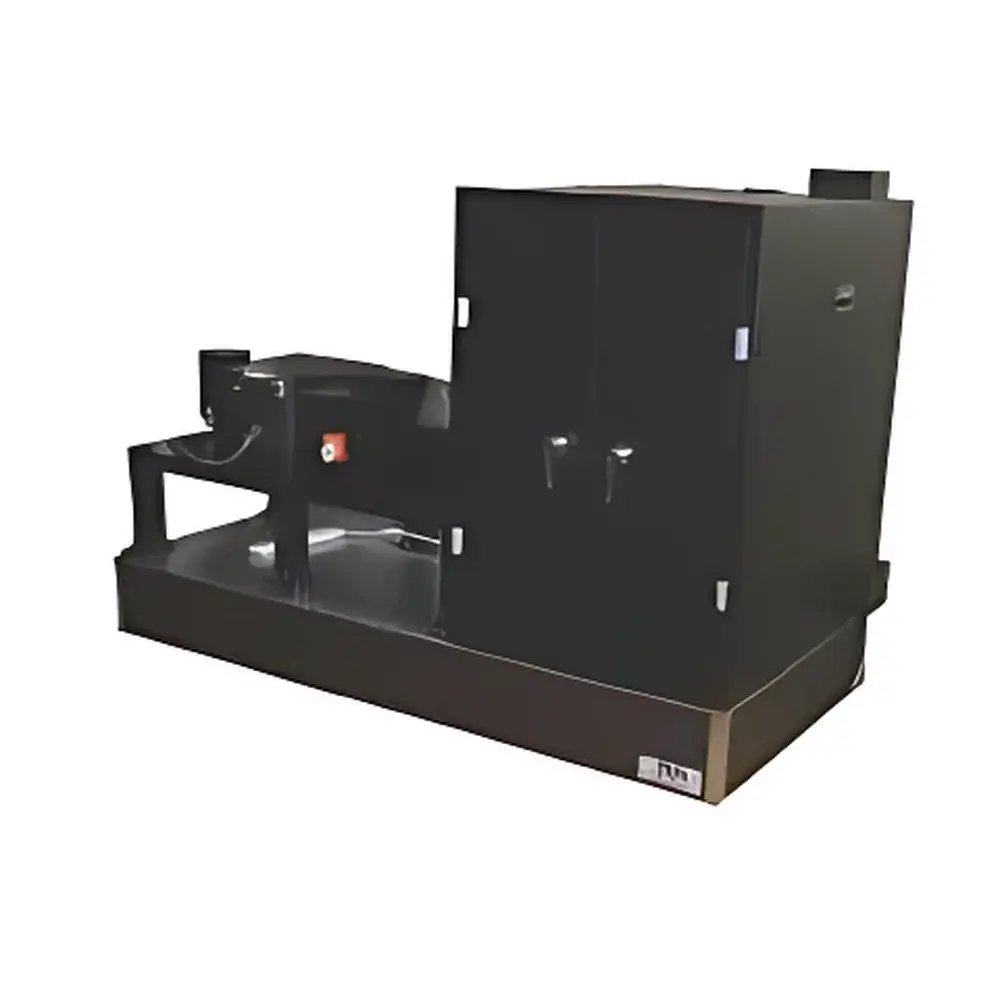
NRI Series Benchtop Infrared Refractometer
| Origin | Japan |
|---|---|
| Manufacturer Type | Authorized Distributor |
| Origin Category | Imported Instrument |
| Model | NRI Series |
| Price Range | USD 20,000–33,000 (FOB) |
| Instrument Type | Benchtop Refractometer |
| Temperature Control | Integrated Peltier-based Thermostatic Stage |
| Digital Display | High-Resolution TFT LCD with Real-Time Readout |
| Spectral Range | 1.0–14.0 µm (1000–14,000 nm) |
| Refractive Index Resolution | 1 × 10⁻⁴ (0.0001 RIU) |
| Measurement Principle | Minimum Deviation Angle Method (Prism-Based) |
Overview
The NRI Series Benchtop Infrared Refractometer is a precision optical metrology instrument engineered for high-accuracy refractive index characterization of bulk infrared-transparent materials and thin-film coatings across the mid-infrared spectral region. It operates on the classical minimum deviation angle principle—also known as the prism dispersion method—where a collimated monochromatic beam traverses a precisely oriented prism-shaped sample, and the angular deviation of the emergent ray is measured with sub-arcsecond resolution. By varying incident wavelength within the 1.0–14.0 µm range (corresponding to wavenumbers 10,000–714 cm⁻¹), the system enables full dispersion curve acquisition (n(λ)) for crystalline and amorphous IR substrates. Designed for R&D laboratories and optical component QA/QC environments, the NRI Series delivers traceable, repeatable refractive index values at the 10⁻⁴ level—meeting the stringent requirements for certifying Ge, Si, ZnSe, KRS-5, AMTIR, and chalcogenide glass windows, lenses, and anti-reflection coatings used in thermal imaging, FTIR spectroscopy, and laser delivery systems.
Key Features
- Wide spectral coverage from 1.0 to 14.0 µm, compatible with tunable quantum cascade lasers (QCLs) or broadband IR sources coupled via fiber-coupled input optics
- Integrated Peltier-controlled sample stage with ±0.1 °C temperature stability over −10 °C to +80 °C, enabling thermo-optic coefficient (dn/dT) quantification
- Digital angular encoder with <0.5 arcsec resolution for precise minimum deviation detection; automated peak-search algorithm eliminates operator subjectivity
- Benchtop form factor with vibration-damped optical baseplate and modular sample holder accommodating prisms ≥10 mm base length and ≤30 mm height
- Compliance with ISO 10110-2 (optical material specification) and ASTM E1996 (test methods for refractive index of optical glasses) for reporting uncertainty budgets
Sample Compatibility & Compliance
The NRI Series supports standard prism geometries (60°, 30°–60°–90°, and custom apex angles) fabricated from single-crystal germanium (Ge), silicon (Si), zinc selenide (ZnSe), thallium bromoiodide (KRS-5), and multi-component IR glasses. Thin-film samples are evaluated using the “prism coupling” configuration, where the film is deposited directly onto the prism base—enabling n and k determination of AR/HR coatings down to 50 nm thickness. All measurements adhere to Good Laboratory Practice (GLP) documentation standards, with audit trails compliant with FDA 21 CFR Part 11 when operated with optional validated software modules. Calibration is performed using NIST-traceable reference prisms (e.g., BaF₂, CaF₂) certified across the operational wavelength band.
Software & Data Management
The instrument is controlled via NRI-Control Suite v3.x—a Windows-based application supporting both manual alignment and fully automated wavelength sweeps. Raw angular data, temperature logs, and environmental metadata (ambient humidity, pressure) are stored in HDF5 format with embedded SI units and ISO 8601 timestamps. Export options include CSV, MATLAB .mat, and XML files conforming to the Optical Metrology Data Exchange Standard (OMDES v1.2). The software includes built-in Sellmeier fitting routines, dn/dT calculation tools, and overlay plotting for comparative dispersion analysis across multiple samples or thermal states. Optional 21 CFR Part 11 compliance package provides electronic signatures, role-based access control, and immutable audit logs.
Applications
- Characterization of IR lens materials during prototyping and production release testing
- Verification of coating design fidelity for multi-layer interference filters operating beyond 8 µm
- Thermo-optic property mapping of chalcogenide glasses for tunable IR photonics
- Quality assurance of ZnSe output couplers in CO₂ laser systems
- Supporting ISO 11146-compliant M² measurement setups requiring precise substrate n(λ) inputs
- Academic research in phonon-polariton dispersion in polar dielectrics (e.g., LiNbO₃, GaP)
FAQ
What wavelength calibration standards are supported?
NIST-traceable reference prisms (BaF₂, CaF₂, Si) calibrated at discrete wavelengths between 2.0 and 12.0 µm are supplied with each system.
Can the NRI Series measure absorbing materials?
Yes—provided the sample exhibits measurable transmission (>5%) at the target wavelength and maintains sufficient surface polish to minimize scattering losses.
Is vacuum or purged operation required?
Not mandatory; however, for measurements below 3.0 µm or above 12.0 µm, nitrogen purge or dry-air enclosure is recommended to suppress atmospheric H₂O and CO₂ absorption bands.
How is temperature uniformity ensured across the prism?
The Peltier stage features dual-point RTD sensing and closed-loop feedback, maintaining axial gradient <0.05 °C across a 25 mm prism footprint.
Does the system support custom prism mounting fixtures?
Yes—modular kinematic mounts and adjustable clamping plates accommodate non-standard apex angles and oversized substrates up to 50 mm diameter.




