
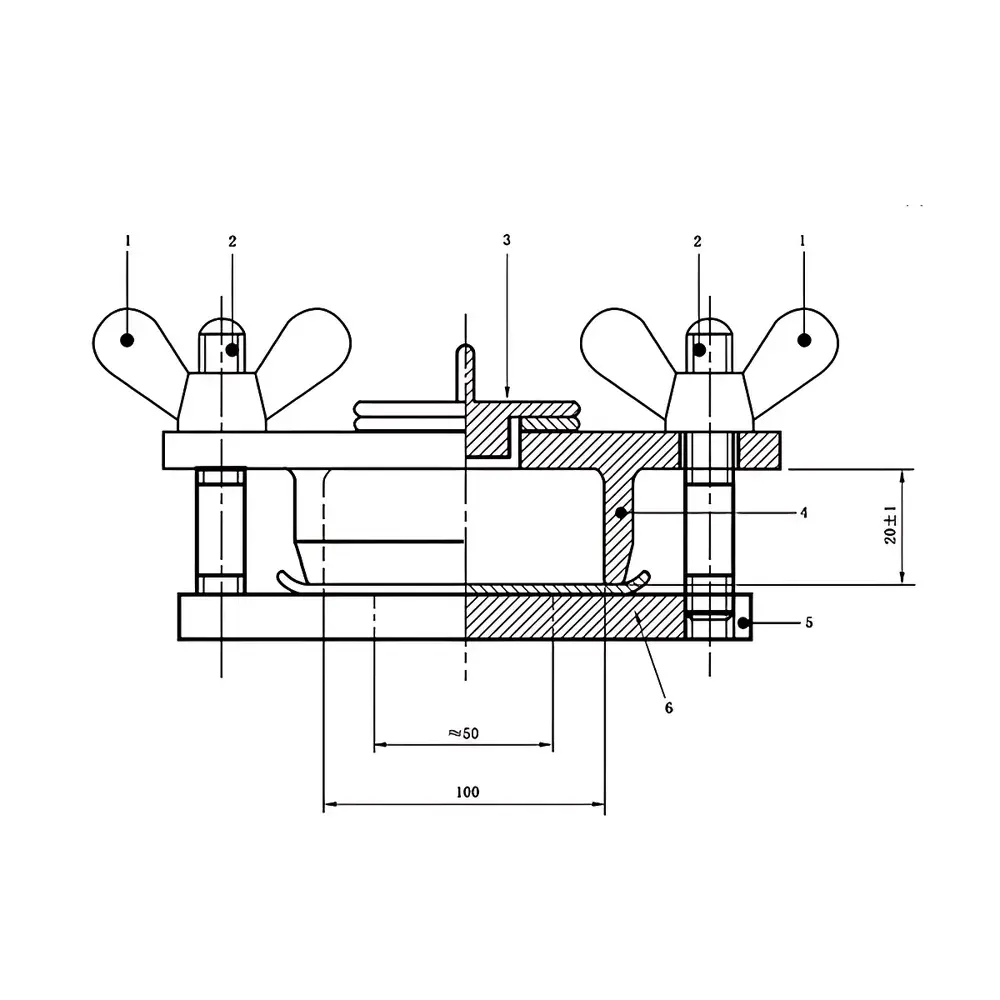
NYX DT 200 Chemical-Resistant Boot Degradation Test Cell
| Brand | NYX |
|---|---|
| Origin | Tianjin, China |
| Manufacturer Type | Direct Manufacturer |
| Origin Category | Domestic (China) |
| Model | DT 200 |
| Pricing | Available Upon Request |
| Construction Material | ASTM A240 316L Stainless Steel |
| Chamber Internal Diameter | 100 mm |
| Chamber Internal Height | 20 ± 1 mm |
| Base Plate Central Opening | 50 mm |
| Optional Sample Cutting Die | 120 ± 1 mm |
Overview
The NYX DT 200 Chemical-Resistant Boot Degradation Test Cell is a precision-engineered laboratory apparatus designed to evaluate the physical degradation behavior of protective footwear materials—specifically rubber and polymer-based outsoles and uppers—when exposed to standardized chemical challenge agents under controlled immersion conditions. It operates in accordance with the core mechanical immersion methodology defined in GB 20265:2019 Section 6.23.1 and EN 13832-1:2006 Clause 4.2.2.1, which require quantitative assessment of dimensional change, mass loss, surface cracking, and tensile property reduction following fixed-duration chemical exposure. The test cell provides a reproducible, sealed environment that eliminates uncontrolled vapor loss, thermal drift, and mechanical disturbance during immersion—critical for inter-laboratory comparability and regulatory acceptance.
Key Features
- Monolithic 316L stainless steel construction per ASTM A240, ensuring long-term resistance to corrosion from aggressive solvents, acids, alkalis, and hydrocarbon-based test media commonly used in boot certification protocols (e.g., acetone, toluene, 40% sulfuric acid, 10% sodium hydroxide).
- Cylindrical chamber with precisely machined internal dimensions: 100 mm nominal inner diameter and 20 ± 1 mm effective immersion depth—optimized to accommodate standard boot sole specimens while maintaining consistent fluid volume-to-surface-area ratio per ISO 48-2 and ASTM D471 guidelines.
- Modular assembly comprising base plate (with centered 50 mm through-hole for specimen mounting), vertical containment cylinder, high-torque stainless steel bolts, wing nuts, and fluorosilicone-sealed stopper—enabling rapid setup, leak-free sealing, and full disassembly for cleaning or calibration verification.
- Optional certified sample cutting die (120 ± 1 mm diameter) manufactured to ISO 2768-mK general tolerances, facilitating compliant specimen preparation per EN 13832-1 Annex A and GB/T 2941 requirements for uniform thickness and edge geometry.
- Zero-drift design: All interfaces utilize metal-to-metal contact surfaces combined with elastomeric compression seals; no adhesives or polymer gaskets that may swell or leach into test media.
Sample Compatibility & Compliance
The DT 200 accommodates flat-cut specimens cut from finished boot soles or standardized vulcanized rubber sheets (e.g., natural rubber, nitrile, neoprene, polyurethane). Specimen thickness must be within 2.0–6.0 mm to ensure full submersion without bottoming out. The device supports testing across all chemical classes referenced in EN 13832-1 Table 1 and GB 20265:2019 Annex B—including aliphatic and aromatic hydrocarbons, ketones, esters, chlorinated solvents, and aqueous corrosives. Data generated using this cell are admissible for CE marking dossier submissions, CNAS-accredited laboratory reports, and MDR/IVDR technical documentation when paired with validated gravimetric, caliper, and tensile testing workflows.
Software & Data Management
The DT 200 is a manual, non-instrumented test cell and does not incorporate embedded sensors or digital connectivity. However, it is fully compatible with GLP-compliant laboratory information management systems (LIMS) and electronic lab notebooks (ELN) via standardized test protocol templates. Users may integrate it into audit-ready workflows supporting FDA 21 CFR Part 11 compliance by documenting operator ID, lot numbers of test chemicals and specimens, immersion start/end timestamps, ambient temperature/humidity logs, and post-test measurement records (mass, thickness, crack count) using traceable calibrated instruments (e.g., Mettler Toledo XP204 balance, Mitutoyo Absolute Digimatic caliper). Calibration certificates for ancillary equipment and material safety data sheet (MSDS) traceability are required for ISO/IEC 17025 accreditation.
Applications
- Pre-certification validation of chemical resistance for occupational safety footwear intended for petrochemical, pharmaceutical, wastewater treatment, and battery manufacturing environments.
- Quality control screening of incoming raw rubber compounds and compounded elastomer batches prior to sole molding.
- Comparative evaluation of alternative polymer formulations during R&D for improved solvent resistance without compromising flex fatigue life.
- Root cause analysis of field failures involving swelling, softening, or delamination of boot components after workplace chemical exposure.
- Supporting ISO 13688:2013 general requirements for protective clothing performance classification, specifically clause 6.4 on chemical permeation and degradation resistance.
FAQ
Is the DT 200 suitable for testing full boots, or only cut specimens?
Only flat, disk-shaped specimens cut from sole or upper materials are compatible; full-boot immersion is not supported due to geometric and sealing constraints.
Does the cell include temperature control or heating capability?
No—the DT 200 is a passive immersion vessel. Temperature regulation must be achieved externally using a calibrated environmental chamber or water bath meeting ISO 291 conditioning requirements (23 ± 2°C, 50 ± 5% RH).
Can I use non-standard test liquids not listed in EN 13832-1?
Yes—provided chemical compatibility with 316L stainless steel is verified and test conditions (concentration, duration, temperature) are documented per ISO/IEC 17025 method validation principles.
What maintenance is required between tests?
Thorough rinsing with deionized water followed by ethanol wipe-down and air-drying; inspection for pitting or seal deformation before each use.
Is third-party calibration available for the DT 200?
Dimensional verification (ID/OD, height, hole alignment) can be performed by accredited metrology labs using CMM or optical profilometry; no functional calibration is required as it is a passive mechanical fixture.





