
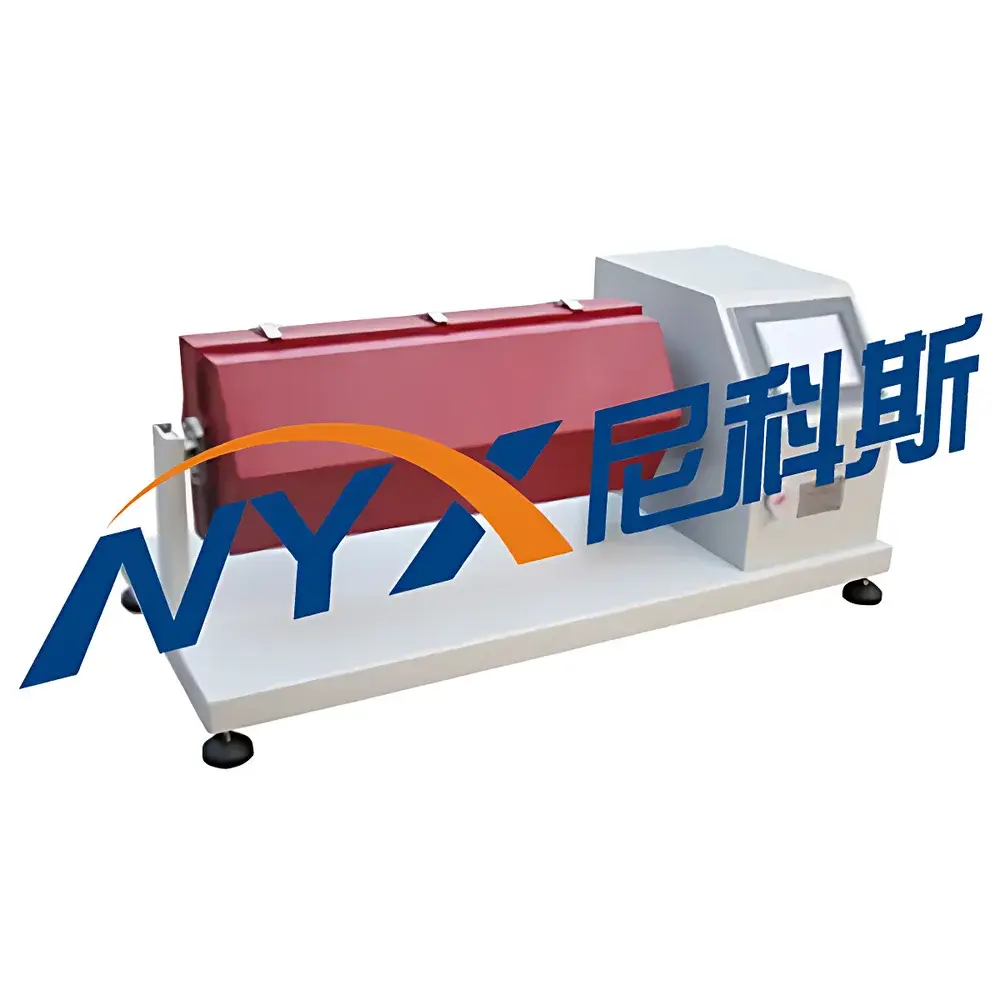
NYX HY-767C Nickel Release Tester (Abrasion Simulator for EN 12472:2005 Compliance)
| Brand | NYX |
|---|---|
| Origin | Tianjin, China |
| Manufacturer Type | Direct Manufacturer |
| Country of Origin | China |
| Model | HY-767C |
| Price Range | USD 4,200 – 7,000 |
| Rotational Speed | 20–60 rpm |
| Sample Holder Span Adjustment | 200–400 mm |
| Drum Inner Diameter | 190 ± 2 mm |
| Drum Material | High-resilience synthetic rubber (dimensionally stable) |
| Max Timer Duration (Forward/Reverse) | 17 h 59 min each |
| Control Interface | Touchscreen with programmable cycle logic |
| Rotation Reversal | Automatic directional switch at preset intervals |
| Safety Features | Interlocked transparent safety door, circuit breaker, emergency stop |
| Motor Type | Brushless DC motor with load-independent speed stability |
| Pause Function | Real-time operational suspension via front-panel button |
Overview
The NYX HY-767C Nickel Release Tester is a precision-engineered abrasion simulator designed explicitly to replicate two years of simulated wear on metallic components—primarily jewelry, eyewear frames, watch cases, and textile accessories with metal trim—prior to nickel release quantification per EN 12472:2005. Unlike generic tumbling devices, this instrument implements a controlled, standardized mechanical abrasion protocol based on the Couette-type rotational motion of a hexagonal drum containing abrasive slurry and sample fixtures. Its core function is not direct nickel measurement but rather the reproducible physical preconditioning step mandated by EN 12472:2005 Clause 4.3 and referenced in EN 1811:2011 Annex A. The device ensures uniform surface wear across all test specimens through precise angular displacement, consistent torque delivery, and programmable bidirectional rotation—critical for achieving inter-laboratory comparability in regulatory compliance testing.
Key Features
- Programmable bidirectional rotation with independent forward/reverse timing up to 17 hours 59 minutes per direction, enabling full-cycle simulation of long-term mechanical stress.
- Adjustable sample holder span (200–400 mm) accommodates diverse specimen geometries—including bracelets, spectacle temples, and garment fasteners—without compromising rotational balance.
- Dimensionally stable rubber-lined drum (ID: 190 ± 2 mm) minimizes harmonic vibration and prevents deformation under continuous operation, ensuring repeatable contact mechanics between samples and abrasive medium.
- Brushless DC drive system maintains ±1 rpm speed accuracy across full load range (up to 5 kg total mass), eliminating drift due to slurry viscosity or sample weight variation.
- Touchscreen HMI with intuitive cycle configuration supports multi-step programs: pre-wear stabilization, main abrasion phase, directional reversal, and cooldown pause—all logged with timestamped event records.
- Integrated safety architecture includes door interlock circuitry, thermal overload protection, and an emergency pause button compliant with IEC 61000-6-2 EMC immunity requirements.
Sample Compatibility & Compliance
The HY-767C supports flat, curved, and articulated metallic specimens ≤40 mm in maximum dimension and ≤500 g per item. It is validated for use with standard EN 12472:2005 abrasion media (e.g., synthetic sweat solution + pumice granules or specified silica-based slurry). The instrument meets mechanical performance criteria outlined in ISO/TS 24348:2014 (Clause 6.2) for wear simulators used in nickel migration assessment. Test reports generated using this device satisfy evidentiary requirements for CE marking submissions under EU Regulation (EC) No 1907/2006 (REACH) Annex XVII entry 27, as well as GB/T 28485–2012 and GB/T 38009–2019 for domestic Chinese market access. All operational parameters are traceable to internal calibration logs, supporting GLP-aligned audit readiness.
Software & Data Management
The embedded control firmware stores up to 100 programmable test protocols with user-defined labels, speed profiles, reversal points, and dwell times. Each run generates a CSV-formatted session log including start/stop timestamps, actual RPM deviation (<±0.5%), cumulative rotation count, and door-open events. Export is via USB 2.0 port; no cloud connectivity or proprietary software installation required. Audit trail functionality complies with ALCOA+ principles—data is immutable post-execution, with electronic signatures optional via external LDAP integration. Firmware updates are delivered as signed binary packages verified against SHA-256 checksums, fulfilling basic cybersecurity expectations per IEC 62443-3-3.
Applications
- Pre-abrasion conditioning of nickel-containing alloys prior to EN 1811:2011 extraction and ICP-MS/AAS analysis.
- Verification of barrier coating durability on stainless steel watch backs and spectacle hinges under cyclic mechanical stress.
- Comparative evaluation of electroplated vs. PVD-coated fasteners used in technical textiles subject to repeated flexing and friction.
- Supporting R&D validation for nickel-free alternatives (e.g., titanium alloys, ceramic composites) under accelerated wear protocols aligned with ISO 105-X12.
- Internal QC screening for suppliers manufacturing metal trims for apparel, footwear, and medical wearable devices governed by ISO 10993-5 cytotoxicity prerequisites.
FAQ
Does the HY-767C perform nickel quantification directly?
No. It executes only the mechanical wear stage defined in EN 12472:2005. Quantitative nickel release must be measured separately via atomic absorption spectroscopy (AAS) or inductively coupled plasma mass spectrometry (ICP-MS) following EN 1811:2011 extraction procedures.
Can the drum accommodate non-metallic textile accessories?
Yes—provided the accessory contains nickel-releasing metallic elements (e.g., zippers, snaps, rivets) and is secured to the hexagonal rack without interfering with slurry circulation or drum balance.
Is calibration certification included with shipment?
A factory-issued calibration report covering rotational speed accuracy, timer deviation, and temperature stability (ambient operating range: 15–30°C) is provided. NIST-traceable third-party calibration is available as an optional service.
What maintenance is required for long-term reliability?
Monthly inspection of drum liner integrity, quarterly lubrication of drive shaft bearings, and annual verification of touchscreen responsiveness and interlock switch actuation thresholds—documented in the included maintenance logbook.
How does the HY-767C differ from general-purpose tumble testers?
It incorporates EN-specific geometric tolerances (drum ID, hexagon angle), programmable reversal logic, and torque-regulated motor control absent in industrial tumblers—ensuring metrological equivalence to reference laboratories accredited to ISO/IEC 17025.





