
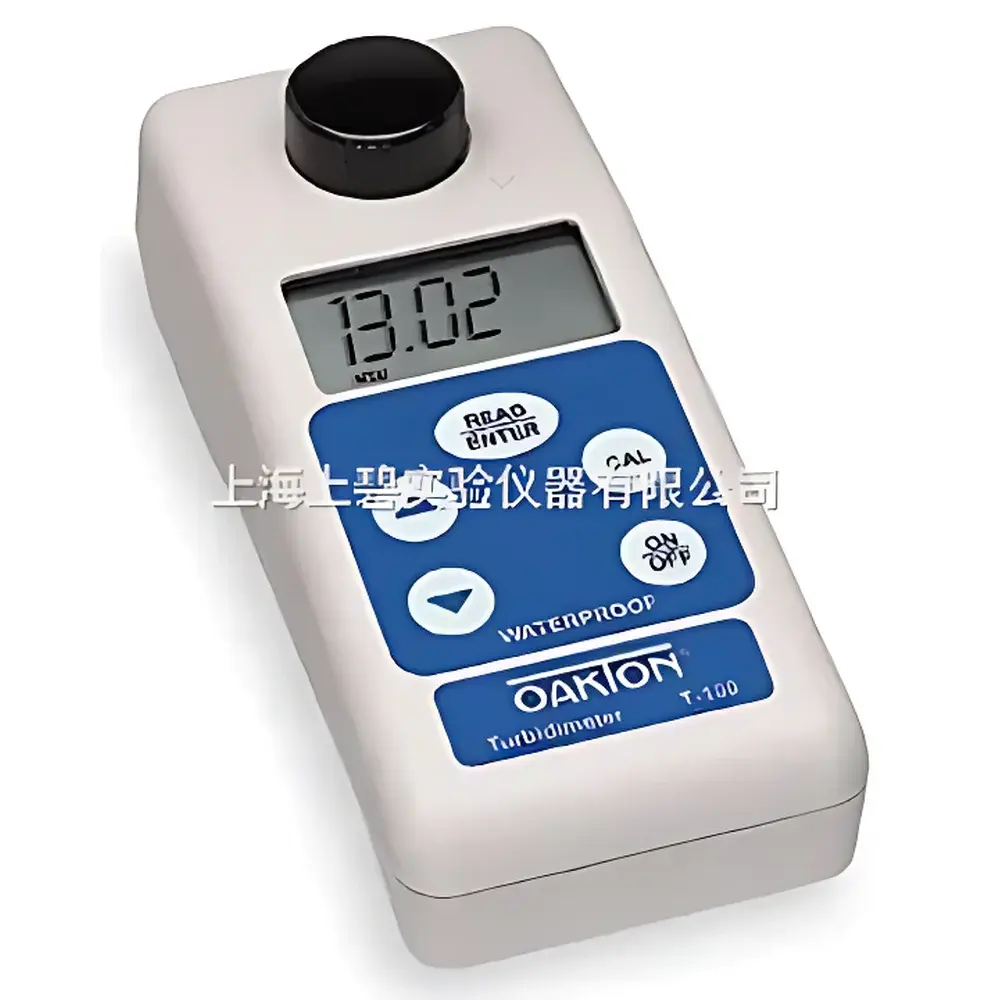
OAKTON T-100 Portable Turbidimeter
| Origin | USA |
|---|---|
| Manufacturer Type | Authorized Distributor |
| Origin Category | Imported Instrument |
| Model No. | 35635-00 |
| Product Type | Portable |
| Measurement Range | 0–19.99 NTU (low range), 20.0–99.9 NTU (mid range), 100–1000 NTU (high range) |
| Resolution | 0.01 NTU (0–19.99), 0.1 NTU (20.0–99.9), 1 NTU (100–1000) |
| Operating Temperature | 0–50 °C |
| Accuracy | ±2% of reading (0–500 NTU), ±3% of reading (500–1000 NTU) |
| Light Source | Infrared LED |
| Sample Volume | 10 mL |
| Response Time | <6 s |
| Power Supply | 4 × AAA batteries |
| Dimensions (L×W×H) | 16.5 × 7 × 5 cm |
| IP Rating | IP67 |
| Auto-ranging | Yes |
| Auto-shutdown | Yes |
| Calibration Standards Included | 0.02, 20.0, 100, and 800 NTU |
Overview
The OAKTON T-100 Portable Turbidimeter (Model 35635-00) is a field-deployable, ISO 7027-compliant optical instrument engineered for rapid, reliable turbidity quantification in water quality monitoring applications. It operates on the principle of infrared nephelometry—measuring scattered light intensity at 90° relative to an incident infrared LED beam—minimizing interference from color, absorbance, or particle fluorescence commonly encountered in natural and treated waters. Designed for compliance with EPA Method 180.1 and ASTM D6508, the T-100 delivers traceable, repeatable measurements across three dynamic ranges (0–19.99, 20.0–99.9, and 100–1000 NTU), enabling seamless transition from low-turbidity drinking water analysis to high-turbidity wastewater or process stream evaluation. Its sealed optical path eliminates drift from ambient light ingress or lens contamination, ensuring long-term stability without routine recalibration.
Key Features
- IP67-rated rugged housing: Fully dust-tight and submersible up to 1 m for 30 minutes; buoyant design allows safe operation near open water bodies.
- Four-point calibration protocol: Guides users stepwise through standard verification using supplied 0.02, 20.0, 100, and 800 NTU reference suspensions—enhancing linearity and minimizing systematic error across full scale.
- Intelligent auto-ranging: Automatically selects optimal measurement range and resolution (0.01/0.1/1 NTU) based on sample response, eliminating manual range selection errors.
- Optimized infrared optics: 850 nm LED source minimizes spectral interference from yellow-brown dissolved organic matter (e.g., humic substances), improving accuracy in colored samples per ISO 7027 Annex B recommendations.
- Low-power architecture: Delivers >1,000 measurements per set of AAA batteries; auto-shutdown after 10 minutes of inactivity conserves energy without compromising data integrity.
- Large backlit LCD: Displays real-time NTU value, active range, unit designation, battery status, and diagnostic icons—including over-range, low signal, or calibration alert indicators.
Sample Compatibility & Compliance
The T-100 accepts standard 10 mL glass cuvettes (included) and is compatible with all formazin-based and stable polymer calibration standards traceable to NIST SRM 2102. Its optical geometry conforms to ISO 7027:2016 requirements for ratio nephelometric turbidimeters, supporting regulatory reporting under US EPA Clean Water Act programs and EU Directive 2000/60/EC. The instrument meets GLP documentation requirements when used with printed calibration logs and timestamped measurement records. No software validation package is required for non-GMP field use; however, audit-ready calibration certificates for included standards are available upon request.
Software & Data Management
While the T-100 operates as a standalone field instrument with no onboard data logging, its measurement protocol supports full traceability via external documentation. Each calibration event and measurement can be manually recorded with date/time, operator ID, standard lot numbers, and environmental conditions (temperature, ambient light). For laboratories requiring electronic record retention, the device integrates seamlessly with LIMS platforms via manual entry or barcode-scanned standard IDs. All firmware logic adheres to IEC 61508 functional safety principles for portable instrumentation, and battery voltage monitoring ensures consistent LED output intensity—critical for photometric reproducibility.
Applications
- Drinking water distribution system verification (post-filtration, post-chlorination)
- Wastewater effluent compliance monitoring per NPDES permits
- Industrial cooling tower and boiler feedwater clarity assessment
- Educational laboratory instruction in environmental chemistry and analytical methods
- Field screening of stormwater runoff, lake inlets, and aquifer recharge zones
- Validation of membrane filtration performance and coagulation-flocculation efficiency
FAQ
What calibration standards are included with the T-100?
Four certified reference suspensions: 0.02 NTU (ultra-low baseline), 20.0 NTU (drinking water range), 100 NTU (process water), and 800 NTU (wastewater/high-solids range)—all supplied in sealed, light-protected vials with NIST-traceable certificates.
Is the T-100 compliant with US EPA Method 180.1?
Yes—the instrument satisfies the optical configuration, wavelength (850 nm ± 20 nm), and detector angular acceptance criteria specified in Method 180.1 for field-portable turbidimeters.
Can the T-100 measure samples below 0.02 NTU?
It displays down to 0.01 NTU in the lowest range, but quantitative accuracy below 0.02 NTU requires verification with a lower-certified standard and is not covered by factory calibration.
How often should calibration be performed?
Daily calibration is recommended for regulatory reporting; weekly verification suffices for routine field screening—always before first use and after exposure to extreme temperature shifts or physical shock.
Does the T-100 require annual factory recalibration?
No—its solid-state infrared LED and fixed optical path eliminate drift; only periodic verification against traceable standards is required per ISO/IEC 17025 Clause 6.5.2.



